
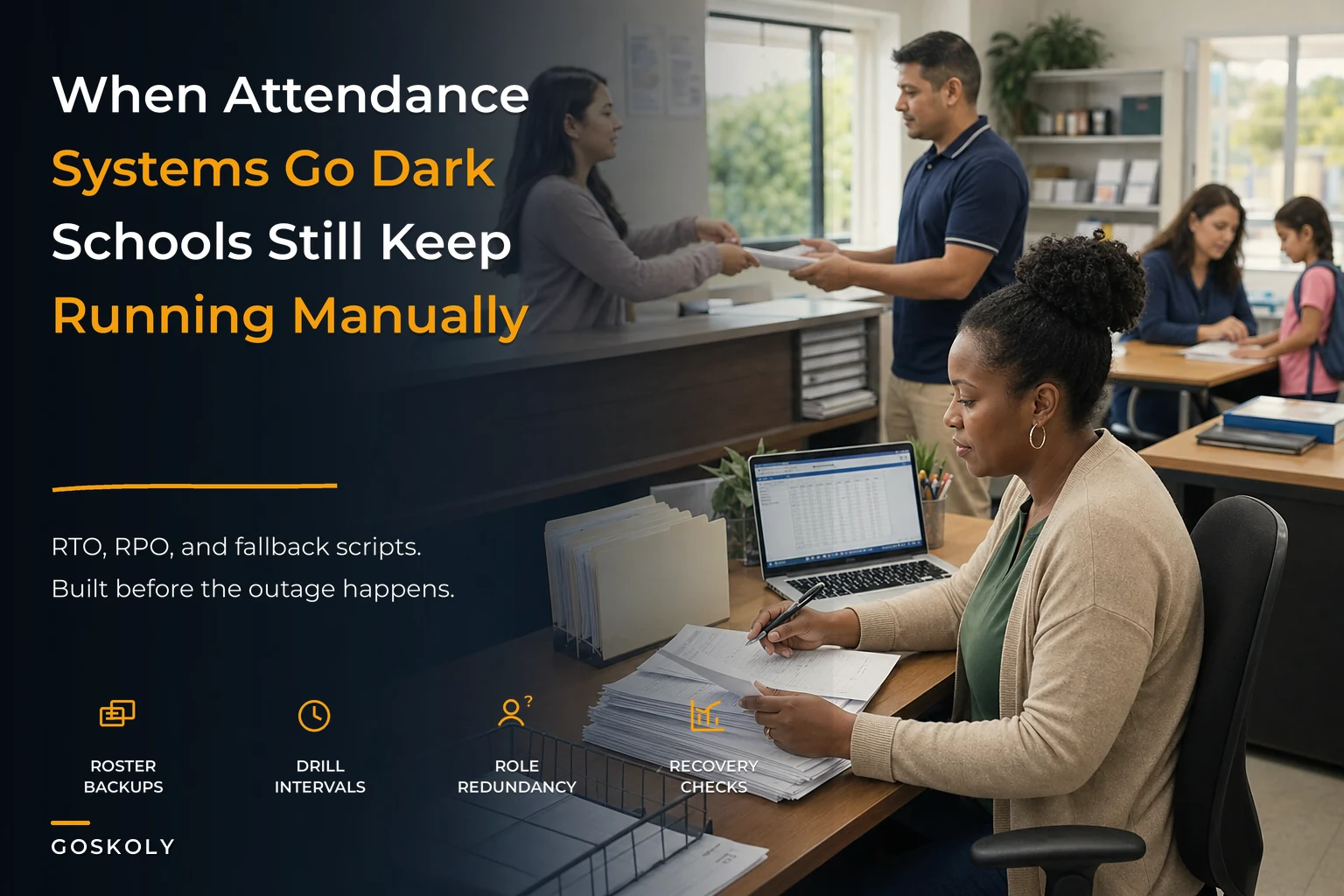

Monday morning, 7:23 AM. Your student information system crashes during peak attendance entry. By 7:45, the registration desk has a line of frustrated parents trying to enroll mid-year transfers. Meanwhile, your emergency notification platform shows "service unavailable" right when you need to send out a weather delay message. Most schools have some kind of backup plan buried in a binder somewhere. But when you look at how schools actually perform during system failures, the gap between having a plan and executing it is massive. It comes down to three things: clear recovery targets, role redundancy that actually works, and fallback procedures people have genuinely practiced.
Recovery Time vs Recovery Point: What Schools Get Wrong
Most school administrators know RTO and RPO exist as concepts. Recovery Time Objective — how fast you get back online. Recovery Point Objective — how much data you can afford to lose. But translating these into actual school operations means understanding which functions genuinely can't wait versus which ones just feel urgent in the moment.
Take attendance tracking. Your RTO might be 4 hours because state reporting requires daily submission by noon. But your RPO? Essentially zero — you can't lose attendance data without compliance issues. Compare that to cafeteria ordering systems where your RTO might be 24 hours (paper forms work temporarily) but your RPO could be a full day's worth of transactions without serious consequences. Things get messier when schools treat every system equally. Districts will spend enormous resources on instant failover for library management systems while their special education documentation tools — which carry federal compliance requirements — run on single points of failure.
| Function | Critical RTO | RPO | Compliance Risk | Parent Impact |
|---|---|---|---|---|
| Attendance Systems | 2–4 hours (school days) | Zero data loss | Daily state reporting | Immediate for early dismissal notifications |
| Registration/Enrollment | 8 hours (peak seasons) | 1 hour maximum | Immunization verification deadlines | High during enrollment windows |
| Parent Communication Platforms | 30 minutes for emergencies | Message logs must be complete | Emergency notification requirements | Extreme during crisis situations |
| Grade Management | 48 hours (except marking period end) | 24 hours typically acceptable | Report card deadlines | Low except during grade posting windows |
The mistake schools make is planning for ideal recovery instead of realistic recovery. Your attendance system might have a 2-hour RTO on paper, but if backup procedures require manually entering 1,200 student records from paper sheets, you're looking at 6–8 hours minimum with available staff.
Role Redundancy That Actually Functions
Traditional disaster recovery assumes your IT coordinator handles technical recovery while department heads manage their areas. Except your IT coordinator might be stuck at home during an ice storm. Your registrar might be out sick. Your principal might be at a district meeting when things break.
Eliminate administrative overload.
GoSkoly helps you manage schedules, attendance, and communications seamlessly.
- Unified student and staff management
- Automated attendance tracking
- Integrated communication tools
No credit card required
Real redundancy means every critical function has three people who can execute recovery procedures — not just "know about them" but actually execute them. This gets complicated in schools where specialized knowledge often lives with one person.
Primary Owner
-
Full system knowledge
-
Makes procedural decisions
-
Leads recovery efforts
-
Maintains documentation
Secondary Operator
-
Can execute all standard procedures
-
Handles 80% of scenarios independently
-
Practices monthly with primary
-
Updates runbooks quarterly
Emergency Backup
-
Knows critical path procedures
-
Can maintain basic operations
-
Focuses on compliance minimums
-
Practices quarterly
The gap between theory and practice shows up fast when you test this. Secondary operators often can't actually access necessary systems, don't know where manual forms are stored, or haven't been updated on procedure changes from six months ago. Building real redundancy requires structured handoffs — not "Sarah knows how to do this" but documented procedures Sarah has actually performed, with specific scenarios she's handled independently.
Manual Fallbacks That People Can Execute
Paper backup forms in a filing cabinet aren't a fallback procedure. A real fallback is something your staff can execute under pressure without constant guidance.
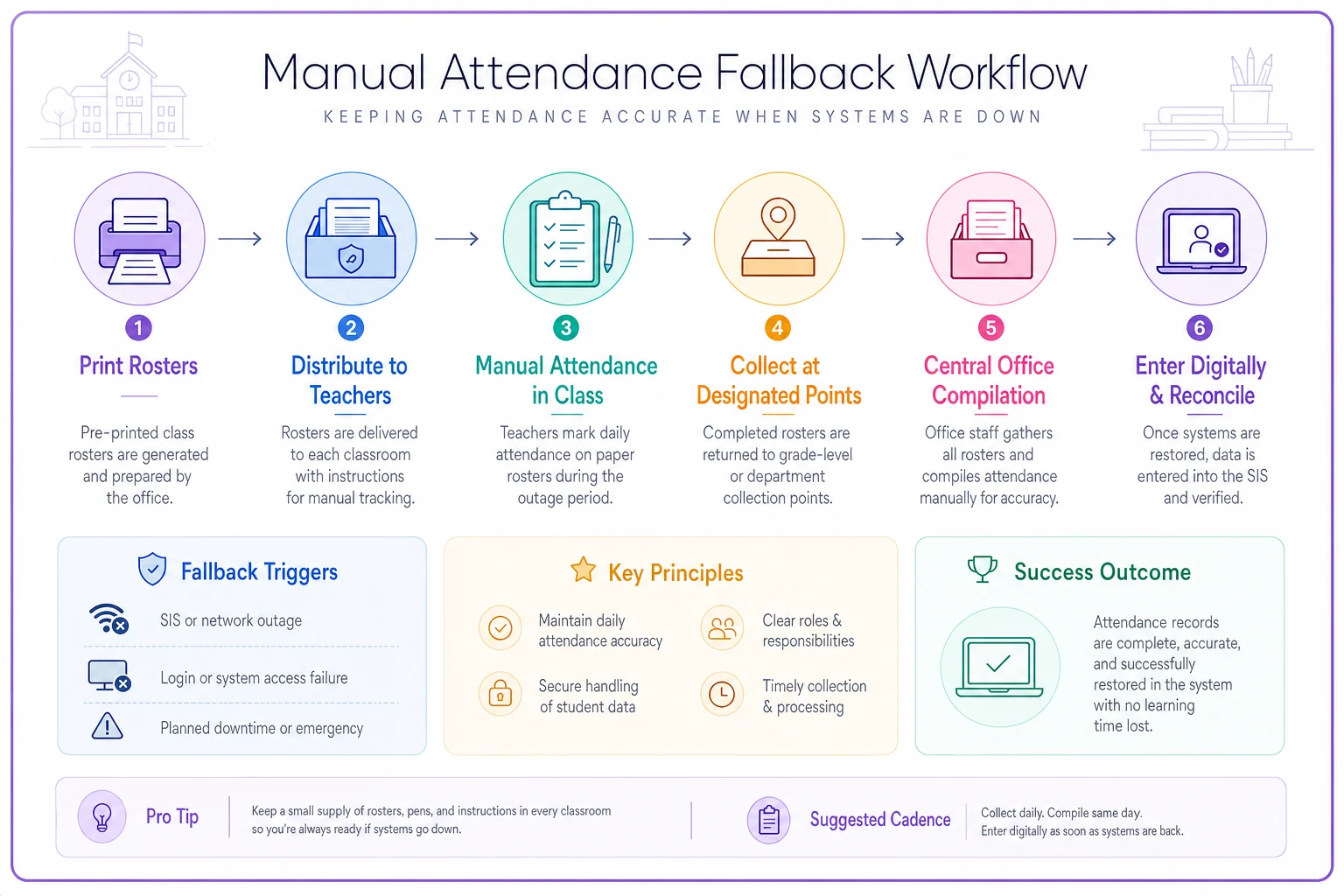
For attendance, a working fallback requires more than just forms — it needs a clear sequence everyone already knows:
-
Pre-printed attendance rosters updated weekly
-
Color-coded forms for different scenarios (late arrival, early dismissal, absence)
-
Designated collection points on each floor
-
Time-stamped collection schedule
-
Central compilation process
-
Digital entry checklist for when systems come back online
But execution breaks down in predictable ways. Teachers don't know where the backup forms are. The office runs out of pre-printed rosters because nobody updated them. The collection process assumes staffing levels that don't exist during emergencies.
Manual processes also need to account for parent communications. When your automated calling system fails, how do you notify 800 families about an early dismissal? Phone trees stopped working when everyone ditched landlines. Email requires the same systems that just went down. Text messaging needs platforms you might not have manual access to.
Illustration of the manual attendance fallback workflow below.
Schools that handle this well maintain printed contact sheets updated monthly, pre-assigned calling groups of around 20–30 families per staff member, physical phone access in multiple locations, pre-written message templates for common scenarios, and backup communication through social media and school websites.
Testing Through Periodic Drills
The difference between schools that handle failures smoothly and those that fall apart comes down to practice. Not annual procedure reviews — actual drills where systems are unavailable and people execute fallback procedures for real.
Effective testing follows a progression:
Announced Tabletop Exercises (Monthly) Walk through scenarios without disrupting operations. "The attendance system just went down at 8 AM — what's your first action?" These sessions surface knowledge gaps without operational impact.
Controlled Partial Drills (Quarterly) Actually execute fallback procedures for single functions. Run morning attendance on paper. Process a handful of real registrations manually. Send a test parent notification through backup channels. These uncover practical problems — forms that don't work, procedures that take too long, coordination gaps between departments.
Surprise Single-System Tests (Semi-annually) Without warning, declare one system unavailable for 2 hours. This reveals whether people actually know the procedures, can find the resources, and can coordinate without preparation.
Full-Scale Simulation (Annually) Multiple system failures during a complex scenario. Tests interaction between different fallback procedures, resource allocation under stress, and decision-making when things get complicated.
Include newer staff in tabletop exercises to surface onboarding gaps early.
Most schools stop at tabletop exercises, maybe running one actual drill per year. That leaves a significant gap between theoretical knowledge and practical capability.
Day-of-Failure Scripts
When systems actually fail, people need specific instructions, not general guidance. That means pre-written scripts for common scenarios that anyone can follow.
``
ATTENDANCE SYSTEM FAILURE — MORNING PROTOCOL

7:00–7:15 AM — Initial Response
Office manager activates manual attendance protocol
Distributes backup rosters to grade-level coordinators
Announces collection times over PA system
IT begins system diagnosis

7:15–7:45 AM — Collection Phase
Teachers complete paper attendance
Mark late arrivals on supplemental forms
Submit forms to floor coordinators by 7:40
Coordinators deliver to main office by 7:45

7:45–8:15 AM — Compilation
Office staff compile attendance by grade
Flag any missing classrooms
Create absence list for nurse/counselors
Prepare state reporting summary

8:15–8:30 AM — Verification
Cross-check late arrival log
Verify special program attendance
Contact missing classroom teachers
Finalize counts for reporting

8:30 AM — Decision Point
If system restored: Begin digital entry
If still down: Submit paper report to district
Communicate status to administrators
Prepare afternoon collection materials
``
Scripts need to be specific enough to follow but flexible enough to handle variations. They should clearly identify who does what, when, and what happens if that person isn't available.
Critical Function Test Templates
Testing templates standardize how you evaluate each critical function's resilience. Without them, testing becomes inconsistent and gaps get missed.
An enrollment system test template covers:
Pre-test Setup
-
Verify all roles have trained backups present
-
Confirm manual forms are current and available
-
Check backup contact information accuracy
-
Review compliance deadlines affected
-
Document current enrollment pipeline
Failure Simulation
-
System unavailable starting
[time]
-
Duration
[2/4/8 hours]
-
Scenario complications
[staff absence/high volume/compliance deadline]
-
External factors
[weather/communication limits/facility issues]
Execution Monitoring
-
Time to activate fallback
___
-
Staff who knew procedures
___/%
-
Forms/resources not found
___
-
Steps skipped/modified
___
-
Parent complaints received
___
-
Processing delays created
___
Recovery Validation
-
Data entered accurately
___/%
-
Compliance requirements met
Y/N
-
Backlog cleared within
___ hours
-
Errors requiring correction
___
-
Documentation complete
Y/N
Improvement Actions
-
Procedure updates needed
-
Training gaps identified
-
Resource additions required
-
Communication improvements
-
Next test scheduled
Without templates, tests become checkbox exercises that don't actually improve resilience. The template forces you to examine what really happened versus what should have happened.
Building Your School Operations Resilience Playbook
Creating an effective playbook starts with an honest assessment of current capabilities. Most schools overestimate their readiness because they confuse having documentation with having executable procedures.
Start with a critical function inventory. Not everything needs elaborate fallback procedures. Focus on functions with compliance requirements, direct parent impact services, safety-related systems, and academic continuity needs.
For each critical function, document the current technology dependencies, actual (not theoretical) recovery capabilities, existing manual procedures, staff who can execute those procedures, and the resource requirements for fallback operations.
Then build incrementally. Don't try to address everything at once. Pick one critical function, develop its fallback procedures, test with real scenarios, refine based on results, then move to the next one.
The playbook itself should be accessible offline with printed copies in multiple locations, updated after every test or actual incident, written for someone unfamiliar with your specific systems, organized by scenario rather than by department, and reviewed by the people who would actually use it in a real situation.
The Reality of School System Failures
Schools face a challenge most businesses don't — they can't just close temporarily. Parents still drop off kids. Buses still run. Meals still get served. Learning still needs to happen.
That creates pressure to "just make it work" through heroic individual efforts. But that approach falls apart when your heroic individuals aren't available, or when multiple systems fail at the same time.
Schools that handled complete network outages during state testing windows, power failures during enrollment peaks, and communication platform crashes during weather emergencies all shared the same characteristics: clear recovery targets everyone understood, redundancy that went beyond IT systems to include operational roles, and manual procedures people had actually practiced.
The investment required isn't primarily financial. It's organizational commitment to treating operational resilience as seriously as academic planning — dedicated time for drills, protected resources for manual backup systems, and willingness to learn from failures without blame.
Connecting Recovery Planning to Daily Operations
The most effective resilience playbooks don't exist in isolation. Your emergency communication workflows need clear fallback procedures. Your staff onboarding protocols should include resilience training. Your modular operations structure has to account for degraded conditions.
This integration means resilience becomes part of normal operations rather than a separate activity. When you update attendance procedures, you update fallback procedures at the same time. When you train new staff, failure scenarios are part of the curriculum. When you test emergency communications, backup channels get tested too.
AI-powered operations platforms help by building resilience into everyday workflows — maintaining parallel manual processes, automatically generating updated paper forms, tracking redundancy coverage, and coordinating fallback procedures when something goes wrong. But the technology only works if the underlying framework is there: clear targets, real redundancy, practiced procedures.
Building operational resilience isn't about preparing for disasters that might never happen. It's about knowing your school can handle whatever operational challenges come up while keeping service running for students and families.
Start small but start now. Pick your most critical function — probably attendance or parent communications. Document current failure points. Create simple fallback procedures. Test them next month. Refine based on what you learn.
Every drill that reveals problems is a successful drill, because it identifies what needs fixing before an actual failure forces the issue.
Your resilience playbook becomes a living document that grows with each test and each incident. Over time, handling system failures shifts from crisis management to executing practiced procedures. Staff know their roles. Parents maintain confidence. Students experience minimal disruption.
That doesn't happen overnight, but it starts with recognizing that resilience requires more than backup systems — it requires an operational framework that assumes failures will occur and prepares your entire organization to handle them without falling apart.
Ready to optimize your school operations?
Join hundreds of schools using GoSkoly to save time, improve collaboration, and enhance student outcomes.