



Walk into any school district office around 3:30pm and you'll see the same scene. Assistant principals hunched over spreadsheets trying to reconcile attendance data. Office managers juggling parent phone calls while searching through three different systems for student records. Department heads sending the same information request for the fourth time this month because nobody can find where decisions get documented.
Why School Operations Break at Scale
Small schools often run surprisingly well on informal systems. When you've got 200 students and everyone fits in the same building, a lot happens through hallway conversations and quick emails. The principal knows every family, teachers handle their own parent communication, and the office manager keeps critical information organized.
But watch what happens when enrollment hits 800 students. That informal communication network collapses. The principal can't personally track every student issue. Teachers start missing important updates because they weren't copied on the right email chain. Parents get conflicting information from different staff members. Administrative tasks that took an hour now consume entire afternoons.
The breaking point usually comes during state reporting season. I watched one district spend three weeks trying to compile attendance data that should have taken three hours. Different staff members had been tracking the same metrics in different formats. Some used Google Sheets, others had personal Excel files, and critical notes lived in email threads nobody could find. They eventually got their report submitted, but not before multiple all-hands meetings and several tense exchanges about whose numbers were "right."
This wasn't incompetence. These were skilled educators working incredibly hard. They just never built the operational foundation to handle complexity beyond a certain scale. Every new initiative, every additional compliance requirement, every enrollment increase added another layer of duct tape to an already fragile system.
The Hidden Cost of Operational Chaos
Poor school operations cost real hours and real money that could go toward education instead of administration.
Eliminate administrative overload.
GoSkoly helps you manage schedules, attendance, and communications seamlessly.
- Unified student and staff management
- Automated attendance tracking
- Integrated communication tools
No credit card required
Take student enrollment and scheduling. In a district with around 1,200 students, I tracked how much time staff spent on scheduling-related tasks during a typical semester. Between initial course assignments, handling change requests, resolving conflicts, and managing waitlists, they burned roughly 470 administrative hours. At an average hourly rate, that's $14,000-$16,000 in staff time for what should be a largely systematic process.
Consider discipline and behavior tracking. One high school with approximately 950 students had three different people maintaining separate behavior logs. The assistant principal used one system, the counseling team had another, and individual teachers kept their own records. When they needed to document interventions for a student's IEP meeting, it took hours to piece together a complete picture. Multiply that across dozens of IEP meetings per year, and you're looking at weeks of duplicated effort.
The real tragedy is opportunity cost. Every hour an assistant principal spends reconciling attendance spreadsheets is an hour not spent on instructional leadership. Every afternoon a counselor wastes searching for student records is time not spent actually counseling students. Schools end up in this vicious cycle where operational inefficiency prevents them from focusing on their core educational mission.
Building Your School Operations Playbook
A functional school operations playbook isn't about creating more bureaucracy. It's about building clear, repeatable processes that reduce friction and free up time for what actually matters - educating students. The key is making it modular, so you can implement pieces without overhauling everything at once.
Start with role clarity. Too many schools operate on "everyone does everything," which really means critical tasks fall through cracks. Your playbook needs to specify exactly who owns each operational domain. Not just "the counseling team handles behavior issues," but which counselor manages the referral intake, who tracks interventions, who communicates with parents, and who reports to administration.
Attendance Clerk (Primary Owner)
-
Daily attendance collection and entry by 9
30am
-
First-line parent communication for absences
-
Weekly chronic absence report generation
-
Maintains excuse documentation
Grade-Level Administrator
-
Reviews chronic absence reports weekly
-
Initiates intervention protocols for at-risk students
-
Coordinates with counseling for support services
-
Escalates legal compliance issues
Data Coordinator
-
Monthly attendance analytics and trend analysis
-
State reporting compilation and submission
-
System accuracy audits
-
Cross-references with enrollment data
Teachers
-
Period-by-period attendance within 10 minutes of class start
-
Flags patterns or concerns to grade-level admin
-
Documents classroom-level interventions
Assign one person to own each module during rollout so accountability is clear and issues get resolved quickly.
Each role has specific deliverables and timelines. This isn't micromanagement - it's clarity that prevents the "I thought someone else was handling that" conversations that plague school operations.
Decision Trees That Actually Work
Every school claims to have protocols, but most are either too vague to be useful or so complex nobody follows them. Effective decision trees need to be simple enough to use in real-time but comprehensive enough to handle edge cases.
Here's a student discipline escalation tree that actually gets used:
Level 1: Classroom-Managed Behaviors Teacher documents in behavior log → Implements classroom intervention → Parents notified via standard form email/call → If behavior continues after 3 documented interventions, escalate to Level 2
Level 2: Administrative Involvement Referral submitted through designated system (not email) → Administrator reviews within 24 hours → Consequence assigned based on behavior matrix → Parent conference scheduled if pattern behavior → Counseling referral if underlying issues suspected → After 2 Level 2 incidents in 30 days, escalate to Level 3
Level 3: Formal Disciplinary Action Behavior team meeting convened → Review all documentation → Develop behavior intervention plan → Consider alternative placement options → Set review date for progress → If safety concern or legal issue, immediately escalate to Level 4
Level 4: District-Level Response District discipline coordinator notified → Legal compliance review → Potential suspension/expulsion proceedings → Due process protections activated → Board notification if required
The magic isn't the specific steps - it's that everyone knows exactly what triggers each level and what should happen next. No more ad-hoc decisions that create inconsistency and parent complaints about unfair treatment.
KPIs That Drive Action, Not Just Reports
School KPIs often become exercises in data collection for data's sake. The state wants these numbers, the board wants those metrics, and meanwhile, nobody's using any of it to actually improve operations. Your playbook needs KPIs that trigger specific actions, not just generate reports.
Structure your KPIs around intervention triggers:
| Metric | Measurement Frequency | Warning Threshold | Critical Threshold | Triggered Action |
|---|---|---|---|---|
| Chronic Absence Rate | Weekly | 12% of students | 15% of students | Warning: Team meeting to review interventions. Critical: Individual student action plans |
| Office Referrals | Daily tracking, weekly review | 20% increase over baseline | 30% increase over baseline | Warning: Review behavior support systems. Critical: All-hands training on de-escalation |
| Parent Response Rate | Per communication | Below 70% acknowledgment | Below 50% acknowledgment | Warning: Review communication channels. Critical: Direct phone outreach campaign |
| IEP Meeting Compliance | Weekly | Any meeting outside window | Multiple violations | Warning: Process audit. Critical: Compliance team intervention |
| Course Request Fulfillment | Per scheduling cycle | Below 85% first choice | Below 75% first choice | Warning: Schedule review. Critical: Additional sections or staffing review |
Each KPI has a clear owner, a specific measurement cadence, and most importantly, predetermined responses when thresholds are crossed. You're not waiting for end-of-year reports to realize something's broken.
Governance Checkpoints Without the Bureaucracy
Governance in schools often swings between two extremes: either everything requires committee approval (paralysis by democracy) or individual administrators make decisions in isolation (inconsistent chaos). Your playbook needs governance checkpoints that ensure oversight without grinding operations to a halt.
Structure governance around natural operational rhythms. Weekly operations meetings shouldn't rehash individual student issues - save those for separate case conferences. Instead, focus on system-level patterns and process breakdowns.
First 15 minutes: KPI Review
-
Which metrics are outside normal ranges?
-
What triggered responses are underway?
-
Any early warning signs to monitor?
Next 20 minutes: Process Breakdowns
-
Where did our systems fail this week?
-
What workarounds are people creating?
-
Which decisions got stuck or delayed?
Final 10 minutes: Resource Allocation
-
What support do process owners need?
-
Any emergency coverage required?
-
Upcoming constraints to plan around?
Monthly governance should zoom out further, looking at trend lines rather than individual weeks, and quarterly reviews should examine whether the playbook itself needs updating based on what you've learned.
Copy-Paste Templates That Actually Get Used
Templates only work if people actually use them. Schools create elaborate form libraries that sit untouched while staff keep sending unstructured emails. The key is making templates so obviously useful that NOT using them creates more work.
A parent communication template for attendance issues that schools actually adopt:
Subject: [STUDENT NAME] Attendance Update - Action Needed
Dear [PARENT/GUARDIAN],
This automated notice is to inform you that [STUDENT NAME] has been marked absent for [NUMBER] periods/days as of [DATE].
Current Status:
-
Total absences this term
[NUMBER]
-
Excused
[NUMBER]
-
Unexcused
[NUMBER]
-
Tardies
[NUMBER]
Required Action:
-
[IF UNEXCUSED] Please provide documentation for recent absences by [DATE]
-
[IF PATTERN] A conference has been scheduled for [DATE/TIME]
-
[IF CHRONIC] Your student is at risk of attendance-related academic impact
Resources Available:
-
Transportation assistance
Contact [NAME] at [PHONE]
-
Health services
Available through [RESOURCE]
-
Counseling support
Schedule through [SYSTEM]
Please acknowledge receipt of this notice by replying to this email or calling [PHONE].
[SIGNATURE] [AUTOMATED FOOTER WITH ATTENDANCE POLICY LINK]
This works because it includes clear data points, specific required actions, and available support resources. It's not just notification - it's a complete communication that reduces back-and-forth while documenting everything needed for compliance.
The AI Operations Advantage
Modern school operations playbooks can benefit significantly from AI automation for practical administrative tasks. Not robots replacing teachers, but automation that handles repetitive work so humans can focus on human interactions.
Take the attendance workflow described earlier. AI-powered operational software can automatically flag absence patterns, generate parent notifications in multiple languages, and compile intervention recommendations based on what's worked for similar students. The attendance clerk still owns the process, but instead of spending hours on data entry and mail merge, they're reviewing AI-generated insights and making decisions about which students need additional support.
Consider the discipline escalation tree. AI agents can track behavior patterns across classrooms, automatically compile documentation for meetings, and even predict which students might need preventive intervention based on early warning signs. The assistant principal still makes disciplinary decisions, but they're working with complete, organized information instead of piecing together scattered reports.
Schools seeing the biggest operational improvements aren't trying to automate everything. They're using AI to handle information gathering, pattern recognition, and routine communications, while keeping humans in charge of relationships, judgment calls, and complex problem-solving. Your playbook should identify which tasks benefit from AI automation and which require human expertise.
A simple workflow visualization can make clear where automation helps and where humans must remain in control.
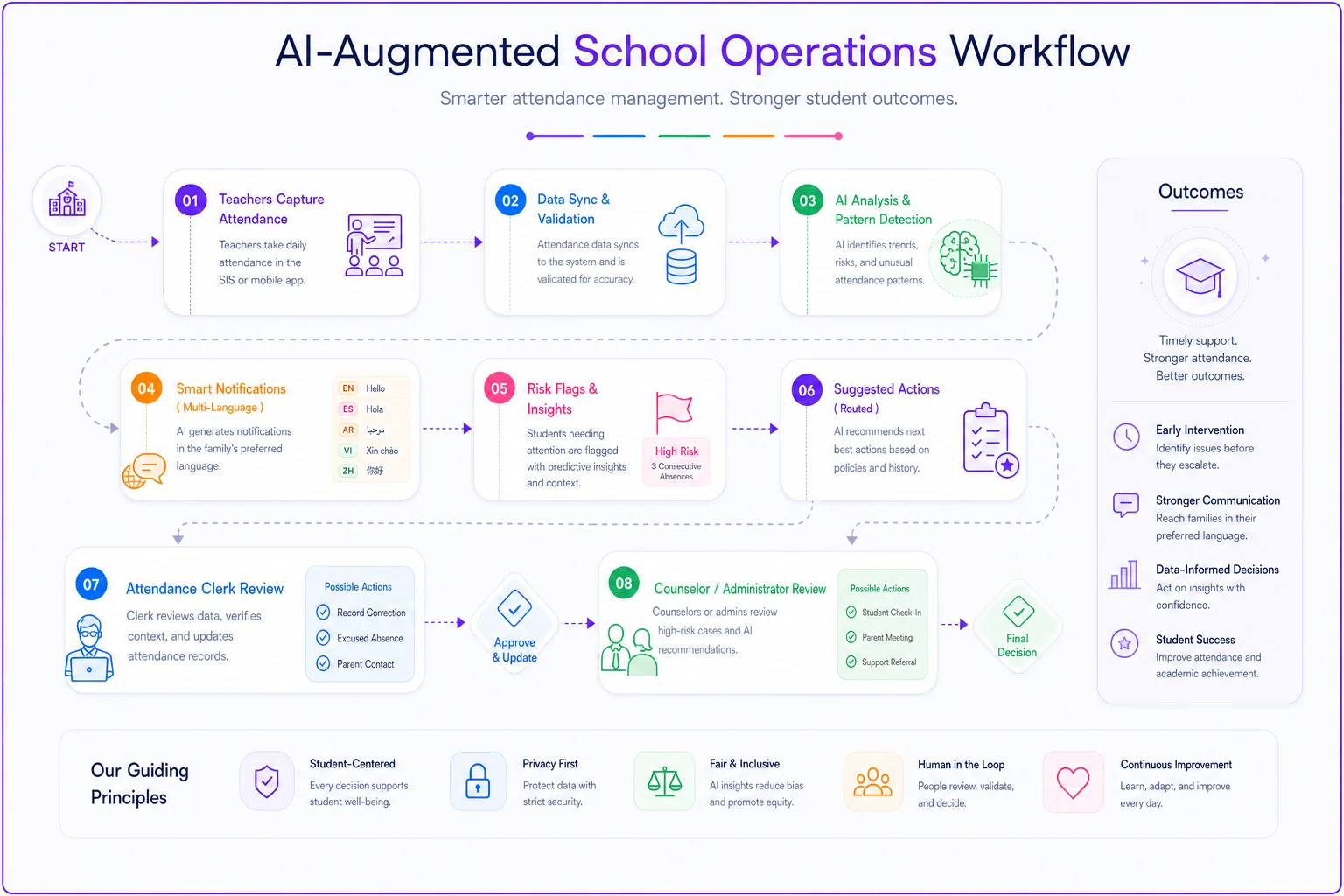
Your playbook should map which steps are automated, which are human-reviewed, and who signs off at each transition.
Scaling Your Playbook as You Grow
The ultimate test of any school operations playbook is whether it scales. The system that works for 500 students should expand smoothly to handle 1,500 without a complete rebuild.
Build your playbook in layers. The foundation layer includes core processes that every school needs: enrollment, attendance, grading, discipline, and communication. These should be solid before adding complexity. The second layer adds specialized workflows for your specific context: special education processes, extracurricular management, or advanced academic programs. The third layer includes optimizations and automations that make sense only at larger scale.
As enrollment grows, you add modules rather than restructuring everything. When you hit 750 students, maybe you add a dedicated data coordinator role and expand your KPI dashboard. At 1,000 students, you might implement automated communication workflows and add governance checkpoints for resource allocation. At 1,500 students, perhaps you create specialized teams for different operational domains rather than having generalists handle everything.
Schools that struggle with growth try to stretch their small-school processes instead of evolving them. They keep adding band-aids instead of implementing scalable systems. Your playbook should explicitly identify trigger points where processes need to level up, not just handle more volume.
Making It Stick
Creating a playbook is the easy part. Getting people to actually follow it when they're drowning in daily crises - that's where most schools fail. Implementation needs to be gradual, visible, and immediately beneficial to the people doing the work.
Start with your biggest pain point. If attendance tracking is consuming entire afternoons, implement that module first. Get it working smoothly before moving to the next area. People need to see immediate benefit or they'll revert to old habits the moment things get hectic.
Make the playbook visible. Not buried in a shared drive, but actively referenced in meetings, printed and posted where relevant work happens, and integrated into daily tools. When someone asks "how do we handle this situation?" the answer should reference the playbook, not create new ad-hoc processes.
Most importantly, treat your playbook as a living document. Every term, review what's working and what's not. Which processes are people actually following? Where are they creating workarounds? What new situations arose that the playbook didn't cover? Regular updates based on real usage keep the playbook relevant instead of becoming another dusty binder on a shelf.
The Path Forward
A functioning school operations playbook isn't about perfection. It's about creating enough structure that routine tasks happen smoothly while maintaining flexibility for the unexpected situations that define school life. It's about freeing administrators from spreadsheet reconciliation so they can focus on instructional leadership. It's about giving teachers clear processes so they can concentrate on teaching instead of administrative confusion.
The schools thriving despite increasing complexity aren't the ones with the most resources or the newest technology. They're the ones that built clear, scalable operational systems before they desperately needed them. They invested in process clarity when things were manageable, so they could handle growth without proportional increases in administrative burden.
Your school operations playbook should be uniquely yours, reflecting your specific context, challenges, and resources. But it should also be systematic enough that new staff can quickly understand their role, experienced staff can work efficiently, and the whole system can evolve as you learn what works. Start with role clarity, add decision trees for common scenarios, implement KPIs that drive action, and build in governance checkpoints that maintain quality without creating bottlenecks.
The difference between schools that scale successfully and those that collapse under complexity isn't talent or dedication. It's systematic operations that turn chaos into manageable workflows. Build your playbook before you desperately need it, and you'll find that growth becomes an opportunity rather than a crisis.
The difference between schools that scale successfully and those that collapse under complexity isn't talent or dedication. It's systematic operations that turn chaos into manageable workflows. Build your playbook before you desperately need it, and you'll find that growth becomes an opportunity rather than a crisis.
Ready to optimize your school operations?
Join hundreds of schools using GoSkoly to save time, improve collaboration, and enhance student outcomes.