


Most schools dump new administrators into chaos. Here's your login, there's your desk, meet Sarah who might help you figure things out when she's not swamped with her own work. Fast forward three months and everyone's wondering why the new assistant principal is still asking basic questions about the attendance system.
It's not the people—it's the complete absence of real onboarding that builds actual competence.
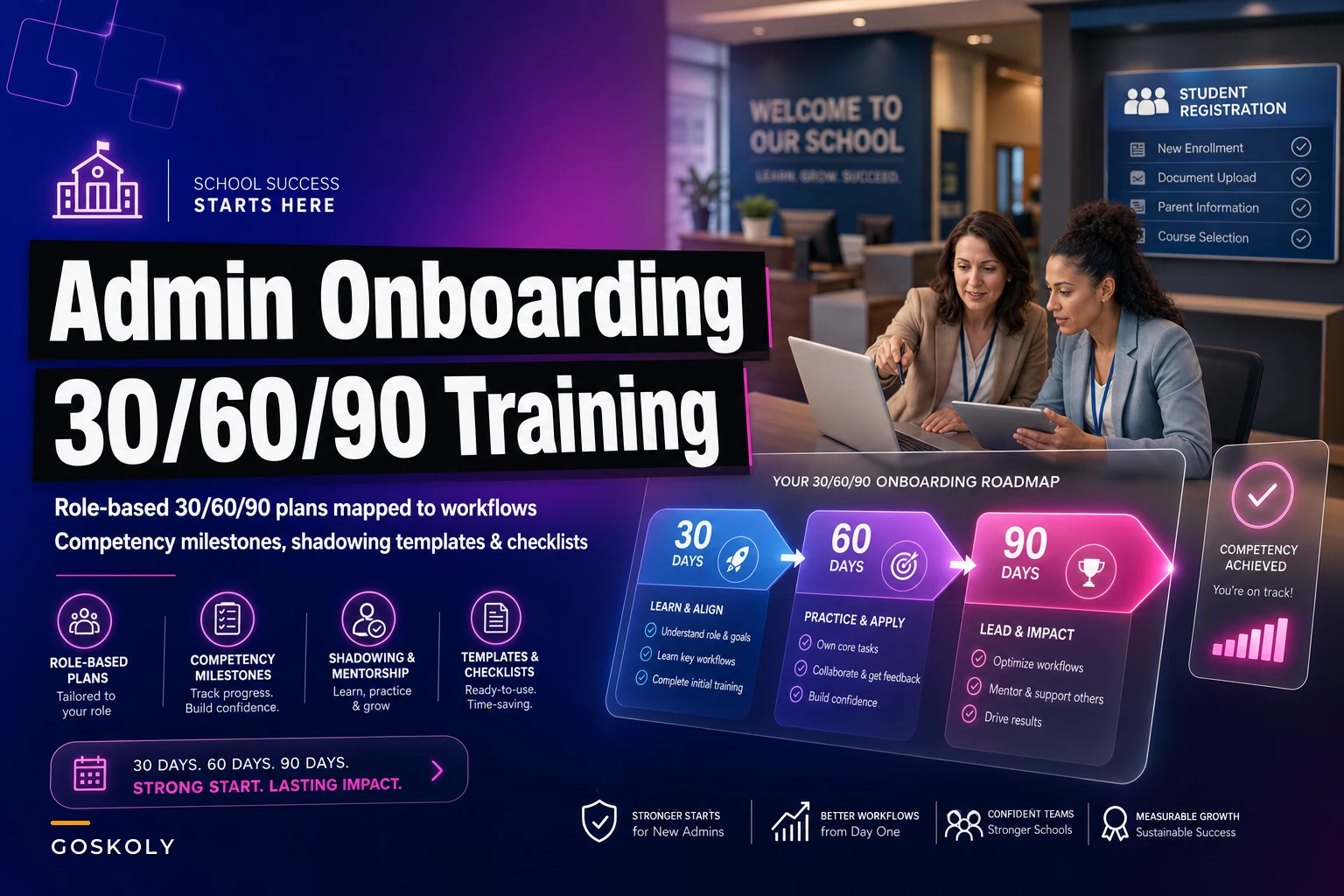
Schools using structured 30/60/90 day plans with measurable milestones get their new administrators fully productive in half the time. Everyone else? Still cleaning up preventable mistakes months later.
Why school admin onboarding typically fails
School administrators manage between 15 to 40 different systems and processes. Student information systems, attendance tracking, discipline protocols, parent communication platforms, state reporting requirements, budget codes, emergency procedures, special education compliance. The list never stops growing.
Traditional onboarding treats this as one massive information dump. Day one: here's everything. Figure it out.
New admins learn through crisis management. They discover the attendance system when furious parents call about marking errors. Budget codes make sense after accidentally charging supplies to the wrong account. IEP procedures click after missing a crucial deadline.
This reactive learning creates two operational problems. First, preventable mistakes that consume hours fixing. Second, incomplete knowledge where admins only understand the systems they've personally broken.
Your veteran office manager becomes a walking help desk instead of focusing on actual work because there's no systematic knowledge transfer.
Building milestones that measure actual readiness
Generic onboarding checklists treat all tasks equally. "Learn attendance system" sits next to "review fire drill procedures" like they need the same understanding depth.
Eliminate administrative overload.
GoSkoly helps you manage schedules, attendance, and communications seamlessly.
- Unified student and staff management
- Automated attendance tracking
- Integrated communication tools
No credit card required
Real competency milestones focus on operational readiness, not task completion. Instead of checking off "attended budget training," you measure whether someone can independently process a purchase order, spot incorrect coding, and explain the approval workflow to others.
Functional milestones for different admin roles:
Attendance Secretary - 30 Day Milestones:
-
Process daily attendance for 200+ students in under 45 minutes
-
Identify and resolve three types of attendance discrepancies
-
Generate state-compliant attendance reports without assistance
-
Handle parent attendance calls using proper documentation procedures
Assistant Principal - 30 Day Milestones:
-
Complete full discipline incident documentation meeting legal requirements
-
Navigate student information system to pull behavioral history
-
Lead one parent conference following district protocols
-
Access and interpret standardized test data for grade-level meetings
Registrar - 30 Day Milestones:
-
Process new student enrollment including all required documentation
-
Execute proper withdrawal procedures maintaining audit trail
-
Verify residency documents according to district policy
-
Generate enrollment reports for state compliance
These aren't vague skills. They're specific, observable actions tied directly to job functions. You can watch someone do them and definitively say whether they're ready for independent work.
Structured shadowing that prevents knowledge gaps
Most shadowing involves following someone around hoping to absorb information through proximity. That's not training—that's tourism.
Effective shadowing for school admin onboarding requires structured observation with progressive responsibility transfer. Take enrollment processing:
Day 1-3: Observation Phase
-
New registrar watches experienced staff process three enrollment scenarios
-
- Standard in-district enrollment
-
- Transfer from another state with missing records
-
- Special education student requiring immediate services
During observation, the new admin documents each step, noting system navigation, required forms, and common issues. They build their own reference guide.
Day 4-7: Assisted Performance
-
New registrar handles enrollment with experienced staff coaching
-
- They drive the computer while veteran guides them through
-
- Veteran identifies potential issues before they become problems
-
- New admin practices explaining requirements to parents
Day 8-10: Supervised Independence
-
New registrar processes enrollment independently while veteran observes
-
- Veteran only intervenes for compliance issues
-
- New admin troubleshoots minor problems themselves
-
- Post-enrollment review identifies any missed steps
The workflow below shows the steps from observation to supervised independence.
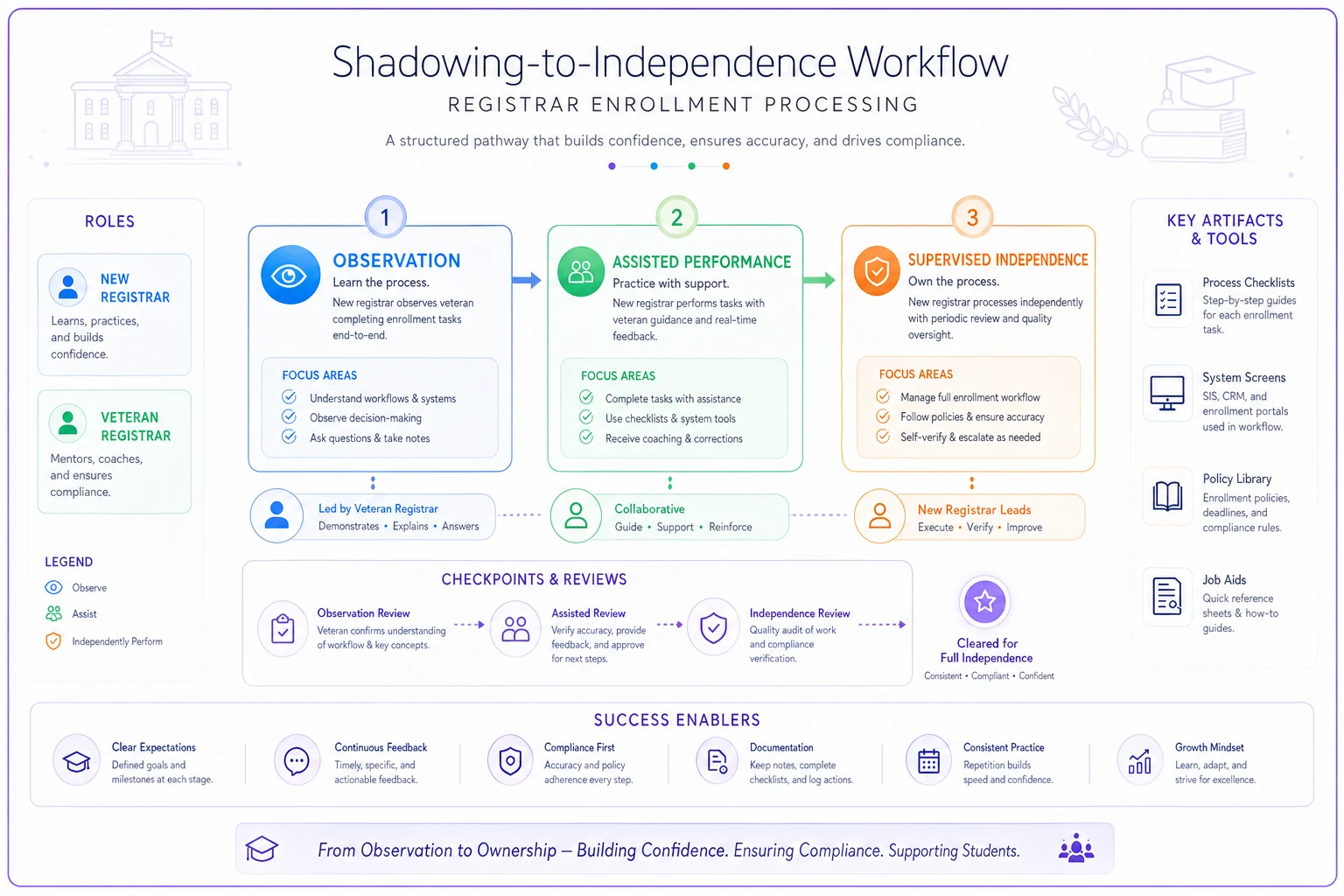
Have mentors note frequent missteps during assisted performance so follow-up training can target the actual gaps.
By day ten, you have someone who's actually processed multiple enrollments, not just watched them happen.
Capturing institutional memory through knowledge transfer
Schools lose decades of operational knowledge every time an experienced admin retires. The attendance secretary who's been there 20 years knows sophomore parents always panic about credits in October. The veteran assistant principal remembers which teacher conflicts need careful scheduling separation. The longtime registrar knows exactly which apartment complexes require extra residency verification.
None of this appears in procedure manuals.
Process Documentation:
-
Step-by-step workflows for routine tasks
-
Screenshots of system navigation
-
Common error messages and fixes
-
Approval chains and backup contacts
Situational Patterns:
-
Seasonal workload variations
-
Recurring parent concerns by time of year
-
Historical problems with specific procedures
-
Unofficial workarounds that keep things moving
Relationship Mapping:
-
Which district office contacts actually respond
-
Parent community dynamics and communication preferences
-
Teacher personalities and collaboration styles
-
External agency contacts and their response patterns
The registrar example: Beyond knowing how to process enrollment, they need to understand that military families often arrive with incomplete records but have federal protections, certain zip codes trigger automatic free lunch eligibility, and the district enrollment specialist prefers text messages for quick questions but requires email for official requests.
This matters more than any procedure manual.
Role-specific 30/60/90 progression paths
Generic timelines assume all admin roles develop at the same pace. They don't.
An attendance secretary needs basic competence immediately—they're processing daily attendance within their first week. A curriculum coordinator might not face their first real test until textbook adoption season. Building realistic progressions means understanding each role's operational rhythm.
Attendance Secretary Timeline:
First 30 Days - System Proficiency
-
Master daily attendance processing
-
Learn excuse note verification procedures
-
Understand state attendance codes
-
Navigate chronic absence thresholds
-
Build relationships with frequent parent callers
Days 31-60 - Complex Scenarios
-
Handle attendance appeals process
-
Coordinate with truancy officer
-
Process homebound student attendance
-
Manage attendance for field trips and activities
-
Generate monthly attendance reports
Days 61-90 - Full Autonomy
-
Train substitute coverage for absences
-
Identify attendance pattern concerns proactively
-
Coordinate with counselors on at-risk students
-
Prepare attendance data for state audit
-
Suggest process improvements
Assistant Principal Timeline:
First 30 Days - Foundation Building
-
Complete all required compliance training
-
Shadow five discipline conferences
-
Review previous year's discipline data
-
Learn emergency response protocols
-
Establish relationships with key teachers
Days 31-60 - Guided Practice
-
Lead discipline conferences with supervision
-
Conduct formal classroom observations
-
Participate in IEP meetings
-
Coordinate one school event
-
Handle parent concerns with backup available
Days 61-90 - Independent Operation
-
Manage assigned grade level or department independently
-
Lead professional development session
-
Complete teacher evaluations
-
Handle complex discipline cases
-
Contribute to administrative team decisions
The progression matches operational reality. Attendance work starts immediately. Administrative leadership builds gradually.
Measuring performance vs checkbox completion
Traditional onboarding measures completion: Did they attend the training? Did they read the manual? Did they shadow for three days?
These metrics tell you nothing about capability.
Performance measurement for school admin onboarding should focus on operational outcomes. Can they do the job without constant support? Are they making fewer errors than baseline? Do other staff trust them with critical tasks?
A measurement framework that tracks real competency:
| Milestone Type | Traditional Metric | Performance Metric |
|---|---|---|
| System Knowledge | Completed SIS training | Processes 50 student records without errors |
| Compliance Understanding | Read policy manual | Correctly identifies 3 compliance issues in scenario review |
| Communication Skills | Attended customer service workshop | Handles 10 difficult parent calls with positive resolution |
| Emergency Preparedness | Reviewed evacuation procedures | Executes drill responsibilities without prompting |
| Collaboration Ability | Met with department heads | Successfully coordinates cross-department project |
Track error rates, support requests, and time-to-completion for standard tasks. A new registrar who needs help with every enrollment after 60 days hasn't actually learned the job, regardless of how many trainings they've attended.
Scaling training consistency with technology
School districts with multiple buildings face an additional challenge: ensuring consistent admin training across locations. What the high school registrar learns should match what elementary offices practice.
Manual training coordination falls apart quickly. HR creates beautiful onboarding packets that sit in drawers. Mentors share different versions of processes. New admins at different schools receive completely different training experiences.
AI-powered operational software designed for school administration can transform onboarding from hoping people figure it out to knowing they're prepared. Instead of static checklists, you build dynamic training workflows that adjust based on role, track actual competency demonstrations, and ensure nothing falls through cracks.
The right platform lets you create role-specific onboarding paths where:
-
Training materials link directly to the systems being learned
-
Competency validations require actual task completion, not just attestation
-
Shadowing schedules automatically coordinate between participants
-
Knowledge transfer captures both procedures and contextual insights
-
Progress tracking shows exactly where each new admin stands
When a new attendance secretary starts, they receive day-by-day guidance through their specific progression. Their mentor gets automated reminders about what to cover. The principal sees real-time progress toward operational readiness. HR maintains oversight across all buildings.
The system captures what actually works. If new admins consistently struggle with a specific budget code process, that signals a training gap. If everyone masters attendance quickly but stumbles on discipline documentation, you know where to strengthen support.
Setting clear endpoints to avoid permanent training
Some schools never stop training their administrators. Six months in, senior staff still answer basic questions. A year later, "new" admins still need hand-holding through routine tasks.
This happens when onboarding lacks clear endpoints and accountability. Without defined competency milestones, there's no transition from trainee to fully functional team member. People stay in perpetual learning mode because no one ever declares them ready.
Setting firm timeline expectations changes the dynamic:
-
30 days
Core functions performed with minimal assistance
-
60 days
Complex scenarios handled independently
-
90 days
Training others and improving processes
These aren't arbitrary deadlines. They're operational necessities. Schools can't afford administrators who need constant support indefinitely. The academic year doesn't pause for extended learning curves.
Build in checkpoint conversations at each milestone:
-
What's working well?
-
Where do you still need support?
-
What additional training would help?
-
Are we on track for full independence?
If someone isn't meeting milestones, address it immediately. Maybe they need different training methods. Maybe the role isn't the right fit. Either way, you discover this at 30 days, not 180.
The compound effect of systematic onboarding
Properly structured school admin onboarding pays dividends far beyond the individual. When administrators become fully functional faster, experienced staff reclaim hours each week. When knowledge transfer becomes systematic, institutional memory survives retirements. When training follows consistent patterns, quality becomes predictable across buildings.
One middle school in Colorado tracked the impact of implementing role-based 30/60/90 plans with competency milestones. Their new attendance secretary reached full productivity in 5 weeks instead of the typical 12. The experienced secretary who previously answered questions all day gained back roughly 8 hours per week. Parent complaints about attendance errors dropped by around 60%.
The bigger win came during their next hiring cycle. Because they'd captured the knowledge transfer process, training the replacement when their veteran retired took half the usual time. The institutional knowledge that typically walks out the door stayed in their operational workflows.
This compounds over time. Each successful onboarding strengthens the process. Each role documented improves the template. Each competency milestone validated becomes more precise. Instead of starting from scratch with every new hire, schools build an increasingly robust training infrastructure.
Districts seeing the best results treat admin onboarding as operational infrastructure, not an HR checkbox. They invest in building proper role-based progressions. They measure real performance. They capture institutional knowledge systematically. They use technology to ensure consistency at scale.
A school admin onboarding plan isn't about getting someone through their first week. It's about building the operational competence that keeps schools running smoothly despite constant staff transitions. When you get this right, new administrators don't just survive their first 90 days—they thrive from day one.
A school admin onboarding plan isn't about getting someone through their first week. It's about building the operational competence that keeps schools running smoothly despite constant staff transitions. When you get this right, new administrators don't just survive their first 90 days—they thrive from day one.
Ready to optimize your school operations?
Join hundreds of schools using GoSkoly to save time, improve collaboration, and enhance student outcomes.