

Most districts don't have an engagement problem. They have a measurement and coordination problem that looks like an engagement problem.
Walk into almost any district office and you'll find the same thing: a communications coordinator sending robocalls, a family liaison texting parents from a personal phone, three schools running their own Facebook pages, a translation vendor invoice nobody fully understands, and a superintendent who genuinely believes engagement is "strong" because the last board meeting had decent attendance. Nobody is lying. They just have no shared picture of who is actually being reached, in what language, through which channel, and whether it landed.
That's the real gap. A parent engagement strategy for K-12 that works isn't a list of nice outreach ideas. It's a system that maps use-cases to channels, sets reach targets by cohort, holds response SLAs for families who need language and accessibility support, and reviews all of it on a cadence so the district can course-correct before spring, not after.
This article walks through how that system fits together — and where it breaks as a district grows past a few schools.
Why engagement quietly falls apart at scale
At one or two schools, engagement runs on relationships. The office manager knows which families need a phone call instead of an email. The principal knows the three parents who translate for their neighbors. It works because it's small enough to hold in someone's head.
Then the district grows to eight, fifteen, thirty schools — and that informal knowledge doesn't transfer. The pattern tends to look like this:
-
Channels multiply faster than governance. Every new principal adds a tool. Now you've got email, SMS, an app, three social platforms, paper flyers, and a phone tree — and no one owns the map of which channel is for what.
-
Language support becomes a lottery. School A has a Spanish-speaking front office. School B routes everything through Google Translate. School C forgets entirely. A family's experience depends almost entirely on which building their kid attends.
-
"Reach" gets reported as sends, not receipts. Leadership sees "12,000 messages sent" and assumes 12,000 families heard something. The bounce rate, the wrong-number rate, and the "read in a language I don't speak" rate are all invisible.
-
Accessibility is an afterthought. Nobody has an SLA for how fast a request for large-print, ASL interpretation, or a screen-reader-friendly format gets fulfilled — so it gets fulfilled whenever someone happens to have time.
The core issue: engagement work is distributed across dozens of people, but accountability for equitable reach lives nowhere in particular. Everyone is doing their piece. No one owns the whole.
Start with a channel-matrix, not a channel list
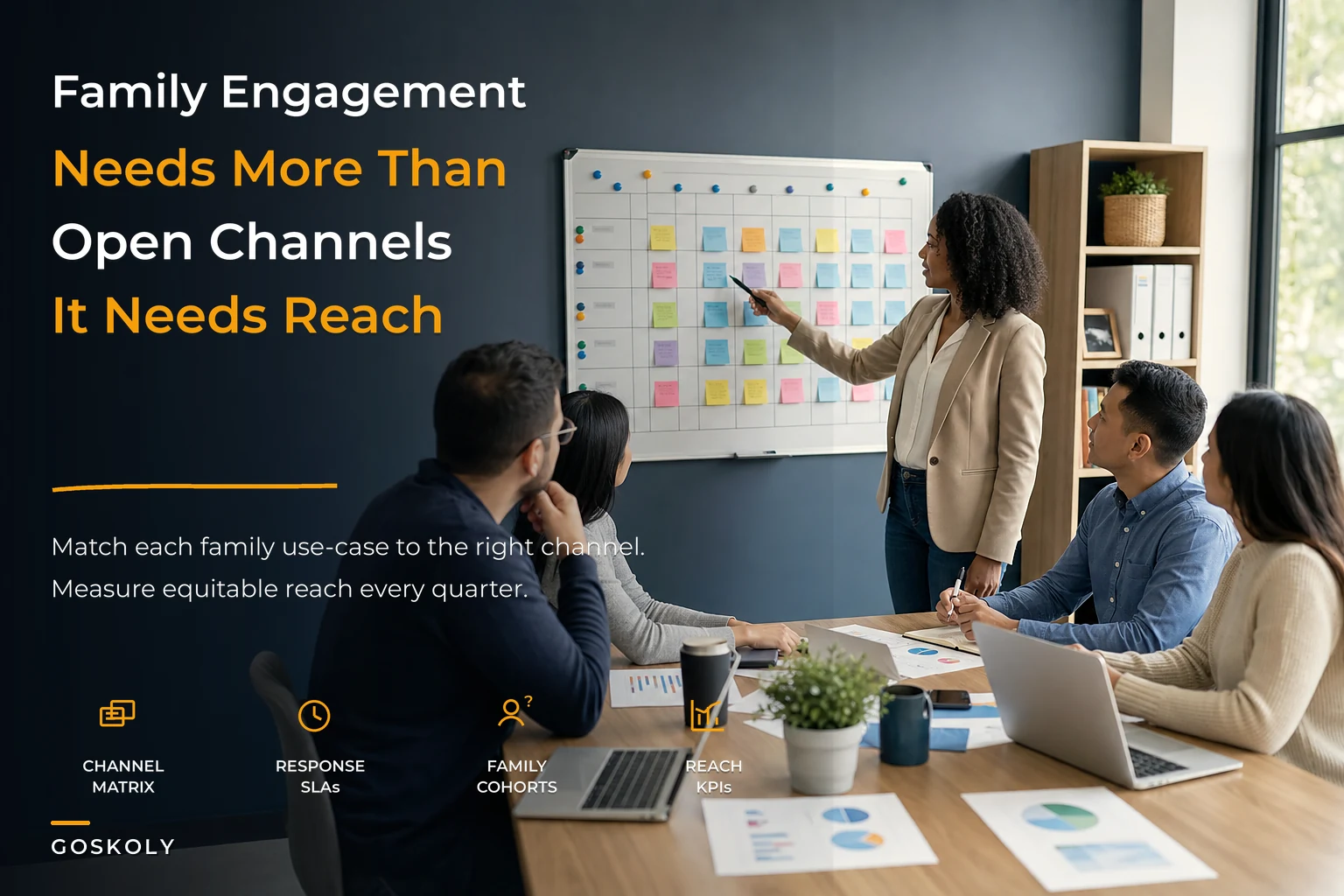
The first fix is deceptively simple: stop treating channels as a menu and start treating them as a matrix. On one axis, your engagement use-cases. On the other, your channels. In each cell, a decision — primary, backup, or not used — plus who owns it.
Eliminate administrative overload.
GoSkoly helps you manage schedules, attendance, and communications seamlessly.
- Unified student and staff management
- Automated attendance tracking
- Integrated communication tools
No credit card required
This matters because not every message belongs on every channel. Treating them interchangeably is how families get seven notifications about a bake sale and zero about an IEP meeting reschedule.
Here's a simplified version of what that matrix looks like in practice:
| Use-case | SMS | Voice call | App/portal | Print/backpack | Social | |
|---|---|---|---|---|---|---|
| Emergency / safety | Primary | Backup | Primary | Backup | — | Backup |
| Attendance follow-up | Primary | Backup | Backup | — | — | — |
| Academic / IEP / conferences | Backup | Primary | Backup | Primary | Backup | — |
| Enrollment & deadlines | Primary | Primary | — | Backup | Backup | Backup |
| Community events | — | Backup | — | Backup | Primary | Primary |
| Volunteer / involvement | Backup | Primary | — | Backup | Backup | Backup |
A couple things worth noticing. High-stakes, time-sensitive messages — safety, attendance — lean on SMS and voice because those get read fastest. That overlaps heavily with the design principles behind an auditable parent emergency communication workflow. Lower-urgency, relationship-building communication leans on email, print, and social. And critically, the matrix names an owner for each row, so when a channel underperforms, there's a person, not a committee, responsible for fixing it.
Name a single owner for each row in the matrix so accountability is clear.
The mistake most districts make is trying to be "everywhere" for every message. Being everywhere means being consistent nowhere. The matrix forces a choice.
Below is a visual workflow of how use-cases map to channels and owners.
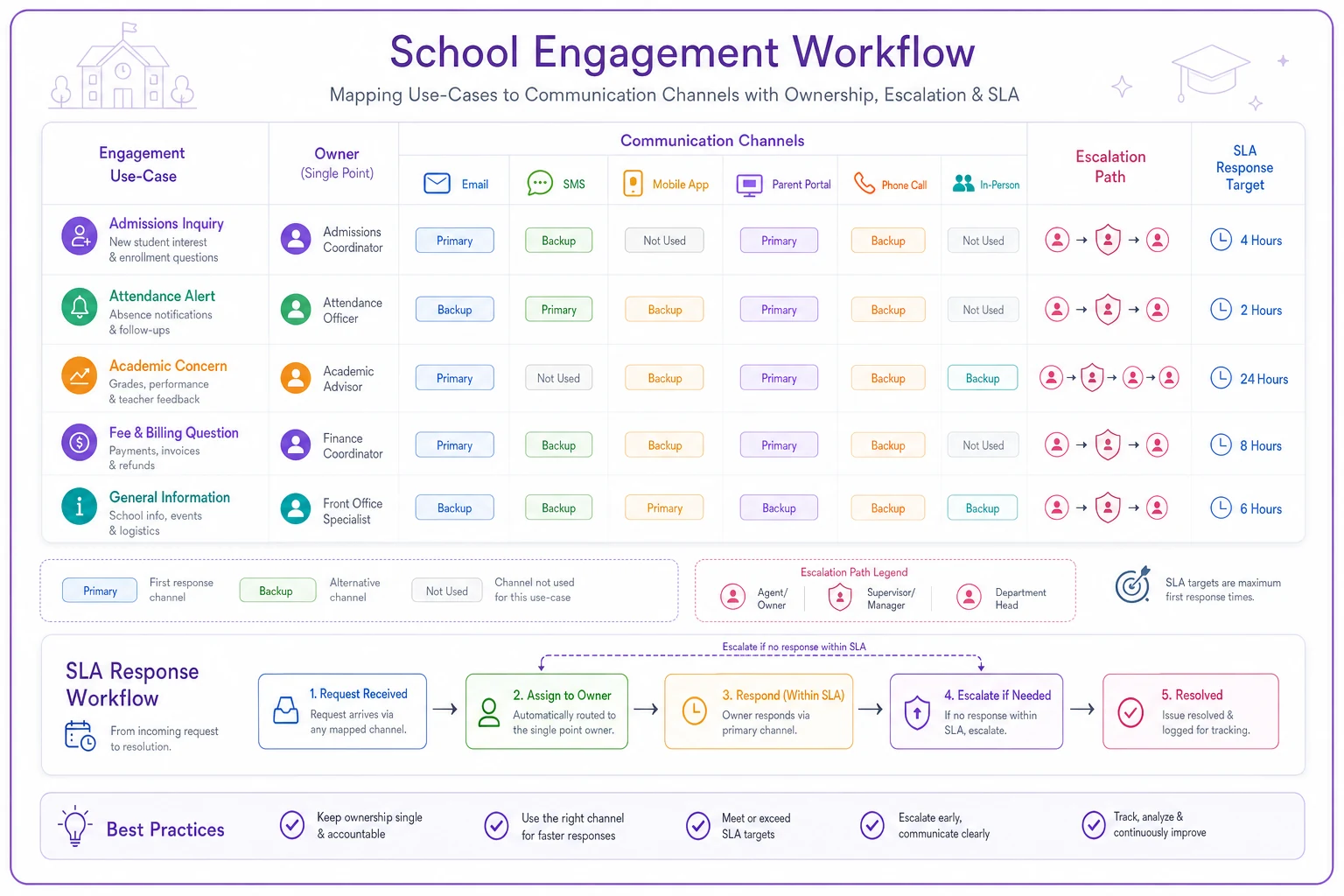
High-stakes, time-sensitive messages — safety, attendance — lean on SMS and voice because those get read fastest. That overlaps heavily with the design principles behind an auditable parent emergency communication workflow.
Define reach as cohort KPIs, not district averages
District-wide engagement averages are probably the most misleading number in this whole domain. A district can report "78% of families reached" while completely missing that reach among newcomer families, families experiencing homelessness, or families of students with disabilities sits closer to 40%.
Averages hide gaps. Cohorts expose them.
So the second piece of the system is defining reach KPIs by cohort — the groups where equity actually gets won or lost. In practice, useful cohorts usually include:
-
Families whose home language isn't English (broken out by the top languages in the district)
-
Families of students on IEPs or 504 plans
-
Families of chronically absent students
-
Families flagged as needing accessibility accommodations
-
Newly enrolled families (first year in district)
-
Families with no confirmed digital contact on file
For each cohort, you track a few things. Not fifty metrics — just the ones that reveal whether reach is real:
-
Deliverability rate — did the message technically arrive (not bounce, not a dead number)?
-
Confirmed-receipt rate — did they open, click, listen, or acknowledge?
-
Language-match rate — was it delivered in a language the family actually reads?
-
Response/action rate — did they do the thing the message asked for?
A real example: a mid-sized district found its overall conference-signup rate looked healthy at around 70%. When they split it by cohort, Spanish-speaking families were near 55% and Vietnamese-speaking families were under 40%. The messages were "sent" to everyone. They just weren't landing for the families who needed a translated, phone-based nudge instead of an English email. The average said everything was fine. The cohort view said the exact opposite.
That's the whole argument for cohort KPIs in one story.
SLA templates for multilingual and accessibility response
Reach is only half the picture. The other half is what happens when a family reaches back — asks a question, requests an interpreter, needs a document in an accessible format. This is where districts lose trust fast, because response quality varies wildly by building and by day of the week.
The fix is response SLAs that are written down, owned, and measured. Not aspirational values — actual time commitments with a responsible party. This connects directly to the discipline laid out in operational equity and language access SLAs, applied specifically to inbound family requests.
| Request type | First response | Full resolution | Owner |
|---|---|---|---|
| General question (any language) | 1 business day | 3 business days | School front office |
| Interpreter request (meeting) | 1 business day | Interpreter confirmed ≥48 hrs before meeting | Family liaison |
| Written translation of a document | 2 business days | 5 business days | District translation coordinator |
| Accessibility format (large print, screen-reader, ASL) | 1 business day | 3–5 business days | Accessibility/SpEd lead |
| Urgent/safety-related | Same day | Same day | Principal + comms |
Two operational notes that make or break this. First, the SLA clock has to start at first contact, however the family reached out — a voicemail in Haitian Creole counts, not just an email in English. If your intake only captures English email tickets cleanly, your SLA is a fiction for exactly the families it's meant to protect.
Second, someone has to actually watch the clock. An SLA nobody measures is just a hope. The districts that make this real assign a weekly owner to pull the list of open requests, flag anything past-due, and escalate. It doesn't need fancy tooling to start — a shared tracker and a Friday review beats an elegant dashboard nobody opens.
The quarterly engagement review cadence
Most engagement strategies die the same way: built once, launched with a memo, never revisited until something goes wrong. The channel matrix, the cohort KPIs, the SLAs — none of it stays healthy without a review rhythm.
Quarterly works better than monthly (too noisy) or annual (too late to fix anything). Each quarter, the engagement owner brings one packet to the table:
The quarterly review packet should include:
-
Cohort reach KPIs vs. targets — with gaps highlighted, not buried
-
SLA performance
% of requests met on time, by request type and by school
-
Channel performance
which channels are gaining or losing deliverability
-
Top 3 equity gaps and the specific action assigned to close each
-
Contact-data health
how many families still have no confirmed reachable contact
-
Anything new — a language cohort that grew, a school that's become an outlier
Then the meeting does three things:
-
Look at where reach dropped or an SLA slipped, by cohort and by school.
-
Assign one owner and one action per gap — with a date, not a vague intention.
-
Adjust the channel matrix or SLA targets if the data says the current setup isn't working.
The biggest mistake at this stage is turning the review into a status meeting where everyone reports that things are "going well." A good review is slightly uncomfortable. If nobody leaves with an assignment, the cadence has already failed.
One pattern worth calling out: contact-data health is usually the hidden root cause behind most reach gaps. You can perfect your channel matrix and still miss a quarter of newcomer families because their phone numbers were entered wrong at enrollment. Reach strategy and data hygiene are the same problem wearing two hats — which is also part of why parent portal adoption matters so much. A family that's actually logged in and confirmed their info is a family you can reliably reach.
A real scenario: a district that stopped guessing
Consider a district of about 11,000 students, roughly a third of whom came from homes where English wasn't the primary language. Their comms looked busy — plenty of messages going out — but three principals kept hearing the same complaint at community meetings: we never heard about that.
When they finally split reach by cohort, the picture was rough. Overall confirmed-receipt sat around 72%, but for their two largest non-English cohorts it was closer to 45–50%. Interpreter requests were technically "handled," but there was no record of how long they took. Turns out some meeting requests were being confirmed the day before, or not at all.
They didn't buy anything fancy at first. They built the channel matrix, defined six cohorts, set the four reach KPIs, and wrote SLAs on one page. The first quarterly review was genuinely awkward — the data made the gaps impossible to spin.
By the second quarter, non-English confirmed-receipt had climbed into the mid-60s, mostly by shifting those cohorts from English email to translated SMS plus a phone follow-up. Interpreter SLA compliance went from "we don't know" to something they could actually report — around 85% confirmed at least two days out. Numbers weren't perfect. But for the first time, leadership was making decisions on real reach data instead of send counts and anecdotes.
The outcome wasn't a dramatic engagement spike. It was something quieter: they could see the gaps, so they could close them on purpose.
When this system makes sense — and when it's overkill
This full system makes sense when you're past the point where one person knows every family. Usually that's around five or more schools, or any district with meaningful language diversity and a mandate to demonstrate equitable reach to a board or state agency.
This is overkill when you're a single small school where the front office genuinely knows every family by name. Building a cohort-KPI dashboard for 180 students you already reach by walking down the hallway is process for its own sake. Start with the SLA page and a simple channel decision — skip the machinery.
Who should NOT do this: any district that isn't prepared to act on what the data shows. If you build cohort reach reporting and then take no action when a cohort sits at 40%, you've created a liability, not a strategy. Now you've documented a gap you knowingly ignored. The measurement is only worth building if the quarterly review has teeth.
Where tooling actually helps (and where it doesn't)
You can start every piece of this on spreadsheets, and honestly you probably should — it forces clarity about what you're measuring before you automate anything. But the manual version breaks in two predictable places as you scale: pulling cohort reach data across systems by hand every quarter, and tracking SLA clocks on inbound requests that arrive in five languages across six channels.
That's where operational software earns its place — not to replace the strategy, but to keep the channel matrix, cohort reporting, and SLA tracking synchronized so the quarterly review packet assembles itself instead of consuming a coordinator's entire week. The strategy is the thing that matters. The tooling just keeps it from rotting.
The takeaway
Equitable family engagement isn't achieved by sending more. It's achieved by knowing who you reached, in what language, through which channel, and how fast you responded when they reached back — and then reviewing that on a rhythm that actually changes behavior.
Map your use-cases to channels. Measure reach by cohort, not by average. Write down your language and accessibility SLAs and give them an owner. Review it quarterly and leave every meeting with assignments. Do that, and "engagement" stops being a word in a strategic plan and becomes something you can see, question, and improve — for every family, not just the easy-to-reach ones.
Equitable family engagement isn't achieved by sending more. It's achieved by knowing who you reached, in what language, through which channel, and how fast you responded when they reached back — and then reviewing that on a rhythm that actually changes behavior.
Map your use-cases to channels. Measure reach by cohort, not by average. Write down your language and accessibility SLAs and give them an owner. Review it quarterly and leave every meeting with assignments. Do that, and "engagement" stops being a word in a strategic plan and becomes something you can see, question, and improve — for every family, not just the easy-to-reach ones.
Ready to optimize your school operations?
Join hundreds of schools using GoSkoly to save time, improve collaboration, and enhance student outcomes.