
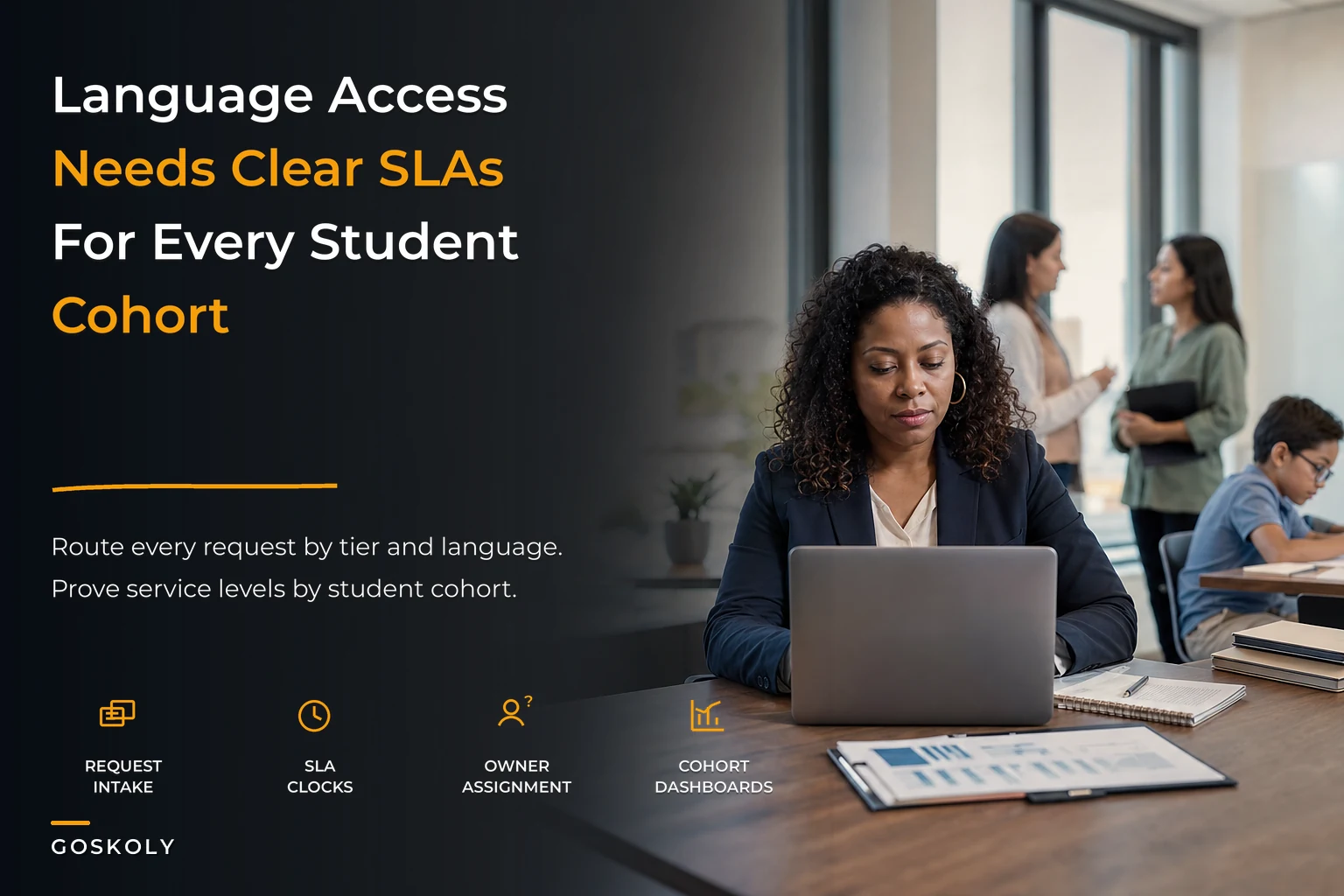

Most districts already believe in equity. That's not the problem. The problem is that equity in a K–12 system lives inside dozens of small handoffs — a translated IEP notice here, an interpreter request there, a screen-reader-compatible enrollment form somewhere else — and none of those handoffs have a clock on them, an owner attached, or a record proving they happened.
So what looks like a values gap is usually an operations gap. When a Spanish-speaking family waits eleven days for a translated suspension notice, nobody decided that on purpose. The request fell into a queue with no service-level agreement, no priority rule, and no dashboard showing it was aging. Multiply that across every language, every campus, and every disability accommodation, and you get a district that's technically compliant on paper and quietly failing specific cohorts of kids in practice.
This article is about the plumbing behind language access and accessibility — the SLA templates, the prioritization logic for supports that are always scarce, and the monitoring and audit exports that let you prove service levels by student cohort instead of hoping. This is the backbone of equity operations K-12, and it's usually the part nobody owns until an OCR complaint or a due-process hearing forces the issue.
Why equity work fragments across the whole operation
The structural reason this breaks: language access and accessibility aren't a department. They're a demand that cuts sideways across every department.
Enrollment needs translated forms. Special education needs interpreters for IEP meetings. The front office needs someone who can talk to a Vietnamese-speaking parent about attendance. Nutrition services needs allergy forms in Arabic. Communications needs the emergency text in six languages. Each of these teams treats translation and accessibility as a favor they occasionally request, not a service with a defined turnaround they're entitled to.
-
Duplicate work. Two campuses pay to translate nearly identical enrollment letters because neither knew the other did it.
-
Invisible backlogs. A stack of accommodation requests sits with one overloaded bilingual staff member, and leadership has no idea until a parent escalates.
-
Inconsistent quality. One school uses a professional vendor, the next uses Google Translate, and the third grabs a bilingual custodian during his lunch break.
The bilingual front-office aide becomes an accidental single point of failure. She's not in the org chart as "language access coordinator," but every translation request in a two-mile radius funnels through her. When she's out sick during enrollment week, an entire cohort of families goes dark — and nobody planned for that because her role was never formalized into a workflow with backup coverage.
This is the same category of failure covered in Student Data Governance for K–12: Operational Failures to Avoid and How to Fix Them: when a critical function has no named owner and no defined process, it doesn't fail loudly. It degrades quietly until something external forces a reckoning.
The scarce-support problem nobody plans for
Here's the uncomfortable operational truth: interpreters, certified translators, ASL providers, and specialized assistive tech are always scarce relative to demand. You will never have enough. So the real question isn't "how do we serve everyone equally" — it's "when two families need the one available interpreter at the same time, who decides which one gets served first, and on what basis?"
Eliminate administrative overload.
GoSkoly helps you manage schedules, attendance, and communications seamlessly.
- Unified student and staff management
- Automated attendance tracking
- Integrated communication tools
No credit card required
Most districts have no answer to that question. Which means it defaults to whoever escalates loudest, whichever principal has the most political weight, or simple first-come-first-served — none of which map to actual need or legal risk.
That's the failure. Scarcity is inevitable; unprincipled scarcity is a choice.
A workable prioritization framework looks less like a values statement and more like a triage protocol:
| Priority Tier | Request Type | Target Response | Rationale |
|---|---|---|---|
| P1 – Legal/Safety | Due-process notices, IEP/504 meetings, disciplinary hearings, emergency comms | Same day / by meeting date | Legally bound deadlines; missing them creates liability and denies rights |
| P2 – Access-Critical | Enrollment, health/allergy forms, special ed evaluations | 2–3 business days | Blocks a student from accessing school or a required service |
| P3 – Engagement | Progress reports, event notices, general newsletters | 5–7 business days | Important for inclusion, but not access-blocking |
| P4 – Nice-to-have | Optional programs, non-critical announcements | Best effort | Serve when capacity allows |
The point of a table like this isn't the exact numbers — your district will set its own based on staffing. The point is that when the interpreter is double-booked, the person making the call has a rule to follow instead of a gut feeling. And when a P2 request slips past its window, that becomes a visible, trackable exception rather than a silent one.
One pattern worth flagging: districts that write prioritization rules but never tie them to capacity data end up with beautiful policies and the same chaos underneath. If you don't know how many interpreter-hours you actually have per week, your tiers are fiction. The rules and the capacity manifest have to live together.
Owner-by-owner SLA templates that actually get followed
An SLA that says "translations completed in a timely manner" is worthless. No owner, no clock, no definition of done. The SLAs that hold up under an audit — and under a family's frustration — share a specific anatomy.
-
A named owner role (not a person — a role, so it survives turnover).
-
A trigger — the exact event that starts the clock (request submitted, meeting scheduled, form generated).
-
A response target and a resolution target — acknowledgment is not completion, and families need both.
-
A quality standard — vendor-certified vs. staff vs. machine-assisted, and which is acceptable for which tier.
-
An escalation path — who gets pinged, and when, if the clock runs out.
-
A record requirement — what gets logged so you can prove it later.
Here's what one line of that template looks like filled in, for interpreter requests at an IEP meeting:
> Service: ASL/spoken-language interpreter for IEP meeting > Owner role: Special Education Coordinator (campus) > Trigger: IEP meeting date confirmed in the SIS > Response target: Interpreter confirmed within 3 business days of scheduling > Resolution target: Interpreter present at meeting; if unavailable, meeting rescheduled with documented parent consent — never held without language access > Quality standard: Certified interpreter for legal meetings; no family members, no bilingual staff pulled ad hoc > Escalation: If unconfirmed 5 business days before the meeting, auto-escalate to district Special Ed Director > Record: Request timestamp, confirmation, interpreter credential, attendance logged in student file
Notice how much of this is about timing relative to a downstream deadline, not just raw turnaround. A three-day interpreter SLA is meaningless if the meeting is tomorrow. Good SLAs anchor to the event that actually matters and count backward from it.
The other thing that separates real SLAs from decorative ones: they define the failure behavior. What happens when you can't meet it? The example above says the meeting gets rescheduled with consent — it is never held without access. That's a decision made in calm daylight, written down, instead of a panicked judgment call by a coordinator five minutes before a meeting starts.
What breaks when you scale from one campus to twelve
At a single school, informal works. The principal knows which three families need Somali translation, the counselor keeps a mental list, and things mostly get handled. It's fragile, but it's small enough to hold in one person's head.
That model shatters the moment you scale, and it shatters in predictable ways:
-
No shared queue. Twelve campuses run twelve private backlogs. The district can't see aggregate demand, so it can't staff or contract correctly. You over-serve the squeaky-wheel school and under-serve the quiet one — which, more often than not, is the one with the highest need.
-
Inconsistent SLAs by accident of geography. A family that gets 48-hour translation at one school gets two-week translation across town. Same district, same right, different service. That inconsistency is exactly what an OCR investigation loves to find.
-
Vendor sprawl. Each campus has its own translation vendor, its own rate, its own quality. Nobody's negotiating volume pricing or standardizing quality because nobody sees the whole spend.
-
Evidence gaps. When the complaint or audit lands, you're reconstructing what happened from email chains and someone's memory, per campus, for the past two years.
The connective tissue that fixes this is a single demand pipeline — every request, from every campus, for every language and accessibility need, entering one intake with tier tagging and owner assignment. It doesn't have to be fancy. It has to be one place, so that demand is visible and service levels are comparable across cohorts.
The same principle shows up in Parent Portal Adoption and Support: Multilingual Authentication Playbooks and SLA-Backed Help Paths — the front door families use has to actually work in their language, or the whole equity effort collapses at step one, before any translation SLA even gets triggered.
Monitoring by cohort, not by average
The single most important idea in this whole article: averages hide inequity.
If your dashboard says "average translation turnaround: 4.2 days," you've learned almost nothing. That average can hide the fact that Spanish requests average 2 days and Haitian Creole requests average 14, because you have one Creole contact and she's swamped. Aggregate metrics are where inequity goes to disappear.
The monitoring that actually matters slices service levels by cohort:
-
By language — turnaround and SLA compliance for each language served, not blended.
-
By campus — so you can spot the school that's silently drowning.
-
By service type — interpreter requests vs. document translation vs. accessibility accommodations behave differently and need separate tracking.
-
By tier — P1 compliance should be near-perfect; if it's not, that's a red alert, not a rounding error.
-
By disability accommodation — screen-reader-compatible documents, braille, captioning, all tracked as their own service lines.
A useful dashboard answers, at a glance: which cohort is currently getting worse service, and is any P1 request aging past its deadline right now? Those two questions catch most problems before they become complaints.
Pro-tip: Build cohort filters for language and campus first — they reveal disparities fastest.
For the deeper discipline of building metrics that don't mislead you, School Performance Analytics: Avoid These KPI and Reporting Pitfalls covers the traps in detail — and cohort-blindness is one of the biggest. A metric that looks healthy in aggregate and rotten by subgroup is worse than no metric, because it manufactures false confidence.
This is where AI-assisted operational tooling earns its place quietly — not as a headline, but as the thing that watches every request against its SLA clock, flags the ones aging toward breach, and generates the cohort-sliced view automatically instead of someone rebuilding it in a spreadsheet every Friday. The value isn't novelty; it's that nothing silently ages past its deadline when the system is watching the queue for you.
Audit-ready exports: proving it after the fact
The exports are the part everyone ignores until they desperately need them. When an OCR complaint arrives, or a due-process hearing is scheduled, or a school board member asks a pointed question, you have to produce evidence — organized, by cohort, covering a time range — often on a tight deadline.
If that evidence lives in email threads and per-campus binders, you're going to spend weeks assembling it, and the gaps will show. If requests flow through one pipeline with timestamps and outcomes, the export is a query.
A defensible audit export for language access typically includes:
-
Every request in the period, with language, service type, tier, and campus
-
Timestamps for request, acknowledgment, and completion
-
SLA target vs. actual, with compliance flagged
-
The owner role responsible for each
-
Quality/credential info for legal-tier work (proving you used certified interpreters, not a family member)
-
Documented exceptions and what happened when an SLA was missed
That last one matters more than people expect. Auditors and hearing officers don't expect perfection. They expect a system — evidence that you had rules, tracked against them, caught the misses, and responded. A clean record of "we missed this SLA, here's the escalation that fired and how we resolved it" is far stronger than a suspiciously perfect record with no exceptions, because the perfect record usually means you weren't measuring.
A short real scenario
A mid-sized district — around 9,000 students, eight campuses, roughly a quarter of families speaking a language other than English at home — kept running into the same pattern: IEP meetings held without interpreters, translated notices going out days late, and no way to see it coming.
Translation and interpreter requests moved through email and hallway conversations. No central queue. When a complaint came in, the special ed office spent the better part of two weeks pulling records from four different campuses to reconstruct what happened for one family.
They didn't buy anything dramatic. They built one intake for all language-access and accessibility requests, wrote tiered SLAs with owner roles, and stood up a dashboard that sliced compliance by language and campus. The prioritization table settled the "who gets the interpreter first" question so coordinators stopped improvising.
[Request Submitted] → [Auto-tagged by Tier + Language] → [Owner Role Assigned] → [SLA Clock Starts] → [Resolution Logged] → [Cohort Dashboard Updated] ↓ [Aging Alert if SLA at Risk] ↓ [Escalation Fired if Breached]
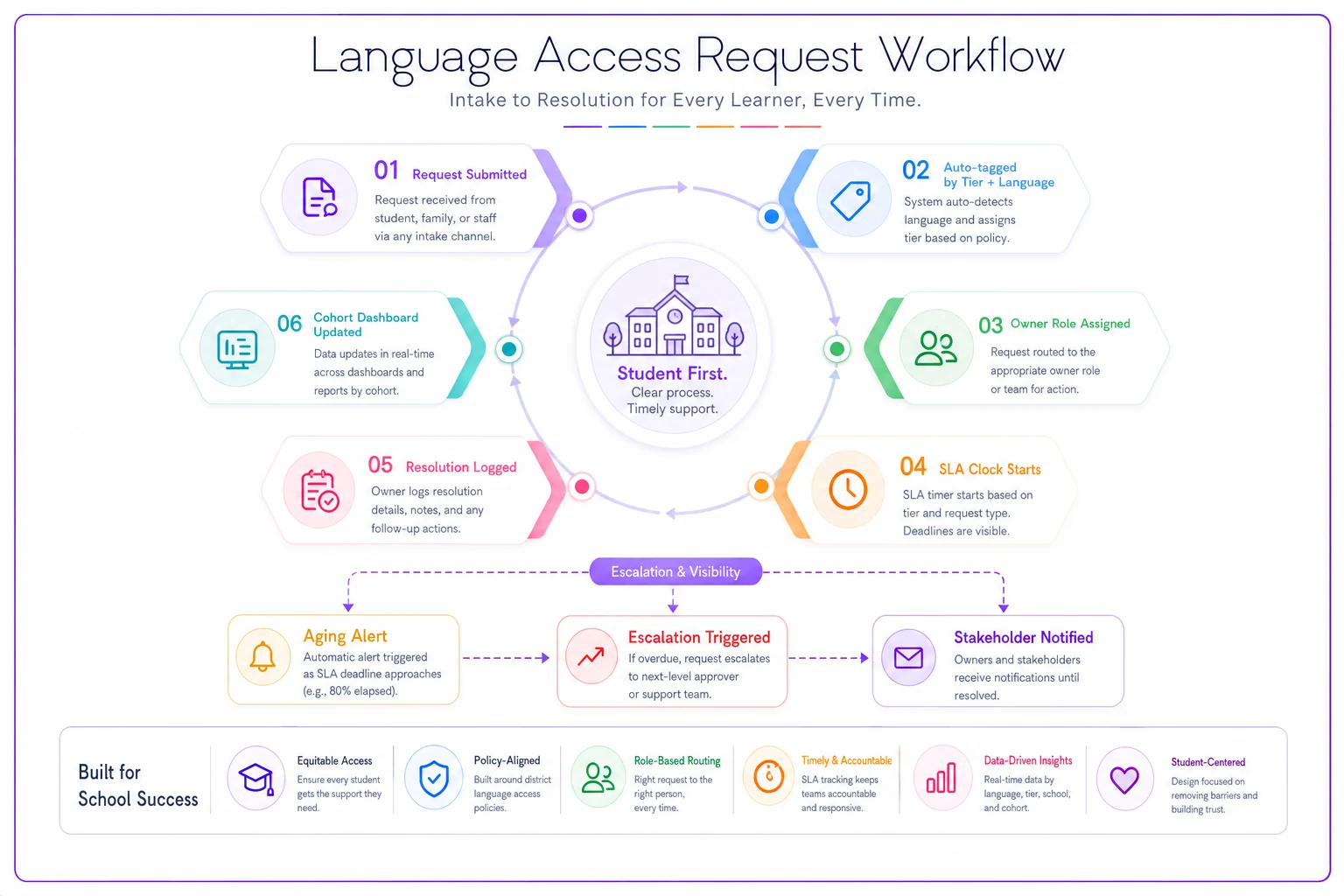
Within about two terms, P1 (legal/safety) compliance moved from something nobody could even measure to consistently near the high 90s. The Haitian Creole backlog — invisible before because it hid inside a healthy-looking average — surfaced immediately, and they contracted a second provider to fix it. The next records request took a couple of hours to fulfill instead of two weeks, because the export was a filter on data they already had.
Nothing about that is a technology miracle. It's what happens when a fragmented, favor-based process becomes a system with owners, clocks, and receipts.
When this level of structure makes sense — and when it's overkill
Not every district needs a formal SLA-and-dashboard apparatus on day one.
This makes sense when:
-
You have a meaningful multilingual population across multiple campuses
-
Requests are already falling through cracks and you're getting escalations or complaints
-
You can't currently answer "what's our translation turnaround for Cohort X?" without a manual dig
-
You've had, or reasonably fear, an OCR complaint or due-process issue tied to access
This is probably overkill when:
-
You're a single small school with a handful of language-access requests a month that one coordinator genuinely handles well
-
Your entire demand fits comfortably in one person's head and has reliable backup coverage
Who should not skip this: any district that's growing, consolidating campuses, or seeing shifting demographics. The informal model doesn't degrade gracefully — it works right up until it doesn't, usually during enrollment season or a crisis, which is the worst possible time to discover you have no system.
The through-line
Language access and accessibility fail in K–12 not because people don't care, but because the work is scattered across every department with no owner, no clock, and no shared view of demand. Scarcity of interpreters and translators is permanent, so the districts that do this well don't pretend otherwise — they build principled prioritization, attach real SLAs to real owners, monitor by cohort so averages can't hide the gaps, and keep exports ready so they can prove service levels instead of arguing about them.
That's the whole system: intake, tiers, owners, monitoring, exports — connected, not siloed. Get those pieces talking to each other and equity stops being a value you assert in a mission statement and becomes something you can actually see, manage, and defend for every cohort of kids you serve.
That's the whole system: intake, tiers, owners, monitoring, exports — connected, not siloed. Get those pieces talking to each other and equity stops being a value you assert in a mission statement and becomes something you can actually see, manage, and defend for every cohort of kids you serve.
Ready to optimize your school operations?
Join hundreds of schools using GoSkoly to save time, improve collaboration, and enhance student outcomes.