


Most districts don't lose money on vendors during the buying phase. They lose it later — when a contract renews on autopilot, when a data export never comes back clean, or when a platform that "worked fine" turns out to be impossible to leave without paying for six months of parallel systems. The buying decision gets all the attention. The exit almost never does.
That imbalance is the core problem with how the school vendor lifecycle procurement process usually runs. Districts treat procurement as a front-loaded event: write the RFP, score the bids, sign, done. But a vendor relationship is a lifecycle — intake, gating, acceptance, operation, renewal, and offboarding — and the parts that cause the most damage are usually the ones nobody wrote requirements for.
This isn't a list of procurement tips. The goal is to show how the pieces connect, where they quietly break as your vendor count grows, and how to build gates and sign-offs that hold up when a contract goes sideways two years after signing.
The gap between what the board approved and what the vendor signed
Every district has policy. Data privacy policy, procurement thresholds, records retention rules, accessibility standards. The trouble is that policy lives in board minutes and PDF handbooks, and contracts live in the vendor's paper — written to protect the vendor.
A pattern that comes up constantly: a district has a strong student-data-privacy policy on paper. Then a curriculum team signs a click-through agreement for a reading app, and that agreement says the vendor can use "de-identified" student data for product improvement, with no deletion timeline. Policy said one thing. The contract said another. Nobody translated policy into an actual contract clause, so the vendor's default terms won.
The failure isn't that the policy was weak. It's that there was no mechanism forcing policy to become a requirement before money moved. Procurement gating is that mechanism — a checklist that a purchase cannot pass without satisfying. Not a suggestion. A gate.
A basic gating checklist that should block a purchase from advancing:
-
Data classification confirmed — does this vendor touch student PII, staff PII, or neither? The answer drives everything downstream.
-
Privacy terms mapped to district policy — specific clauses, not "vendor has a privacy policy."
-
Data-portability commitment in writing — export formats, frequency, and who owns the data on termination.
-
Accessibility conformance stated — VPAT or equivalent for anything students or parents will use.
-
Integration and export requirements attached — the actual schemas and acceptance criteria, not a promise to "integrate with your SIS."
-
Offboarding terms defined — deletion timeline, transition assistance, and cost of leaving.
-
Named district owner assigned — a person, not a department.
If any box is unchecked, the purchase doesn't move. That last item — the named owner — is the one districts skip most, and it's the one that causes the slowest, most expensive failures. A vendor with no internal owner is a vendor nobody is watching, which ties directly into the broader owner-mapped SLA and cross-system responsibility matrix work that should already exist in your operating model.
Why this breaks worse as you add vendors
A district running eight or ten core platforms can manage vendors informally. A few people remember which contract renews when, who to call, and where the data lives. That informal memory is doing real work — and it doesn't scale.
Eliminate administrative overload.
GoSkoly helps you manage schedules, attendance, and communications seamlessly.
- Unified student and staff management
- Automated attendance tracking
- Integrated communication tools
No credit card required
Cross a certain threshold — for most mid-size districts that's somewhere around 40 to 60 active vendor agreements once you count department-level and building-level tools — and the informal system collapses quietly. Nothing dramatic happens on any single day. What happens instead is drift:
-
Renewals auto-execute because no one flagged them 90 days out.
-
The person who understood a vendor's data flow leaves, and nobody documented it.
-
A tool gets "sunset" by a department, but its integration keeps pulling roster data because the offboarding never actually ran.
-
Two departments buy overlapping tools because there's no central intake.
The scaling problem isn't volume alone. It's that each new vendor adds a dependency, and dependencies compound. A single reading platform that pulls nightly roster syncs, writes grades back, and feeds a state report is now wired into three other systems. Offboard it carelessly and you don't just lose the app — you break the roster sync and corrupt a reporting pipeline. This is exactly the kind of hidden coupling that a solid operational data strategy with lightweight lineage is meant to surface before you sign, not after you're already trying to leave.
SLAs that are actually enforceable
Most vendor SLAs are decorative. They say "99.9% uptime" and "response within one business day," then define uptime so loosely — and carve out so many exceptions — that the number means nothing. When the platform is down during first-period attendance, "99.9% monthly uptime" is cold comfort. That 0.1% is still roughly 43 minutes a month, and it always seems to land at 8:05 a.m.
The fix is to link SLA clauses to your own service-level objectives — the outcomes you actually care about — rather than accepting whatever the vendor's generic terms say. An SLO-linked SLA answers: what does this system need to do reliably, when, and what happens when it doesn't?
A few clauses worth negotiating:
| Weak SLA (vendor default) | SLO-linked SLA (what to negotiate) |
|---|---|
| "99.9% monthly uptime" | Defined availability during peak windows (7–9 a.m., grade-submission weeks) with credits tied to those windows |
| "Support responds within 1 business day" | Tiered response: P1 (system down, students affected) within 1 hour; documented resolution targets |
| "Data available for export" | Export in a named format, on demand, tested and accepted before go-live |
| "Vendor maintains reasonable security" | Breach notification within a fixed number of hours, with named contact and required detail |
| "Either party may terminate" | Offboarding assistance obligations, deletion timeline, and a cap on transition cost |
Something most administrators miss: SLA credits are almost never the point. A 10% service credit on a $30k contract doesn't fix a failed state submission. The real value of a well-written SLA clause is that it gives you leverage and a defined trigger — a documented breach you can point to during renewal, in an escalation, or if you need to exit for cause. Write the clauses so they generate evidence, not just refunds.
This is also where your operational risk framework earns its keep. The vendors that need the tightest SLOs are the ones whose failure lands on your prioritized risk register — attendance, SIS, state reporting, emergency communications. Not every vendor needs a hardened SLA. The library ebook add-on doesn't. The system that gates your daily attendance does.
Vendor acceptance tests: prove it before you pay for it
The single most effective control in the whole lifecycle is refusing to sign off on final acceptance until the vendor demonstrates the thing actually works with your data, in your environment.
"Works" is not a demo. Demos run on clean sample data the vendor controls. Acceptance tests run on a representative slice of your real mess — the students with two enrollments, the withdrawn-but-not-purged records, the grade scale that isn't standard, the special characters in family names that break half of all imports.
A workable acceptance-test flow:
-
Define pass/fail criteria in writing before testing starts. Vague criteria mean the vendor decides what "passing" means.
-
Provide a representative data sample — not the cleanest 50 records, but the awkward ones. Include the edge cases you know cause problems.
-
Run the integration end to end — roster in, data out, and if applicable, the write-back path.
-
Verify the export in the format your downstream systems and state reporting actually consume.
-
Test the failure modes — what happens on a bad sync, a partial file, a mid-day change.
-
Log every result against the criteria, with the district owner signing off on each.
-
Withhold final payment or go-live approval until the sign-off is complete.
The mistake is running acceptance tests as a formality after the district has already committed politically. Once teachers are trained and a launch date is public, "acceptance" becomes a rubber stamp — nobody wants to be the person who kills a rollout over an export bug. Structure the timeline so acceptance happens while you still have the leverage to walk away. Tie the last payment tranche to it.
The runbook nobody writes: data portability and offboarding
This is the part that separates districts that get burned from districts that don't. The offboarding runbook gets written at procurement time — not when you're already trying to leave.
Think about what a clean exit actually requires. You need your data back, in a usable format, complete, with the vendor's copy destroyed on a defined schedule. You need any integrations severed cleanly so you don't keep leaking roster data to a system you've stopped paying for. You need to know what breaks downstream when this vendor goes dark. And you need proof it all happened, because a year later an auditor may ask.
A data-portability and offboarding runbook should specify, in advance:
-
What data you get back, in what format, and how you verify it's complete (record counts, spot checks against known values).
-
Deletion obligations — when the vendor destroys their copy, and how they attest to it.
-
Integration teardown steps — which syncs to disable, in what order, so you don't corrupt live systems.
-
Downstream impact map — what depends on this vendor's data and what needs to be re-pointed.
-
A parallel-run window if the tool is being replaced, so you're not switching cold.
-
Owner sign-off confirming the offboarding actually completed, not just that the contract ended.
A realistic example of how this goes wrong: a district drops an assessment platform after three years. The contract ends June 30. Nobody runs the offboarding steps because school's out. In September, staff discover the historical assessment data they assumed they still had was never exported — the vendor purged it 60 days post-termination per a clause no one had read. Reconstructing three years of results, where possible, ate weeks of staff time and left permanent gaps.
The point isn't that switching vendors is dangerous. The exit is an operational process with steps and owners, exactly like onboarding — and it deserves a runbook written before anyone is under pressure to get it done fast.
A real scenario: the auto-renewing platform nobody owned
A mid-size district — around 9,000 students — had a family-communication platform that was originally bought by a community-relations coordinator who had since left. The contract ran roughly $22k a year and auto-renewed each July. No named owner remained. Two buildings had quietly stopped using it in favor of the SIS's built-in messaging, but the district kept paying full price.
The problem surfaced during a routine vendor inventory, not because anyone was actively watching the contract. When they finally reviewed it, they found the auto-renewal clause required 90 days' written notice to cancel — and they'd already blown past that window for the coming year. Locked in for another cycle.
The changes they made afterward were unglamorous but effective. Every vendor got a named owner and a renewal date logged 120 days out. Auto-renewal clauses became a gating flag — allowed, but only with a calendar trigger and an owner attached. Contracts above a set threshold required a documented acceptance sign-off and an offboarding runbook before signing.
The direct savings the next cycle were modest — cutting unused building licenses and renegotiating trimmed roughly $6k–$8k. The real win was that three other contracts that would have auto-renewed got caught in the same net, including one for a tool the district had fully replaced. That one was pure waste they'd have paid for a fourth straight year.
When heavy procurement gating makes sense — and when it doesn't
Not every purchase deserves the full treatment. Running acceptance tests, negotiating SLO-linked SLAs, and writing offboarding runbooks for a $400 classroom app is bureaucracy for its own sake — and it teaches staff to route around procurement entirely.
Where the full lifecycle process is worth it:
-
Any vendor touching student or staff PII.
-
Anything wired into your SIS, finance system, or state reporting.
-
Systems that gate a daily operation — attendance, communications, transportation.
-
Contracts above a meaningful dollar threshold, or with auto-renewal clauses.
-
Anything that would be painful or slow to replace.
Where lighter-touch is fine:
-
Low-cost, single-classroom tools with no PII and no integration.
-
Short pilots with a hard end date and no data commitment.
-
Commodity purchases where switching is trivial.
A district that funnels every tiny purchase through one procurement bottleneck will grind to a halt, and departments will start buying on personal cards to avoid the friction. The right model tiers the process by risk — heavy gates on high-risk vendors, a fast lane for the trivial ones. Match the control to the consequence.
Define clear dollar and risk thresholds so teams know when the full lifecycle process applies and when the fast lane is OK.
A district that funnels every tiny purchase through one procurement bottleneck will grind to a halt, and departments will start buying on personal cards to avoid the friction. The right model tiers the process by risk — heavy gates on high-risk vendors, a fast lane for the trivial ones. Match the control to the consequence.
Bringing the pieces together
Procurement, SLAs, acceptance, and offboarding aren't separate activities. They're one lifecycle, and the weakest link determines your real exposure. A brilliant RFP doesn't help if acceptance is a rubber stamp. A great acceptance test doesn't help if the offboarding clause lets a vendor purge your data 60 days after you leave. The gates only work as a connected chain, with a named owner accountable at each link.
Here's a simple workflow showing the lifecycle and key gates.
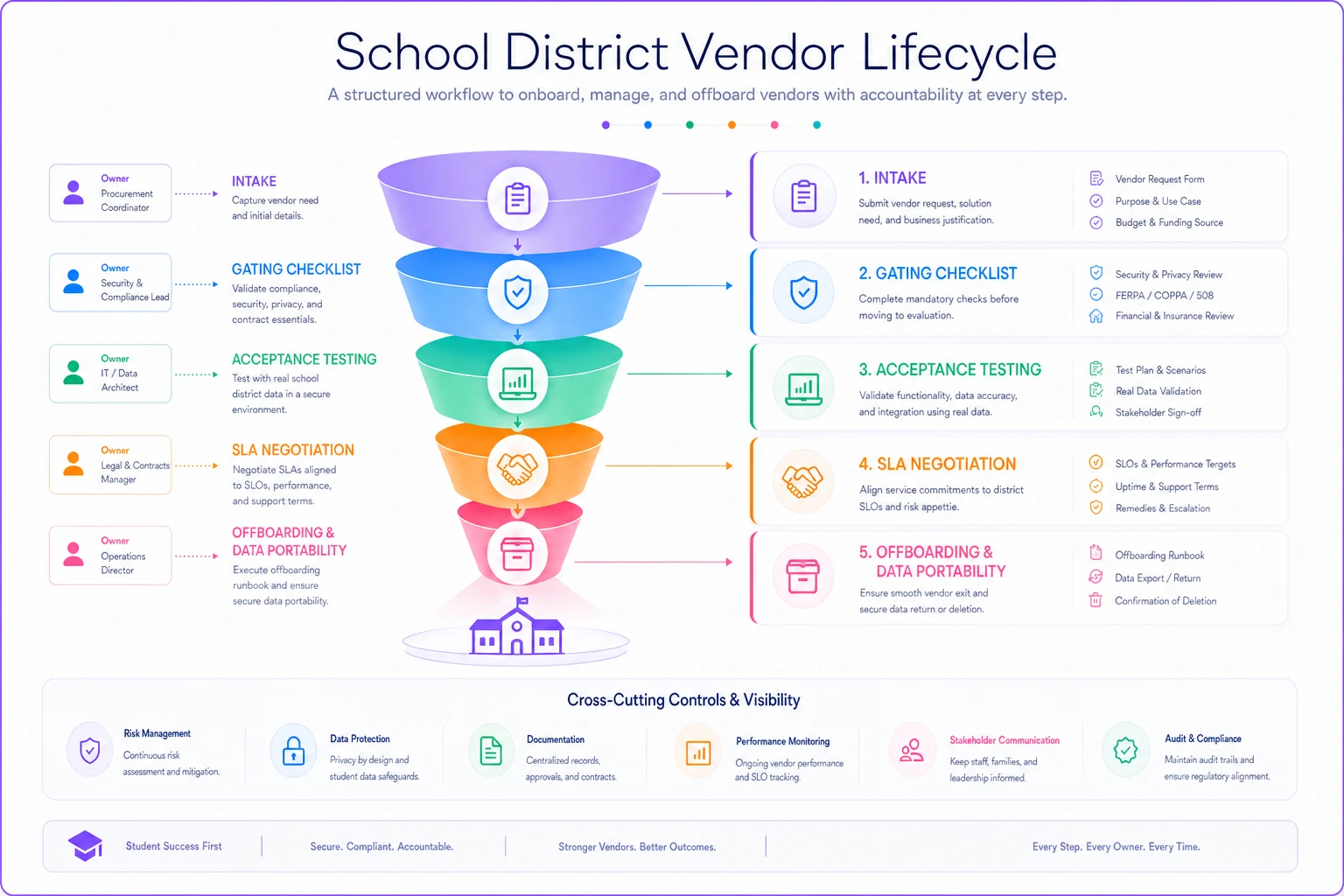
As a district grows and its vendor count climbs, the informal memory that used to hold this together stops working — usually without anyone noticing until a renewal locks in or an export comes back empty. The districts that stay in control are the ones that wrote the boring parts down early: the gating checklist that blocks a purchase, the SLA clause tied to what actually matters, the acceptance test run on real data, and the offboarding runbook drafted while they still had leverage. Get those four things in place and vendor management stops being a series of unpleasant surprises and starts being something you can actually operate.
As a district grows and its vendor count climbs, the informal memory that used to hold this together stops working — usually without anyone noticing until a renewal locks in or an export comes back empty. The districts that stay in control are the ones that wrote the boring parts down early: the gating checklist that blocks a purchase, the SLA clause tied to what actually matters, the acceptance test run on real data, and the offboarding runbook drafted while they still had leverage. Get those four things in place and vendor management stops being a series of unpleasant surprises and starts being something you can actually operate.
Ready to optimize your school operations?
Join hundreds of schools using GoSkoly to save time, improve collaboration, and enhance student outcomes.