

Most K–12 data problems don't start as data problems. They start as ownership problems. Someone in the front office changes how they enter a withdrawal code, a counselor tweaks a course number to make scheduling work, and six weeks later a state report comes back wrong. Nobody did anything malicious. The system just had no way of knowing who was allowed to change what, or where a number came from once it landed in a dashboard.
That's the real gap in most districts. The tools are fine. The SIS works, the assessment platform works, the finance system works. What breaks is the connective tissue between them — the part nobody officially owns. This article is about that connective tissue: metadata, lightweight lineage, consumption patterns, and an ownership matrix that actually holds up when three people are out sick during enrollment week.
Why "we have a data warehouse" doesn't solve anything
There's a common assumption that buying a reporting layer or a warehouse fixes reliability. It doesn't. A warehouse just centralizes the confusion faster.
What tends to happen across a lot of districts is that the warehouse becomes a place where mystery numbers live. A principal pulls a chronic absenteeism figure, the state pulls a different one, and both are technically "from the data warehouse." The warehouse didn't lie. It just aggregated two different definitions of the same metric because nobody wrote down which definition was official.
A K-12 operational data strategy isn't about having more storage or prettier dashboards. It's about being able to answer three boring questions on demand:
-
Where did this number come from?
-
Who is allowed to change the thing it came from?
-
If it's wrong, who fixes it and by when?
Districts that can answer those three questions calmly during an audit are running on a real strategy. Everyone else is running on tribal knowledge, and tribal knowledge walks out the door every June.
Start with metadata, but keep it embarrassingly simple
When people hear "metadata," they picture some enterprise governance tool with a hundred fields nobody fills in. That's the fastest way to kill the whole effort. In practice, the metadata that actually gets maintained is the metadata that fits on one screen.
Eliminate administrative overload.
GoSkoly helps you manage schedules, attendance, and communications seamlessly.
- Unified student and staff management
- Automated attendance tracking
- Integrated communication tools
No credit card required
For each important data element — say, "enrollment status" or "primary disability code" — you really only need a handful of things documented:
-
Definition in plain English. What does "active" actually mean? Enrolled and attending? Enrolled but withdrawn pending paperwork? Districts disagree on this constantly.
-
Source system. Where is this field the master? If it lives in three systems, one of them wins and the others copy.
-
Refresh cadence. Is it real-time, nightly, or "whenever someone remembers to export"?
-
Owner. A named role, not a person's name. People leave; roles don't.
The fields that cause the most reporting pain are almost never the exotic ones. They're the everyday fields with fuzzy definitions — attendance codes, enrollment status, race/ethnicity rollups, program flags like Title I or EL. Those are the ones worth documenting first. The exotic fields rarely move.
A district that documents even 25 or 30 core fields this way is in far better shape than one sitting on a 400-field catalog that nobody trusts. Coverage matters less than accuracy.
Lightweight lineage: knowing where a number has been
Full data lineage tooling is overkill for most districts. What you actually need is lightweight lineage — a documented, human-readable path from source to report for the numbers that matter most.
Think about a single chronic absenteeism figure that shows up in a board presentation. In most districts, that number quietly traveled through something like this:
-
Teachers enter daily attendance in the SIS.
-
An overnight job calculates present/absent per student.
-
A rule converts raw absences into a "chronic" flag based on a percentage threshold.
-
That flag gets rolled up by school and grade.
-
Someone exports it and drops it into a slide or a state submission.
Five steps, and any one of them can distort the final number. If the threshold in step 3 was set to 10% at the district level but a school analyst used 15% in their own spreadsheet, you now have two "official" chronic absenteeism rates and a very awkward board meeting.
Lightweight lineage means writing that five-step path down once, in plain language, and attaching it to the metric. Not a fancy diagram — a short documented flow that a new analyst can read and understand in ten minutes. The goal isn't technical completeness. It's that when a number looks wrong, you can walk backward through named steps instead of guessing.
This ties directly into the mechanics of clean state submissions. If you've dealt with the pain of mapping and monitoring canonical pipelines, you already know how quickly small definitional drift compounds — the same discipline that prevents state reporting submission errors is what makes lightweight lineage worth the effort.
Consumption patterns: who reads what, and how it goes wrong
Most reliability discussions focus on how data gets in. The bigger operational risk is usually how it gets out. Consumption is where the same underlying data quietly fractures into competing versions.
A typical example: a mid-sized district of around 9,000 students has the state pulling official counts from a nightly canonical export, principals using a live dashboard for daily attendance and behavior, the grants office maintaining its own spreadsheet for program eligibility, and a handful of teachers keeping private tracking sheets because they don't trust the dashboard.
Same district. Same students. Four different consumption patterns, each with its own refresh timing and its own quiet assumptions. When the grants number and the state number don't match, everyone spends a week reconciling instead of doing anything productive.
The fix isn't to ban spreadsheets — that never works. The fix is to classify consumption into tiers and be honest about which tier each output belongs to.
| Consumption Tier | Purpose | Refresh | Trust Level | Allowed For |
|---|---|---|---|---|
| Authoritative | State reporting, compliance, board figures | Controlled/nightly | Single source of truth | Official decisions |
| Operational | Daily dashboards for principals, attendance clerks | Near real-time | Reliable but may lag official cutoffs | Day-to-day action |
| Exploratory | Ad-hoc spreadsheets, one-off analyses | Manual | Not authoritative | Investigation only, never reporting |
The mistake districts make is letting exploratory outputs quietly get promoted into authoritative ones. Someone's clever spreadsheet becomes "the number we always use" and nobody remembers it was never validated. Naming the tiers out loud stops that drift — there's now a clear rule: exploratory numbers don't go to the state, full stop.
The ownership matrix that actually survives staff turnover
This is the piece most districts skip, and it's the one that quietly causes the most damage. Without clear ownership, every data element is simultaneously everyone's job and no one's job.
An ownership matrix maps each data domain to four roles. Keep the roles, not the names, because names change constantly.
-
Data Owner — the person accountable for the meaning and correctness of a domain (e.g., the registrar owns enrollment status).
-
Data Steward — the person who does the day-to-day maintenance and cleanup.
-
System Owner — whoever's responsible for the platform where the data lives (often IT).
-
Consumer of Record — the primary official user who signs off that outputs look right (e.g., the state reporting coordinator for compliance data).
The distinction that trips people up: the system owner and the data owner are almost never the same person, and treating them as interchangeable is how accountability collapses. IT owns whether the SIS is up and running. IT does not own whether "primary disability code" is defined correctly — that belongs to special education. When something's wrong, the first question is which kind of wrong: a system problem or a meaning problem. The matrix answers that quickly.
A workable matrix might look like this:
| Data Domain | Data Owner | Steward | System Owner | Consumer of Record |
|---|---|---|---|---|
| Enrollment & withdrawal | Registrar | Front office lead | IT | State reporting coordinator |
| Attendance codes | Attendance supervisor | School attendance clerks | IT | Principal / state coordinator |
| Special education flags | SpEd director | Case managers | IT | Compliance officer |
| Program eligibility (Title I, EL) | Grants coordinator | Program clerks | IT | Grants office |
| Assessment results | Assessment director | Data analyst | IT/vendor | Curriculum leadership |
Pro-tip: Keep roles, not people's names, in the matrix because staff change frequently.
This kind of owner-mapping connects directly to the operational failures that show up when governance is loose. If you want the deeper failure patterns behind weak ownership, the breakdown of common student data governance failures pairs well with the matrix approach here.
What breaks specifically as a district grows
At a single small school, none of this matters much. One registrar knows every edge case, remembers every kid's situation, and can reconcile numbers from memory. Informal works fine at that scale.
The trouble starts when you cross multiple campuses or a few thousand students. That's when the informal knowledge that held everything together stops scaling, and the failure points multiply:
-
Definition drift between campuses. School A codes in-school suspension as present; School B codes it as absent. Both feel obviously correct to the people doing it.
-
Timing mismatches. One campus closes attendance at 9
00 a.m., another at 10:30. The district rollup silently blends two cutoffs.
-
Orphaned processes. The person who built the nightly export retires, and now there's a critical job nobody fully understands but everyone depends on.
-
Reconciliation tax. Staff spend more and more hours matching numbers between systems instead of acting on them. It's quiet, but it eats real payroll hours every reporting cycle.
The pattern is consistent: what worked as tribal knowledge in year one becomes an operational liability by the time you're coordinating five or ten buildings. Metadata, lineage, and the ownership matrix are basically insurance against that transition — you're writing down the knowledge before the person holding it leaves.
A real scenario
A district of roughly 6,500 students across four campuses kept failing its own internal check on enrollment counts. Every October, the state submission number and the district's own dashboard number were off by somewhere between 40 and 70 students. Not huge in percentage terms, but enough to trigger a scramble every single year, plus funding anxiety because per-pupil dollars ride on those counts.
The root cause turned out to be embarrassingly simple once they mapped it out. Two campuses handled "pending withdrawal" students differently — one counted them as active until paperwork cleared, the other dropped them immediately. No definition existed, so both had been improvising for years.
They didn't buy anything new. They wrote a one-paragraph definition of enrollment status, assigned the registrar as data owner across all four campuses, documented the five-step lineage from SIS entry to state export, and classified the dashboard as operational rather than authoritative for official counts. The next October, the discrepancy dropped to single digits — the small remaining gap was just normal timing lag, which they now understood and could explain rather than panic over. The reconciliation scramble that used to eat close to a week of staff time basically disappeared.
Nothing about that fix was technical. It was ownership plus a written definition plus a documented path.
When this level of structure makes sense — and when it doesn't
This isn't free. Documenting metadata, lineage, and ownership takes real time up front, and there's a point below which it's genuinely not worth it.
When it makes sense:
-
You operate more than one campus, or you're past roughly 2,000–3,000 students.
-
You've had at least one reporting discrepancy that caused real stress or funding questions.
-
Key knowledge lives in one or two people's heads.
-
You're planning a system migration or adding a new platform to the mix.
When it's overkill:
-
Single small school where one person genuinely knows everything and isn't leaving.
-
You'd be documenting hundreds of fields nobody actually reports on.
Who should NOT start here:
districts still fighting basic data-entry accuracy at the source. If teachers and clerks aren't entering clean data in the first place, a beautiful lineage diagram just documents the journey of bad data. Fix entry discipline first, then build the structure around it.
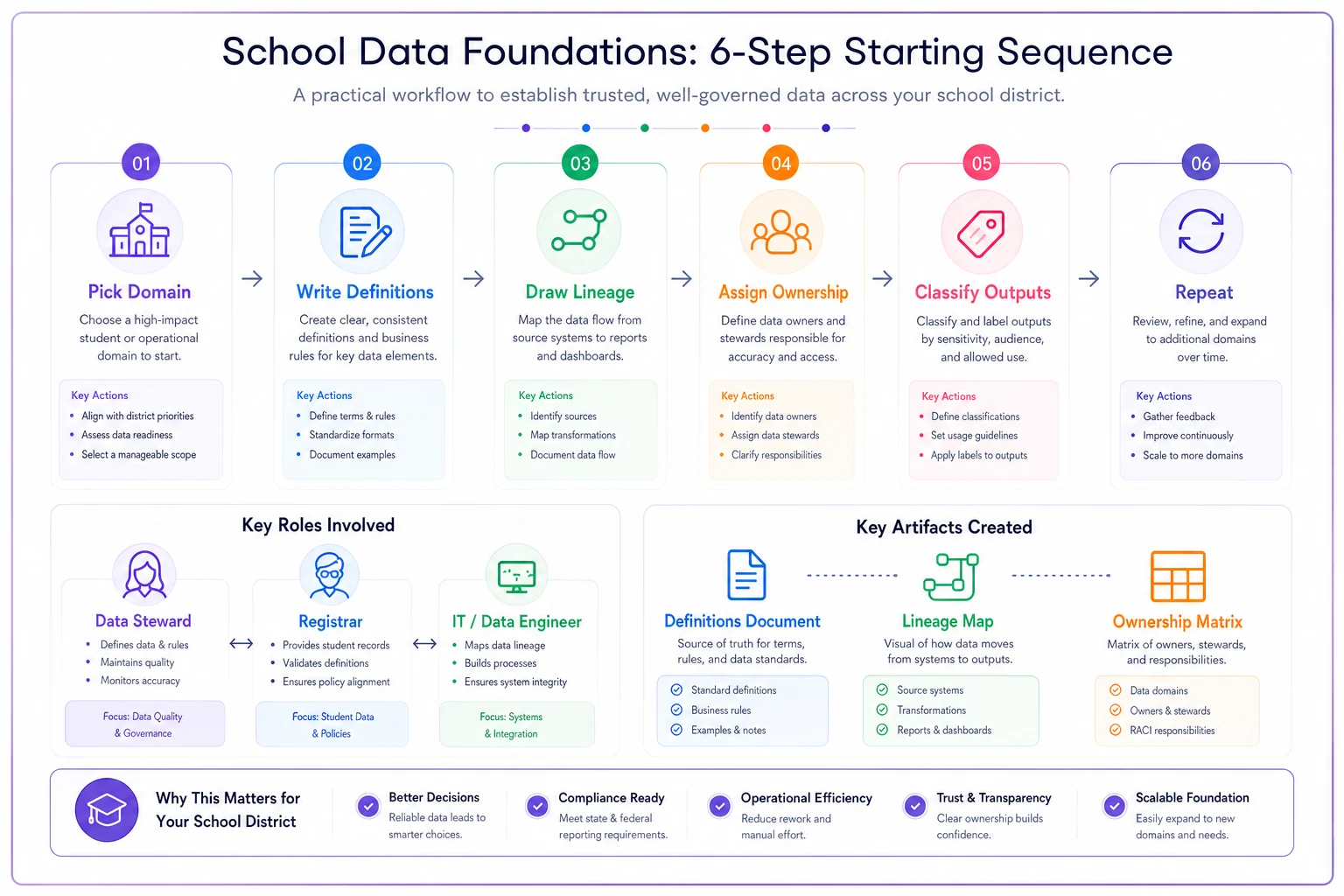
A practical starting sequence
You don't roll this out all at once. The districts that succeed start narrow and expand only after the first domain proves itself.
-
Pick your highest-pain domain. Usually enrollment or attendance — whatever caused the last reporting fire.
-
Write plain-English definitions for its 10–20 core fields. Argue about edge cases now, on paper, not during a deadline.
-
Draw the lineage for the one or two metrics from that domain that go to the state or the board. Keep it to numbered steps.
-
Assign the four ownership roles for that domain and put the matrix somewhere everyone can see it.
-
Classify the outputs into authoritative / operational / exploratory and communicate the rules.
-
Repeat for the next domain only after the first one has survived a full reporting cycle.
A simple rollout workflow:
Where software genuinely helps is in keeping this structure alive rather than in generating it. Operational platforms with AI-assisted monitoring can flag when a field's values suddenly drift from their documented definition, or when an exploratory export starts getting used like an authoritative one — the kind of quiet erosion that rarely gets caught until a deadline. That's a real assist. But the definitions, the ownership, and the lineage decisions still have to come from people who understand the district. No tool decides for you whether a pending-withdrawal student counts as active.
The part worth remembering
Reliable K–12 data isn't a technology outcome. It's an accountability outcome that technology can support. The districts that stay calm during audits and state deadlines aren't the ones with the most expensive systems — they're the ones who can point to a written definition, name an owner, and trace a number back to its source without calling a meeting.
That scenario from earlier — the one where a one-paragraph definition and a clear ownership assignment wiped out years of October chaos — is more common than most administrators expect. The barrier usually isn't technical capability. It's that nobody ever sat down and decided who was responsible for what.
Metadata, lightweight lineage, consumption tiers, and an ownership matrix are just the practical tools for turning tribal knowledge into something the whole district can rely on, even after the people who built it move on. Start with one painful domain, write things down, name the owners, and let it prove itself before you scale. That's the whole strategy. The rest is discipline.
Reliable K–12 data isn't a technology outcome. It's an accountability outcome that technology can support. The districts that stay calm during audits and state deadlines aren't the ones with the most expensive systems — they're the ones who can point to a written definition, name an owner, and trace a number back to its source without calling a meeting.
Ready to optimize your school operations?
Join hundreds of schools using GoSkoly to save time, improve collaboration, and enhance student outcomes.