

Most schools already track risk. It just lives in the wrong places — a spreadsheet the business manager updated for last year's insurance renewal, a couple of Post-it warnings on the front office monitor, and a whole lot of institutional knowledge locked inside the head of the person who's been there 22 years. That works fine, right up until that person is out for surgery during state reporting week and nobody remembers the immunization export breaks if the nurse changes a field label.
That's the real problem. It's not that administrators don't know the risks. It's that the knowledge isn't organized in a way that survives turnover, scale, or a bad Monday. An operational risk framework for school administration is really just the discipline of writing that knowledge down in a way that's ranked, owned, measurable, and tied to something you actually do when things go sideways.
This isn't a compliance exercise. Done right, it changes who does what at 7:15 a.m. when the SIS won't load and 400 parents are trying to check bus status.
Why school risk lives in the wrong format
Walk into most district offices and ask to see the risk register. You'll get one of three things: a static list built for auditors, a color-coded heat map nobody has looked at since the PD day it was created, or a shrug.
The reason is structural. Risk in a school isn't owned by one department. Attendance touches the SIS, the state feed, the nurse's records, and payroll if you're funding based on ADA. When a risk spans four owners, everyone assumes someone else has it handled. A list without owners is just anxiety in a table.
The second issue is that most registers score risk once and move on. A missed IEP timeline in September is a different situation than the same gap discovered two weeks before a compliance visit. Static scoring makes the register lie to you.
What shows up across a lot of school operations is that the register isn't really the deliverable — it's the index. The real work is the catalog of controls behind each risk and the playbook that fires when a control fails. Without those two things attached, a risk register is a museum piece.
The three pieces that have to connect
A working framework has three moving parts, and the value comes entirely from how they link — not from any one of them existing on its own.
Eliminate administrative overload.
GoSkoly helps you manage schedules, attendance, and communications seamlessly.
- Unified student and staff management
- Automated attendance tracking
- Integrated communication tools
No credit card required
-
The prioritized risk register — every material risk, scored, with a named human owner.
-
The control catalog — the specific checks, exports, reconciliations, or approvals that keep each risk from becoming real.
-
The operational SLOs and playbooks — the measurable target for each control ("immunization exceptions cleared within 5 school days") and the exact remediation steps when the target is missed.
When these connect, a risk stops being a vague worry and becomes: this risk → is watched by this control → measured against this target → and if it slips, this person runs this playbook. That chain is the whole game.
Here's a simplified look at how one row travels across all three pieces:
| Risk | Score (L×I) | Owner | Control | SLO | If breached |
|---|---|---|---|---|---|
| State enrollment feed rejects records | High (4×5) | Data/SIS lead | Nightly validation on canonical export | 100% of errors triaged within 1 business day | Run rejection-triage playbook; notify reporting owner; hold submission |
| IEP timeline missed | High (3×5) | SpEd coordinator | Weekly upcoming-deadline report | Zero overdue at week close | Escalate to director; document reason; parent notice within 48h |
| Substitute unpaid / mispaid | Medium (4×3) | Payroll lead | SIS-to-payroll code reconciliation | <2% exception rate per run | Run exception script; correct before pay cutoff |
| Emergency contact data stale | Medium (3×4) | Registrar | Annual + enrollment verification | 95% verified before Oct 1 | Targeted re-verify campaign |
The register itself is boring. The value is in the last three columns — that's where a worry becomes an operation.
Scoring that doesn't lie to you
The most common scoring mistake is treating likelihood and impact as gut-feel numbers picked once a year. A better version weights impact by who gets hurt. A payroll glitch that shorts a sub $180 is annoying. A student data breach exposing special-education records is a career-and-lawsuit event. Those shouldn't share the same impact score just because both technically qualify as "high."
A practical adjustment worth trying: add a third factor for detectability. A risk you'd catch immediately — the portal is down, everyone knows within minutes — is genuinely less dangerous than one that hides. Grades quietly failing to sync to the transcript system for three weeks is a different category of problem. Slow-burn, low-visibility failures are the ones that turn into the emergency board meeting.
So instead of Likelihood × Impact, some districts run Likelihood × Impact × (how long it stays hidden). The register reshuffles immediately, and usually the top of the list changes — the loud, obvious risks drop, and the quiet data-integrity ones jump up. That reshuffle alone is worth doing the exercise.
Re-score on a real cadence. A quarterly pass plus a forced re-score any time an actual incident happens keeps the numbers honest.
What breaks when you grow from one campus to five
At a single school, the framework can survive on shared drives and one competent person. The registrar knows the nurse, the nurse knows the data person, problems get solved in the hallway.
At three campuses, the hallway disappears. The same risk — stale emergency contacts, say — now has three owners doing it slightly differently. One campus verifies at enrollment, one at parent-teacher night, one basically never. When something goes wrong district-wide, leadership can't tell which campus is the weak point because there's no shared control or shared SLO.
This is where a lot of districts discover their "framework" was really just one competent person. Scale exposes it fast. The failure pattern tends to look like this:
-
Controls exist but aren't standardized across sites
-
Owners are named at the district level but the actual work happens at the building level with no clear handoff
-
SLOs are defined but nobody's measuring them consistently, so a breach at Campus B looks identical to healthy operation at Campus A
-
Playbooks live in email threads, so remediation depends on whoever happens to remember the last time it happened
The fix isn't more meetings. It's making the control and the SLO the same everywhere, while letting the owner be local. Standard check, standard target, local human. That's the coordination model that scales without turning into bureaucracy.
The District Systems Operating Model and cross-system responsibility matrix goes deeper on how ownership should map across systems — worth reading alongside this if you're running multiple campuses.
Linking risks to playbooks people will actually run
A playbook that lives in a 40-page binder never gets run. The ones that work are short, triggered by a specific SLO breach, and written for the person who's stressed when they open it.
A good remediation playbook has four things:
-
Trigger the exact condition that starts it ("state feed rejects >0 records")
-
First action in under 15 minutes what to do before anything else — usually contain and notify
-
Owner + backup who runs it, and who runs it if that person is out
-
Definition of done how you know it's actually resolved, not just quieted
Here's how that plays out for a common one — the enrollment feed rejection:
The nightly validation flags 12 rejected records. The SLO says errors get triaged within one business day. The data lead gets the alert, opens the triage playbook, and the first step isn't "fix the records." It's hold the submission so a partial file doesn't go out and create a reconciliation mess later. Then triage: 9 are a formatting issue from a bulk import, 3 are genuine duplicate students. The formatting batch gets corrected together; the duplicates route to the registrar's duplicate-resolution process. Submission goes out once clean. Incident gets logged, which feeds the next re-scoring pass.
The whole sequence is boring and repeatable — which is exactly why it works when the person running it is new and nervous.
Below is a simplified view of how that triage sequence flows from detection to resolution:
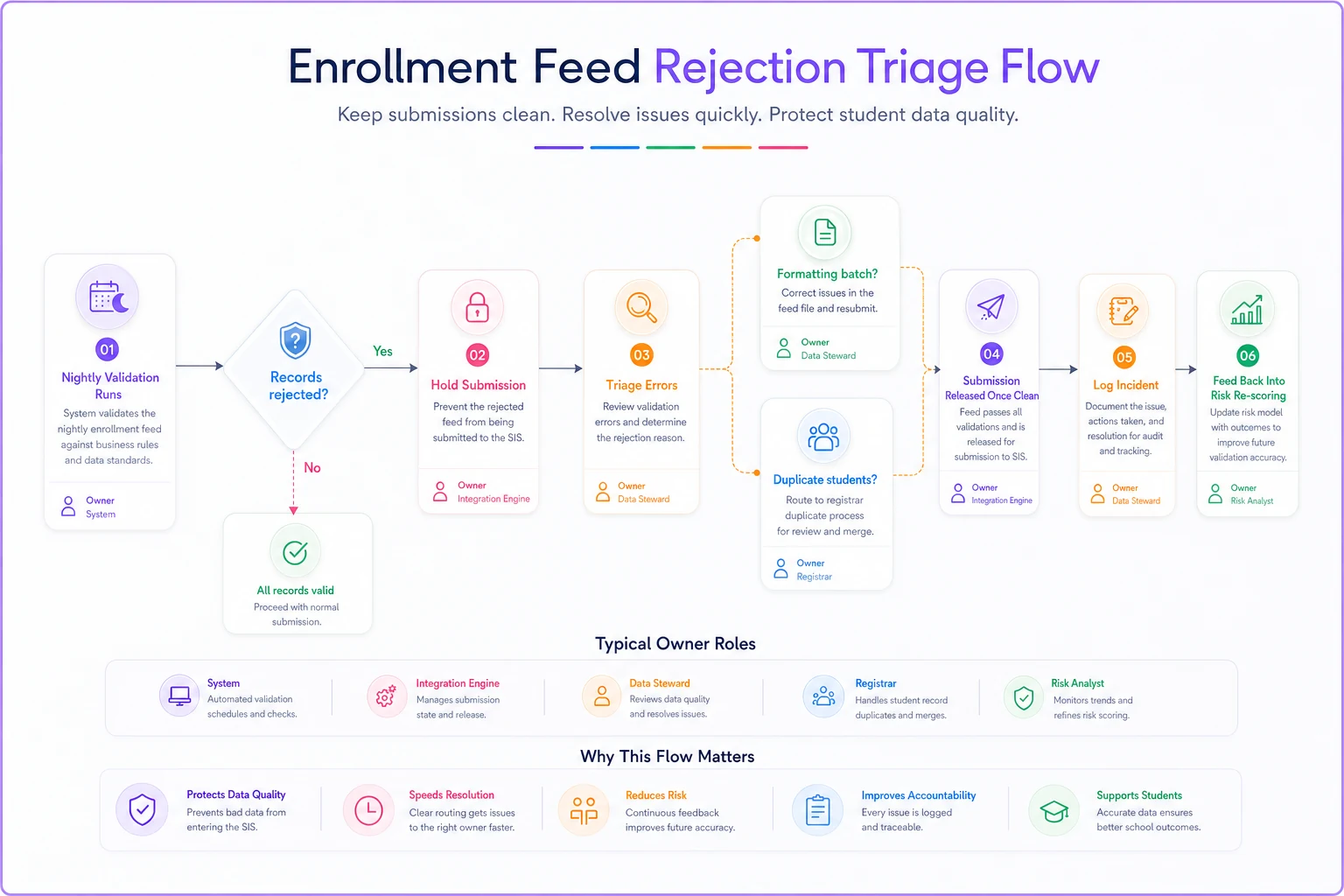
Each step maps to a named owner, which is what makes the sequence repeatable regardless of who's running it that week.
Where software earns its place (and where it doesn't)
You can run a basic version of this on spreadsheets, and small schools should start there. Don't buy a platform to solve a problem you haven't manually understood yet.
Where tooling genuinely helps is the part humans are bad at: remembering to check things on schedule and noticing slow-burn failures. The controls that fail quietly — the sync that stopped, the export that's been throwing the same warning for two weeks — are exactly where automated monitoring pays for itself. An operational platform with AI-assisted monitoring can watch those SLOs continuously, flag a breach when it happens, and route the right playbook to the right owner instead of waiting for someone to notice three weeks later.
Automate monitoring for slow-burn failures first, after you've nailed owners and playbooks.
The point isn't to automate judgment. It's to automate the watching so your staff spends attention on decisions that actually need a human. When a control breaches, a person still decides. The software just makes sure the breach doesn't sit undetected.
When this makes sense: you're multi-campus, you have real turnover, or you've already had one "how did nobody catch this" incident.
When it doesn't: you're a single small school where the whole ops team can see every problem within a day. Manual is fine. Build the register and playbooks first; add tooling when scale makes manual watching unreliable.
Who should hold off: anyone who hasn't named owners yet. Software on top of unowned risks just generates alerts nobody feels responsible for.
Whether you're running on spreadsheets or a more sophisticated platform, the decision of when to add tooling should follow the same logic — manual first, automated when the manual version is already breaking down.
A real scenario
A mid-sized district — four campuses, roughly 2,800 students — kept getting burned by the same category of problem: failures that surfaced weeks after they happened. In one stretch, grade-sync had been partially broken for close to three weeks before anyone noticed, and a batch of immunization exceptions had gone untriaged long enough that around 40 students were technically out of compliance heading into a state visit.
They didn't buy anything at first. They built a 22-line risk register, added the detectability factor to scoring, and wrote six short playbooks for their highest-scoring quiet risks. Just doing that reshuffled priorities — the loud stuff they'd been focused on dropped, and three data-integrity risks jumped to the top.
Over the following couple of terms, silent-failure incidents dropped from something happening most months to roughly one a quarter, and the ones that did happen got caught in days instead of weeks. The immunization backlog that used to spike before every audit basically flattened out because the control had an owner and a 5-day SLO instead of being "whenever the nurse gets to it."
The lesson wasn't the tool. It was that detectability plus a named owner plus a short playbook did most of the actual work.
Making it survive turnover
The final test of any framework is what happens when the person who built it leaves. If the register, controls, and playbooks all live in one head or one private drive, you've built a single point of failure dressed up as a risk program.
A few things keep it alive:
-
Every playbook names a backup, not just a primary owner
-
SLOs are visible to leadership, so a breach is a shared fact rather than a private discovery
-
The register gets re-scored on a real cadence so it never rots into the museum piece version
-
Incidents feed back into scoring — every "how did we miss that" becomes a new line or a tightened SLO
Continuity is the whole reason to do this. The framework isn't there to look good in an audit; it's there so the immunization export still works when the person who understood it is out for surgery. If you're building this alongside broader continuity planning, the School Operations Resilience Playbook covers how these controls hold up when attendance, registration, and parent communication all get stressed at once.
Where to start
Don't try to build the perfect register. Start with the last three things that genuinely went wrong in your building and reverse-engineer them: what was the risk, what control should have caught it, what target would have made the catch fast, and what would you do next time. That's four columns and three rows — you've started.
From there it grows one incident at a time. A framework built from your real failures beats a comprehensive one copied from a template every time, because it reflects how your operation actually breaks, and it's owned by the people who'll actually run it when it does.
From there it grows one incident at a time. A framework built from your real failures beats a comprehensive one copied from a template every time, because it reflects how your operation actually breaks, and it's owned by the people who'll actually run it when it does.
Ready to optimize your school operations?
Join hundreds of schools using GoSkoly to save time, improve collaboration, and enhance student outcomes.