

Most districts don't have an operations problem. They have a sequencing problem. When something breaks — a state submission bounces, fees don't reconcile, a parent emergency message goes to the wrong list — the instinct is to fix that one thing hard and fast, then move on. Six months later the same category of failure reappears in a slightly different form, and nobody can explain why the fix didn't hold.
Almost always, the fix was applied at the wrong maturity level. You can't bolt SLAs onto a process that doesn't have clear ownership yet. You can't automate a workflow nobody has documented. And you absolutely cannot promise a superintendent "reliable reporting" when your underlying data lineage is a verbal agreement between two people who happen to trust each other.
A maturity model gives you a way to stop guessing. It tells you where each operational domain actually sits today, what the next realistic step looks like, and — critically — who owns the checkpoint that proves you got there. This isn't about scoring your district to feel bad about the results. It's about knowing whether attendance operations are at a different level than finance reconciliation, and refusing to invest in advanced work where the foundation isn't poured yet.
Why maturity gets uneven across a district
Maturity is never uniform — worth naming that upfront. A district can run a tight, almost obsessive immunization compliance process while its device inventory lives in three disconnected spreadsheets. Both sit under the same cabinet, same budget, same leadership. One domain got attention; the other didn't.
This happens for understandable reasons. Domains mature where there's regulatory pressure, a painful past incident, or a single motivated owner who refused to let it stay messy. Domains stall where ownership is ambiguous, where the work crosses two departments, or where "it mostly works" was good enough during a crunch and nobody circled back.
The problem is that an organization moves at the speed of its weakest coordinated domain. State reporting can be flawless, but if the enrollment data feeding it is still Level 1, your "mature" reporting is just a clean pipe carrying dirty water. The K–12 operational data strategy only pays off when the domains feeding it are sequenced together — not in isolation.
So the first honest step is accepting that you're not going to assign one maturity score to the whole district. You're going to assess domain by domain, and you're going to find gaps that make some people uncomfortable. That discomfort is exactly the point.
The four-stage ladder
The model has four stages. The names matter less than what has to be true to claim each one — which is why every stage is defined by artifacts, not opinions. If you can't produce the artifact, you're not at that stage, no matter how confident the department head sounds.
Eliminate administrative overload.
GoSkoly helps you manage schedules, attendance, and communications seamlessly.
- Unified student and staff management
- Automated attendance tracking
- Integrated communication tools
No credit card required
| Stage | What's true operationally | Required artifacts | Owner checkpoint |
|---|---|---|---|
| 1 – Ad hoc | Work gets done through individual knowledge and memory. No written process. | None required; informal notes at best | A named person who can do the task (even if undocumented) |
| 2 – Defined | The process is written down and repeatable by someone other than the original owner. | Runbook, role assignment, basic data lineage map | Process owner signs off that the runbook is current |
| 3 – Measured | The process has targets and you can tell when it's failing before someone complains. | SLAs/SLOs, monitoring, exception log, escalation path | Owner reviews metrics on a defined cadence |
| 4 – Optimized | The process self-corrects, feeds improvement cycles, and survives staff turnover. | Trend reporting, documented improvement history, cross-training records | Owner reports to a governance body; improvements are evidenced |
The jump people underestimate is Stage 1 to Stage 2. Writing the runbook feels like busywork when "everyone already knows how to do it." But Stage 1 is where your entire district is one resignation away from an operational cliff. The whole value of Stage 2 is that the knowledge stops living in one person's head.
The jump people overestimate is Stage 3 to Stage 4. A lot of districts think they're optimizing because they generate reports. Reports aren't optimization. Optimization means the trend data actually changes what you do next quarter. If last year's exception log looks identical to this year's, you're at Stage 3 wearing a Stage 4 label.
Artifacts are the proof — not the paperwork
The temptation with any maturity model is to treat the artifacts as a checklist to satisfy an auditor. That's backwards. Each artifact exists because it prevents a specific failure mode.
Data lineage matters because when a number is wrong, the first question is always "where did this come from?" Without lineage, every data dispute becomes an archaeology project. A district that can trace a funding-claim figure back through the attendance snapshot, the SIS roster, and the original intake form resolves disputes in an afternoon. A district without that traces it for a week — and sometimes never fully trusts the answer.
SLAs matter because they convert "we try to respond quickly" into something measurable and ownable. An SLA that says records requests get an acknowledgment within two business days and a response package within the statutory window turns a vague obligation into a tracked commitment with a clear owner.
Runbooks matter because they're what let a substitute, a new hire, or a cross-trained colleague carry the process when the primary owner is out. A good runbook includes the unglamorous stuff: which report to pull, what "normal" looks like, what to do when the numbers don't match, who to escalate to.
A quick sanity check: hand the artifact to someone who doesn't do the job and ask them to perform the task. If they can't, the artifact is decorative. This is the same discipline behind a serious operational risk framework — controls only count if they actually work when tested, not when described.
The lightweight self-assessment
You don't need a consultant or a quarter-long study to get started. You need about 90 minutes and the right people in the room. Here's how the process typically flows from raw domain list to a prioritized action map:
> [GRAPH: Workflow showing the self-assessment process — starting from listing operational domains, moving through artifact-based questioning for each domain, assigning a stage based on confirmed artifacts, naming a real owner per domain, identifying the single next artifact, and ending with plotting domains against each other to surface sequencing priorities]
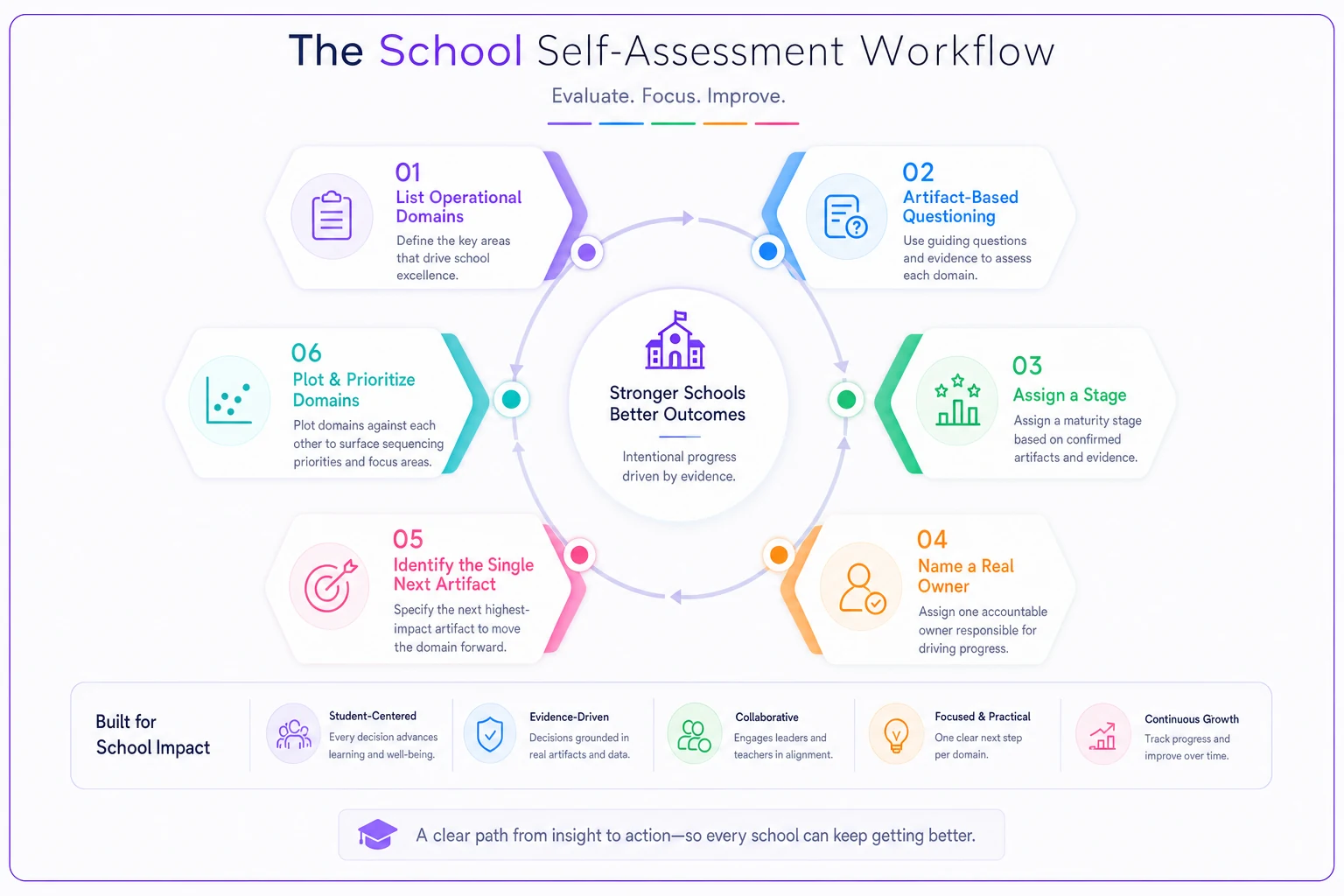
The diagram above lays out the main checkpoints and the flow from domains to a prioritized sequencing map.
The steps themselves are straightforward:
-
List your operational domains. Keep it to real categories
attendance, enrollment, finance reconciliation, state reporting, data governance, device/inventory, parent communications, records/compliance, scheduling. Most districts land somewhere between nine and fourteen.
-
For each domain, ask the artifact questions — not the opinion questions. Don't ask "how mature is enrollment?" Ask "can you show me the enrollment runbook?" and "is there a documented SLA for resolving duplicate records?" The artifact either exists or it doesn't.
-
Assign the stage based on the highest level where ALL required artifacts exist. This is strict on purpose. If a domain has runbooks and SLAs but no monitoring, it's Stage 2, not Stage 3. Monitoring is what makes Stage 3 real.
-
Name an owner for the next checkpoint — a real person, not a department. "IT" doesn't own anything. A named individual does. If you can't name one, that's your actual finding for that domain.
-
Record the single next artifact that moves the domain up one stage. Not three artifacts. One. The next concrete thing.
-
Plot the domains against each other. Now you can see the unevenness. Domains sitting two stages below the ones that depend on them are your sequencing priorities.
A short checklist to run the assessment cleanly
-
- [ ] Every domain has a named owner (person, not team)
-
- [ ] Stage claims are backed by a document you can actually open
-
- [ ] Each domain has exactly one identified "next artifact"
-
- [ ] Dependencies are noted (which domains feed which)
-
- [ ] Nothing is marked Stage 3+ without monitoring in place
-
- [ ] The assessment is dated and scheduled to be re-run
The output isn't a grade. It's a map showing where your foundation is thin under something you're currently treating as solid.
Sequencing: the part everyone skips
Once you can see the map, the real work is deciding what to improve first. And the honest answer is almost never "the lowest-scoring domain." It's the lowest-scoring domain that something important depends on.
Think in dependency order. Data governance and lineage sit underneath nearly everything. If your data governance domain is Stage 1 but your state reporting is Stage 3, you have fragile reporting — because reporting can only be as reliable as the inputs feeding it. Fixing reporting further is wasted motion. Fixing the governance underneath it is what actually protects the reporting.
-
First domains that feed many others (data governance, enrollment/roster integrity, identity)
-
Second domains with regulatory or financial exposure (records requests, compliance, finance reconciliation)
-
Third domains that are painful but contained (scheduling, inventory, device loans)
-
Last pushing an already-strong domain from Stage 3 to Stage 4 while weaker domains sit at Stage 1
That last point is where a lot of improvement budget quietly disappears. A motivated department keeps polishing what it's already good at — because that's where it has momentum and confidence — while the actual risk sits in a neglected corner nobody wants to open.
A real scenario: a mid-sized district's uneven map
A district of roughly 6,000 students ran this assessment across eleven domains over two afternoons. Their expectation going in was that finance would be the problem child — it's where they felt the most pain day to day.
The map said something different. Finance reconciliation was actually sitting at a solid Stage 3: runbooks, defined SLAs, monthly exception reviews. The pain wasn't because finance was immature. It was because the enrollment and roster domain feeding it was at Stage 1 — no runbook, no lineage, corrections happening by email and memory. Every reconciliation headache traced back upstream to data that arrived inconsistent.
They'd spent the prior year investing in finance tooling and reporting. Looking at the map, that was the wrong sequence. The right move was to pull roster integrity up to Stage 2 first.
The intervention was unglamorous: one named owner, one runbook for duplicate and correction handling, and a basic lineage note showing where roster changes originated. About six weeks of part-time effort. Reconciliation exceptions dropped by roughly a third over the following two cycles, and the finance team stopped burning the first week of every month chasing mismatch sources. The reporting they'd already built started looking trustworthy, because the data coming through was finally clean.
The takeaway: the squeakiest domain isn't always the broken one. Sometimes it's the symptom of a quieter domain two steps upstream.
When this model actually helps — and when it doesn't
When it makes sense. This approach earns its keep when you have multiple domains, multiple owners, and a persistent sense that you're always fixing the same categories of problems. It's especially useful right after a leadership transition, before a budget planning cycle, or when you're trying to justify where improvement dollars should go rather than just that they're needed.
When it's a bad idea. If you're in the middle of an active incident, this is not the moment to run a maturity assessment. Stabilize first. The model is a planning tool, not a firefighting tool. Running a structured assessment while a reconciliation crisis or a reporting deadline is on fire just adds overhead to a stressed team. It also doesn't do much for a very small operation where one or two people genuinely handle everything — at that size, the ceremony outweighs the benefit, and a plain resilience and continuity plan is a better use of the hour.
Who should not run this alone. The person who owns the most domains should not be the sole assessor. They'll grade their own work generously — not out of dishonesty, but because they know the undocumented steps that make it "work." Pair them with someone who has to use the artifacts but doesn't produce them. That tension is where honest scores come from.
Keeping the model honest over time
A maturity assessment done once is a snapshot that goes stale fast. Domains that improve tend to drift back down when the motivated owner moves on, when the runbook stops getting updated, or when a reorg scrambles ownership. Stage 4 isn't a destination you reach and leave — it's a level you have to actively defend.
Re-run the assessment on a schedule. Twice a year is enough for most districts, with a lighter mid-cycle check on domains you actively changed. Keep the dated versions. The most useful artifact of all turns out to be the history of your maturity map — it shows which investments actually moved a domain up and held, versus which ones bounced back the moment attention shifted.
That history is also what makes the whole thing credible to a board or cabinet. "We improved roster integrity from Stage 1 to Stage 3 over the year — here are the artifacts and the exception trend" is a very different conversation than "we think things are better now." One is evidence. The other is a feeling.
The maturity model isn't a framework you adopt for its own sake. It's a way to stop spending effort where you already have coverage and start spending it where the foundation is actually thin. Most districts already know, somewhere, which domains keep them up at night. This just makes that knowledge visible, ownable, and ordered — so the next improvement you make is the one that actually holds.
The maturity model isn't a framework you adopt for its own sake. It's a way to stop spending effort where you already have coverage and start spending it where the foundation is actually thin. Most districts already know, somewhere, which domains keep them up at night. This just makes that knowledge visible, ownerable, and ordered — so the next improvement you make is the one that actually holds.
Ready to optimize your school operations?
Join hundreds of schools using GoSkoly to save time, improve collaboration, and enhance student outcomes.