
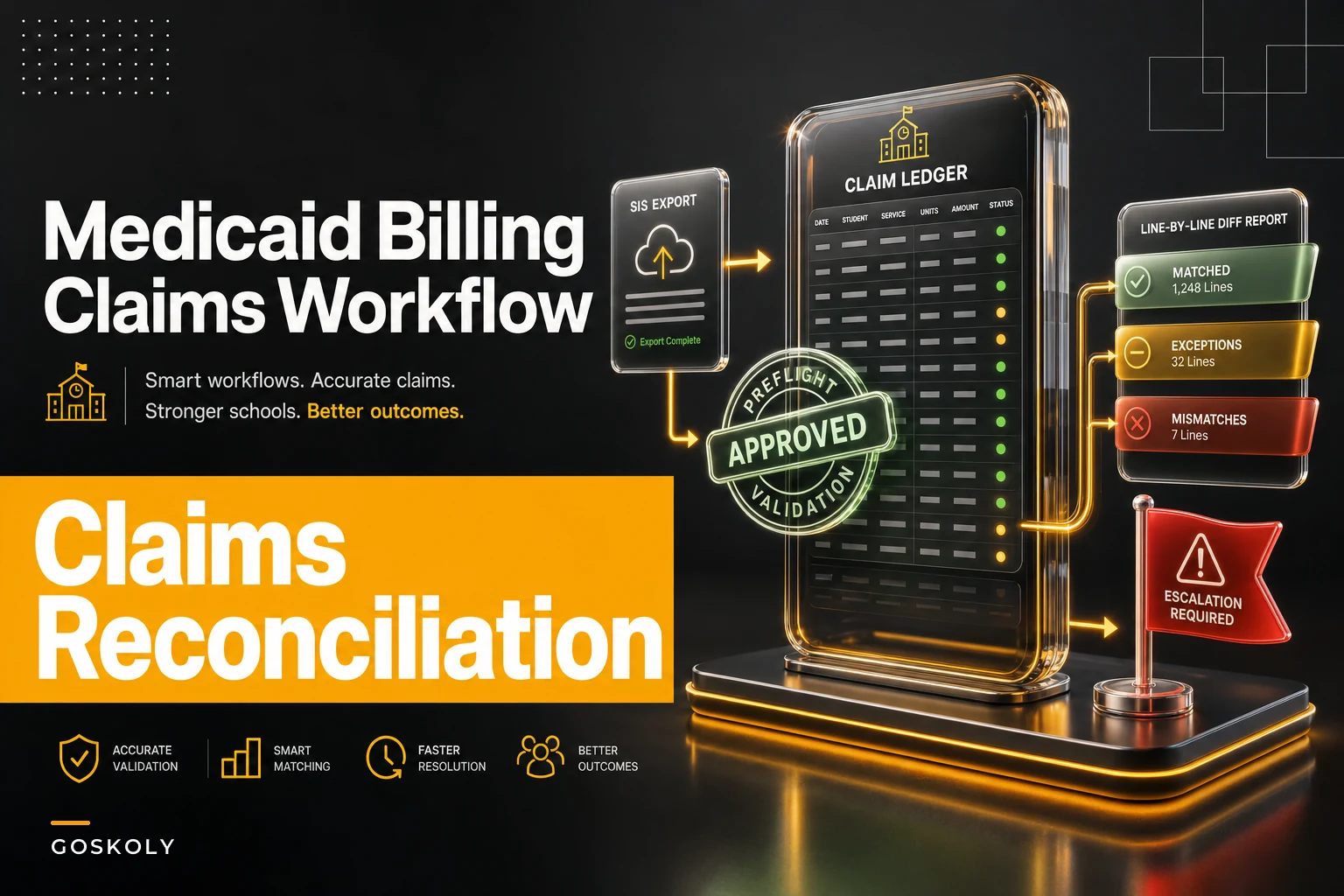

Most districts bill a fraction of the Medicaid-reimbursable services they actually deliver. Not because the services aren't happening, but because the paper trail falls apart somewhere between the therapist's session notes and the claim submission file. A speech-language pathologist runs 22 sessions a week, documents all of them, and maybe 15 make it into a clean claim. The other seven die quietly — missing a consent date, a service code that didn't map, a provider credential that lapsed two months ago and nobody caught.
This article is narrowly about one thing: building a reliable workflow that captures service events from your SIS exports, validates them before submission, and reconciles what the state actually paid against what you claimed. Not Medicaid policy in general. Not whether you should bill at all. The mechanics of capture → validate → reconcile, which is where almost all the lost money and almost all the denials actually live.
Where the money actually leaks
If you trace a denied or never-submitted claim backward, it almost always breaks at one of four joints. Worth naming them plainly because the fix for each is different.
Joint 1: The event never gets captured in a billable form. The service happened. The provider wrote a note in their therapy log or a Google Doc. But nothing structured flowed into a billing-ready record. The session exists as prose, not as a row with a student ID, service date, duration, CPT/HCPCS code, and rendering provider.
Joint 2: Consent is missing, expired, or can't be proven. Parental consent for Medicaid billing is a hard gate. In a lot of districts, consent lives in a signed PDF in a cabinet or a checkbox in the SIS that nobody keeps current. When the service date falls outside the consent window — or the consent form on file is the wrong version — the claim is dead on arrival, but you often don't find out until the state rejects it weeks later.
Joint 3: The claim gets submitted with a field that fails a rule the state enforces. Wrong NPI, a diagnosis code that doesn't support the procedure, a service date on a day the student wasn't enrolled, a provider whose license wasn't active on the date of service. These are all knowable before submission. They get caught after submission because nobody ran the check first.
Joint 4: The remittance comes back and nobody reconciles it line by line. You submitted 340 claims. The state paid 298. Someone looks at the total deposit, sees a number that's roughly in the right range, and moves on. The 42 that were adjusted or denied never get worked, and the same root causes repeat next month.
What ties all four together: the service delivery system and the billing system are different worlds, run by different people, and the handoff between them is manual. That handoff is where the whole game is played.
Start with event-capture templates keyed to your SIS exports
The most durable fix is to stop treating each provider's documentation as a free-form artifact and standardize it into an event template that already knows what a clean claim needs.
Eliminate administrative overload.
GoSkoly helps you manage schedules, attendance, and communications seamlessly.
- Unified student and staff management
- Automated attendance tracking
- Integrated communication tools
No credit card required
A capture template keyed to your SIS export means every billable service event is recorded in a structure where the fields line up, by name, with what you can pull from the SIS. The student identifier in the therapist's note is the same identifier the SIS exports. The service date format matches. The program/eligibility flag comes straight from the SIS special-education record rather than being re-typed by someone who may or may not get it right.
The practical reason this matters: when your capture format and your SIS export share keys, you can join them automatically and catch mismatches at the source. A session logged for a student who isn't flagged special-ed in the SIS export is an immediate flag — either the flag is wrong or the service shouldn't be billed under this program.
A minimal event-capture template that actually holds up:
-
Student key (the exact SIS identifier, not name)
-
Service date and start/end time (duration gets derived, not hand-entered)
-
Service type + billing code (picked from a controlled list, never typed free-form)
-
Rendering provider + their credential identifier
-
Location/setting code
-
IEP/service-plan reference tying the event to an authorized service
-
Consent status snapshot at time of service
-
Progress note / narrative (required for documentation, but separate from the billable fields)
The mistake we see constantly is building this template around what the therapist finds convenient to write, instead of around what the claim requires and what the SIS can confirm. Design it backward from the claim file and the SIS export, and the capture step does double duty — documentation and billing-readiness in one pass. The connection between the service plan and the billable event is the same discipline that makes an IEP documentation workflow hold together: the authorized service and the delivered service have to reference each other, not float independently.
Design capture templates around the claim file and SIS export keys so joins and automated checks become trivial.
The diagram below shows the capture → preflight → reconcile workflow.
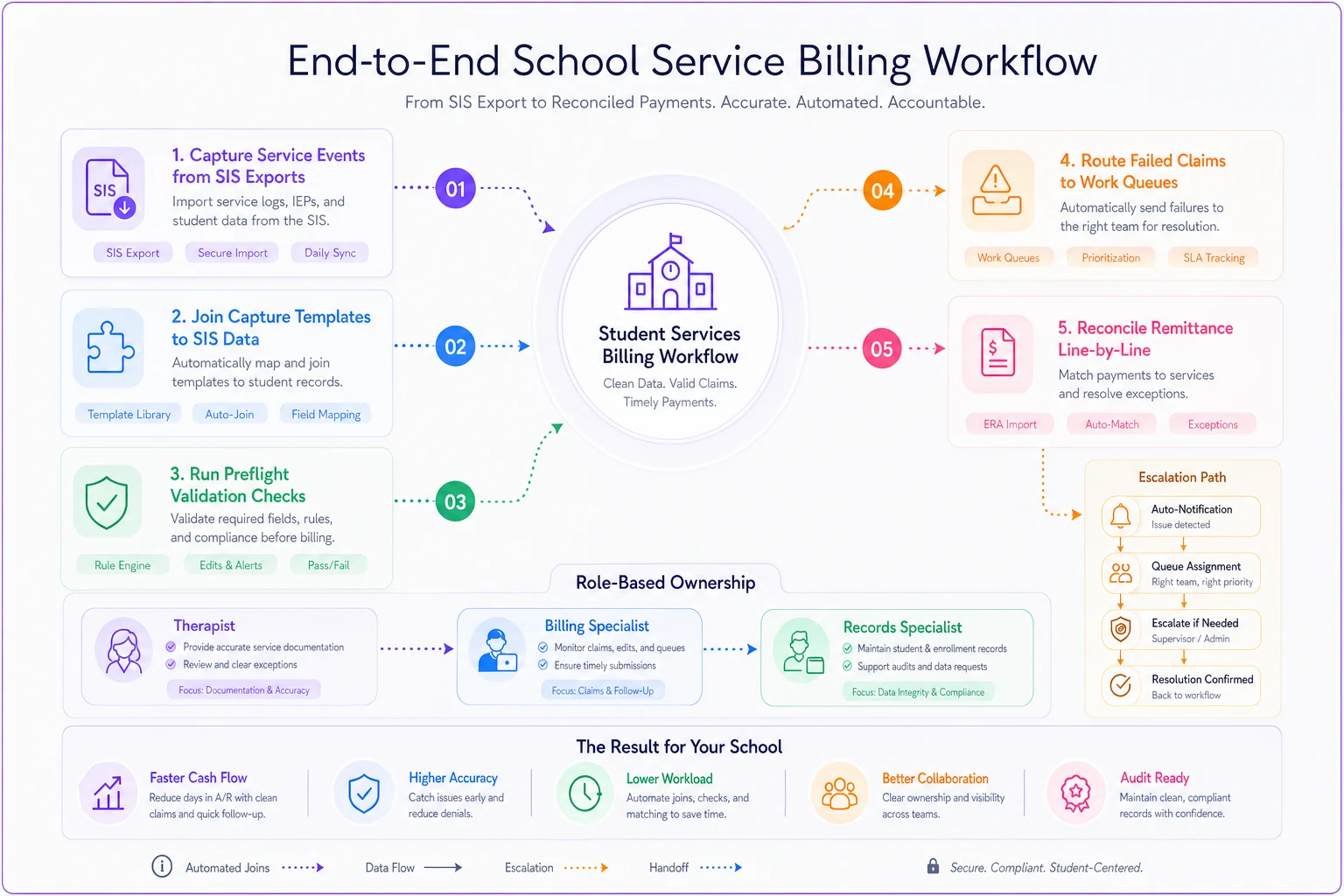
Use this as a visual reference for how the pieces connect.
Consent and extraction fields: the gate before anything else
Consent is the single most common reason clean, well-documented services never turn into revenue. And it's almost always avoidable.
The issue is that consent is usually stored as a fact ("we have a signed form") rather than as a dated, versioned, student-linked record you can check against a service date. Those are very different things. The first tells you a form exists somewhere. The second tells you whether this specific session on this specific date is billable.
Treat consent as an extraction field that travels with the event. For each billable event, the capture process should pull:
-
Consent on file
yes/no
-
Consent effective date and any expiration/renewal date
-
Consent form version (because requirements change and old versions sometimes stop qualifying)
-
Scope — does the consent cover the service types being billed?
A session dated November 12 against a consent that expired October 1 is a non-starter, and you want to know that on November 12, not in February when the remittance comes back. Extraction fields let you run that comparison automatically instead of trusting that someone checked a cabinet.
One pattern worth flagging: districts frequently collect consent once at IEP initiation and never revisit it. Then they lose track of which students have consent that's gone stale, or which incoming students never had it collected at all. A simple recurring extract — every student with an active service plan, their consent status, effective and expiration dates — surfaces the gaps before they cost you claims. Students with services being delivered but no valid consent on file are your immediate work queue.
Claim preflight validation: catch the failures before you submit
This is the highest-leverage step and the one most districts skip entirely. Preflight validation means running every claim through the state's known rejection rules before it goes into the submission file — the same way you'd check a form for errors before hitting send, except systematically and against every rule the payer actually enforces.
The point isn't to guess what the state will reject. Most rejection reasons are deterministic and published. You can encode them.
A preflight pass should check, at minimum:
| Check | What it catches | Why it fails post-submission otherwise |
|---|---|---|
| Student eligibility on service date | Billing for a day the student wasn't Medicaid-eligible or enrolled | State matches enrollment/eligibility files; mismatch = denial |
| Provider credential active on date | Expired license, lapsed credential | Service by unqualified-on-date provider is non-reimbursable |
| Consent valid for date + service type | Expired/missing/out-of-scope consent | Hard denial, often with recoupment risk |
| Code-to-service alignment | Procedure code doesn't match documented service | Denied as unsupported |
| Diagnosis supports procedure | Missing or non-supporting dx code | Denied as medically unnecessary |
| Duration meets code minimums | Session shorter than the code requires | Downcoded or denied |
| Duplicate service same day | Two claims for the same service/student/date | Denied as duplicate |
| NPI / provider ID present and valid | Missing or malformed identifier | File-level rejection |
A claim that fails preflight should never enter the submission file. It should route to a work queue with the specific reason attached, so the person fixing it knows exactly what's wrong — "consent expired 10/01" is actionable, "claim denied" three weeks later is not.
This is also where the economics flip. A denied claim that comes back from the state costs staff time to research, re-document, and resubmit — often more than the claim is worth. A claim caught in preflight costs a two-minute fix. The entire value of this step is moving the correction from after submission (expensive, delayed, sometimes unrecoverable) to before submission (cheap, immediate).
Diff reconciliation: match what you claimed against what they paid
Submitting is only half the loop. The remittance advice that comes back tells you what the state actually adjudicated, and if you're not reconciling that against what you submitted — line by line, claim by claim — you're flying blind on your biggest controllable revenue number.
A diff reconciliation report does exactly one thing: it joins your submitted claims to the remittance and flags every line where they disagree. Three buckets come out of it:
-
Paid as submitted — no action.
-
Adjusted — paid at a different amount or downcoded. Needs a human to decide whether to accept or appeal.
-
Denied / not adjudicated — the ones that need rework and resubmission, each with a reason code.
The reason codes are gold, because they roll up. If 18 of your 42 denials this cycle share the same reason — say, consent-related — that's not 18 individual problems, it's one upstream process failure in your capture or consent step. Reconciliation isn't just about recovering this month's money; it's the feedback signal that tells you which joint is leaking so you can fix the template, not just the claim.
This is the same muscle as any ledger reconciliation — the discipline of matching two systems line by line when they don't agree applies here exactly: never reconcile on totals, always reconcile on individual records, because totals can match while dozens of underlying lines are quietly wrong.
A workable reconciliation cadence:
-
Pull the remittance file as soon as it posts.
-
Auto-join to the submitted-claims batch by claim ID.
-
Generate the three-bucket diff.
-
Route adjusted/denied lines to owners by reason code.
-
Tag each denial with a root-cause category that maps back to a workflow step.
-
At month-end, roll up denial reasons and feed the top three back into capture/preflight.
Reconciliation isn't just about recovering money this month; it's about feeding the top issues back into capture and preflight so the same mistakes stop repeating.
Owner escalation rules for denied claims
A denial that lands in a shared inbox with no owner is a denial that never gets worked. The difference between districts that recover denied claims and districts that don't is almost entirely about routing and ownership, not effort.
-
Consent denials → special-ed records owner, because the fix is a consent record, not a billing edit.
-
Credential/provider denials → whoever maintains provider credentialing.
-
Eligibility denials → the person who reconciles enrollment/eligibility files.
-
Coding/documentation denials → the rendering provider or billing specialist.
-
Anything unresolved past its window → escalate to the program coordinator.
Attach an aging clock. A denial sitting 30+ days without action escalates automatically. Many Medicaid claims have hard timely-filing and appeal windows, and a denial you discover too late to appeal is a permanent loss — which is exactly why reconciliation has to be prompt and ownership has to be explicit.
Denials don't get recovered because someone tried harder. They get recovered because the denial reached the one person who could actually fix it, fast enough to matter. Route by reason, assign an owner, start a clock. The same owner-mapped, evidence-ready approach that makes audit preparation manageable applies here — when every denial has a named owner and a documented resolution trail, your billing records become audit-ready as a byproduct rather than a separate scramble.
A short real scenario
A mid-sized district — around 8,000 students, roughly 60 billable related-service providers across speech, OT, PT, and counseling — was submitting Medicaid claims but running on totals-level review only. They submitted, the deposit came in, and nobody worked the gap.
When they finally reconciled a few cycles line by line, the picture was ugly but fixable. Of roughly 1,100 claims a month, somewhere between 180 and 200 were coming back denied or adjusted. A big chunk — maybe 40% of the denials — traced to two root causes: stale consent records and a handful of providers whose credential dates weren't being checked against service dates.
Neither problem was hard once it was visible. They added consent effective/expiration fields to the capture template and a preflight check that compared service date to both consent validity and provider credential status. Within two or three cycles the denial rate dropped by more than half, and the recovered revenue — claims that previously just evaporated — was in the low tens of thousands per year. No new services delivered. Same providers, same students. They just stopped submitting claims that were predictably going to fail, and started actually working the ones that came back.
When this level of rigor makes sense — and when it doesn't
Build the full capture → preflight → reconcile loop when: you have more than a handful of providers, you're billing enough volume that denials add up, and multiple people touch the process between service delivery and submission. At that scale the manual handoff is where the money dies, and structure pays for itself fast.
Keep it lighter when: you're a very small district with one or two providers and low claim volume. A clean spreadsheet with consent dates and a manual remittance check may genuinely be enough. Don't build a reconciliation engine for 30 claims a month.
Who should not do this halfway: if you're going to bill Medicaid at all, don't skip preflight validation and reconciliation. Submitting without preflight and never reconciling is the worst of both worlds — you carry the compliance exposure of billing while leaving most of the recoverable revenue on the floor and never learning why.
The honest takeaway
The services are already happening. Therapists are already documenting them. The reimbursement gap almost never comes from under-delivery — it comes from the capture, consent, validation, and reconciliation steps being manual, disconnected, and unowned.
Key your capture templates to the SIS so service events and student records can actually be joined. Treat consent as a dated, checkable field rather than a form in a drawer. Preflight every claim against the rules the state already publishes. Reconcile the remittance line by line and route every denial to a named owner with a clock running. Do those four things and the money that's been quietly leaking out of the handoff stops leaking.
Ready to optimize your school operations?
Join hundreds of schools using GoSkoly to save time, improve collaboration, and enhance student outcomes.