


School audits feel designed to break you. Not because auditors are evil (they're actually pretty reasonable), but because gathering evidence from seventeen different systems while maintaining normal operations is basically impossible.
A charter school network I know burned through three weekends pulling enrollment verification docs last spring. Their business manager had sticky notes covering her monitor with database queries, export instructions, and file paths. She'd built this entire manual system to remember which reports came from PowerSchool, which from their SIS, which from the state portal. Every audit season, she'd recreate the same reports, manually compile the same evidence binders, and pray nothing had changed since last year.
Most schools operate exactly like this. They treat audit prep like an annual emergency instead of a predictable operational process.
Why evidence assembly becomes a three-alarm fire
Picture your typical audit request arriving in February. The state wants enrollment verification, attendance records, special education compliance docs, financial reconciliations, staff certifications, and student performance data. Standard stuff, really.
Your registrar knows enrollment lives in PowerSchool. But wait - special ed enrollments are tracked separately in the IEP system. International students have their own spreadsheet. Dual enrollment students exist in the community college's database. So "pull enrollment data" turns into a four-system archaeology project.
Your attendance clerk discovers that daily attendance exports don't match the monthly summaries because someone changed the tardy threshold in October. Now she's manually reconciling 4,000 attendance records to explain a 0.3% variance that nobody actually cares about.
Your SPED coordinator realizes half the required documentation lives in email attachments because the official system only stores final IEPs, not the meeting notes auditors want to see. She starts forwarding emails from 2023 to herself to build a searchable archive.
The business office discovers that expense categorizations changed mid-year when you switched accounting software. They're building crosswalk spreadsheets to map old categories to new ones, turning what should be a simple export into a forensic accounting exercise.
This cascade of complications is the default state. Schools use between 8 and 15 different operational systems. Each system owns a piece of the compliance puzzle. None of them talk to each other. So audit prep becomes a massive manual integration project performed under extreme time pressure.
The hidden operational damage of audit scrambles
Beyond the obvious time sink, these audit fire drills create lasting operational problems.
Eliminate administrative overload.
GoSkoly helps you manage schedules, attendance, and communications seamlessly.
- Unified student and staff management
- Automated attendance tracking
- Integrated communication tools
No credit card required
Institutional knowledge evaporates. That registrar with the sticky note system? When she leaves, her replacement starts from zero. No documentation exists because the process lived entirely in her head. The new person spends their first audit season just figuring out where data lives.
You get compliance theater instead of actual improvement. Teams focus on assembling evidence rather than fixing underlying issues. A school might spend 40 hours documenting attendance reconciliation problems instead of 10 hours fixing the root cause in their attendance tracking system.
Normal operations grind to a halt. During audit season, the registrar stops processing new enrollments. The attendance clerk delays absence follow-ups. The business office postpones vendor payments. You're essentially running at 60% capacity for two months because key staff are buried in evidence assembly.
Building an owner-mapped export framework
Schools that handle audits smoothly share one characteristic: they've mapped every common audit request to specific system exports and assigned clear ownership.
-
Enrollment and demographics
-
Attendance and engagement
-
Academic performance
-
Special programs compliance
-
Financial documentation
-
Staff credentials
-
Facilities and safety
For each request type, document five things:
System of record: Which database holds the authoritative data? Not "enrollment is in PowerSchool" but specifically "official enrollment counts come from PowerSchool's October 1 snapshot stored in the ADA_SNAPSHOT table."
Export process: Exact steps to generate the report. Not "run enrollment report" but "Admin > Reports > State Reports > Enrollment Verification > Select October 1 snapshot > Export as CSV > Save to Audit_Evidence folder."
Data owner: Who maintains this data's accuracy? The registrar might run the export, but the attendance clerk might own the underlying data quality.
Validation checks: What confirms the data is complete? "Total enrollment should match Board Report figure from October meeting minutes."
Assembly timeline: How long does this evidence actually take to compile? Not the optimistic estimate - the real timeline including validation and formatting.
This is what it looks like for a typical enrollment verification request:
| Audit Request | System Location | Export Path | Owner | Validation | Real Timeline |
|---|---|---|---|---|---|
| October 1 Enrollment | PowerSchool ADA_SNAPSHOT | Admin > State Reports > Oct 1 Verification | Registrar | Match board report (Oct minutes p.4) | 2 hours (1 hr export, 1 hr validation) |
| SPED Enrollment | Frontline IEP > Reports | Compliance > Active IEPs > Date Range | SPED Coordinator | Count matches PowerSchool SPED flag total | 4 hours (includes manual status checks) |
| Dual Enrollment | CC Portal + Manual List | Download from partner portal + reconcile | Counseling | Total ≤ 50 students per state cap | 6 hours (requires partner college coordination) |
| McKinney-Vento | PowerSchool + Case Files | Custom field export + homeless liaison docs | Social Worker | Match with district homeless count | 8 hours (documentation scattered) |
The realistic timelines are crucial. Most schools estimate based on perfect conditions, then scramble when reality hits.
Critical export configurations to implement now
Most student information systems can automate 70% of audit evidence generation, but schools rarely configure these capabilities properly.
Snapshot scheduling: Configure your SIS to automatically capture enrollment snapshots on critical dates. October 1, December 1, end-of-semester, state testing windows. These snapshots become your historical record, eliminating the "what was enrollment on X date?" scramble.
Automated reconciliation reports: Build queries that compare data across systems. Enrollment in PowerSchool versus active students in your LMS. Attendance percentages versus grade reports. These reconciliation reports catch discrepancies before auditors do.
Document retention rules: Set up automated document collection for commonly requested evidence. IEP meeting notes, discipline documentation, attendance intervention records. Create a parallel archive that preserves these documents outside of email and personal drives.
Certification tracking: Stop chasing teacher licenses manually. Configure your HR system to track expiration dates and automatically compile certification reports. Include substitute teacher credentials - auditors love catching schools with expired sub licenses.
The reality of automated evidence assembly
A mid-sized district transformed their audit prep from a 200-hour scramble to a 30-hour process. But it wasn't magic - it was systematic operational improvement.
They started by documenting every export process in excruciating detail. Screenshots of every screen, every dropdown selection, every filter criteria. The documentation felt excessive until their experienced registrar took medical leave two weeks before audit season. Her replacement successfully generated every required report using only the documentation.
They built automated data quality checks. Every Monday, queries run to identify students enrolled with missing demographic data, attendance records without corresponding enrollment, special program flags without supporting documentation, staff assignments without current certifications, and financial transactions lacking proper categorization.
These checks run year-round, not just during audit season. Problems get fixed immediately instead of discovered under audit deadline pressure.
They centralized evidence storage. Instead of reports scattered across personal folders, network drives, and email, everything flows to a structured audit evidence repository. Folders organized by year, audit type, and request category. When auditors request "three years of October enrollment," it's a simple folder navigation, not a system archaeological dig.
The game-changer was their automated assembly process. They built simple workflows that triggered two weeks before known audit dates:
-
Run all standard exports
-
Save to designated folders with consistent naming
-
Generate variance reports comparing to previous periods
-
Flag any anomalies for review
-
Compile into preliminary evidence packages
The automation doesn't replace human review, but it eliminates the mechanical work. Staff spend time explaining variances and addressing findings, not wrestling with report generation.
Common audit requests by category
Every school faces slightly different audit requirements, but certain requests appear everywhere. The operational reality of handling the most common ones:
Enrollment Verification
Auditors want point-in-time enrollment counts, demographic breakdowns, and program participation rates. The challenge isn't generating these numbers - it's ensuring consistency across all reports. Your October 1 count better match what you reported for funding, what appears in board minutes, and what your accountability reports show.
Export configuration: Create saved report templates for standard date ranges. Include filters for grade level, program participation, demographic categories. Never manually recreate these reports - use the saved templates to ensure consistency.
Attendance Documentation
Beyond basic attendance rates, auditors examine chronic absenteeism interventions, truancy procedures, and engagement tracking. They want to see systematic follow-up, not just raw numbers.
The operational trap: Schools often track interventions in separate systems or spreadsheets. When audit time arrives, connecting attendance patterns to intervention efforts becomes a manual matching exercise. Build intervention tracking directly into your attendance system or maintain a formal crosswalk between systems.
Financial Compliance
Expense categorization, vendor documentation, procurement processes. Financial audits go deeper than "did you spend the money correctly?" They examine whether your processes ensure ongoing compliance.
Key evidence: Purchase orders matched to invoices matched to payments. Sounds simple until you realize POs live in one system, invoices in another, and payments in a third. Build monthly reconciliation reports that connect these dots automatically.
Special Education Compliance
IEP timeline adherence, service delivery documentation, progress monitoring. SPED audits focus heavily on process compliance, not just outcomes.
The documentation challenge: Most IEP systems track plans but not implementation. Service logs, progress notes, and parent communications often exist only in email or paper files. Implement structured data collection for all SPED interactions, not just formal IEP meetings.
Timeline mapping for different audit types
Not all audits arrive with the same warning. Understanding realistic prep timelines prevents the "drop everything" panic.
Annual compliance audits (60-day notice) Week 1-2: Initial evidence gathering from automated sources Week 3-4: Manual documentation collection for gaps Week 5-6: Internal review and variance explanation Week 7: Package assembly and internal audit Week 8: Submission and clarification prep
Financial audits (30-day notice) Week 1: Pull all financial exports, identify variances Week 2: Gather supporting documentation Week 3: Management review and explanation drafting Week 4: Final assembly and submission
Surprise compliance reviews (48-hour notice) Day 1: Run all automated reports, identify critical gaps Day 2: Focused evidence gathering, prep key staff
The surprise audit scenario reveals whether your system actually works. If you can't generate 80% of standard evidence within 24 hours, your process needs fundamental improvement.
Building your own automated assembly framework
Creating an automated evidence system doesn't require massive technology investment. It requires operational discipline and systematic improvement.
-
Phase 1
Documentation
(Months 1-2) Map every audit request to specific exports. Document every step. Assign ownership. This phase feels tedious because it is. Push through. The documentation becomes your operational foundation. -
Phase 2
Standardization
(Months 3-4) Create templates for every common export. Standardize file naming conventions. Build folder structures that mirror audit request categories. Eliminate variation in how reports get generated. -
Phase 3
Automation
(Months 5-6) Script the mechanical parts. Schedule recurring exports. Build automatic variance reports. Create evidence compilation workflows. Start with the highest-volume, lowest-complexity tasks. -
Phase 4
Integration
(Months 7-8) Connect your various systems through automated data flows. Build reconciliation processes that run continuously. Create dashboards that surface compliance issues immediately. -
Phase 5
Optimization
(Ongoing) Each audit cycle reveals new requirements and edge cases. Update your framework continuously. What took 6 hours this cycle should take 3 hours next cycle.
Here's a simple visual workflow of how the phases connect and trigger the automated assembly process.
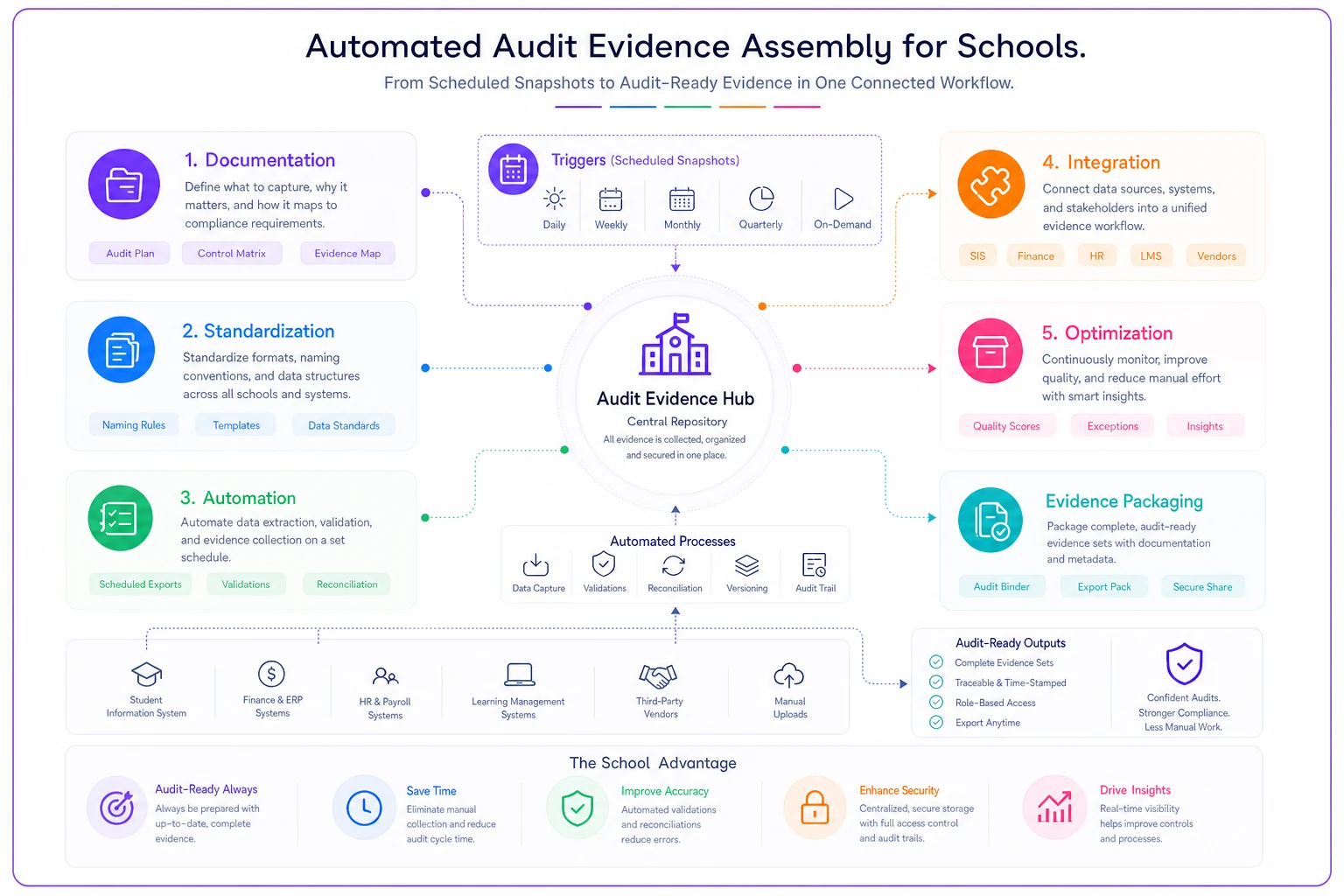
Start with the highest-impact, lowest-effort tasks and iterate.
Technology infrastructure for audit readiness
Schools that handle audits smoothly share similar technical configurations:
Centralized data warehouse: They pull data from all operational systems into a central repository. This doesn't mean expensive enterprise software - even a well-structured shared drive with proper permissions works.
Scheduled exports: Critical reports run automatically on known compliance dates. October 1 enrollment, semester grades, monthly attendance summaries. These exports happen whether someone remembers or not.
Version control: They maintain historical versions of all reports. When auditors question why numbers changed, they can show exactly what was reported when.
Automated alerting: When data quality issues arise - missing demographics, attendance anomalies, certification expirations - the system notifies responsible staff immediately.
This infrastructure supports normal operations too. The same queries that generate audit evidence also produce board reports, grant applications, and management dashboards. Audit readiness becomes a byproduct of operational excellence.
Real implementation: 200 hours to 30 hours
A 1,200-student charter network in Arizona transformed their audit prep last year. Their before state: Business manager, registrar, and data coordinator basically disappeared for six weeks every February. Other staff covered their normal duties while they assembled evidence. Total time investment: roughly 200 hours of direct prep plus another 100 hours of coverage and catch-up work.
Their transformation started with brutal honesty about their current state. They tracked every minute spent on their recent audit:
-
Data pulls
68 hours
-
Validation and reconciliation
54 hours
-
Documentation searching
41 hours
-
Formatting and packaging
28 hours
-
Responding to clarifications
34 hours
Only about 30 hours involved actual thinking and problem-solving. The rest was mechanical work - running reports, matching records, formatting spreadsheets.
They built their automated framework over summer break. Every common audit request got mapped to specific exports with step-by-step documentation. They discovered their attendance system could generate 90% of required attendance evidence through a single parameter-driven report - they'd been creating 15 separate exports manually.
They configured their SIS to automatically snapshot enrollment every Monday. When auditors requested "enrollment as of January 15," they had the exact data available, not a reconstruction from current records with manual adjustments.
They centralized evidence storage with strict naming conventions. "2024Q2EnrollmentVerificationOfficial.xlsx" not "Copy of enrollment report (2) FINALv3REVISED.xls"
When audit season arrived, the transformation was dramatic:
-
Week 1
Automated exports ran overnight. 90% of evidence assembled without human intervention.
-
Week 2
Staff reviewed outputs, addressed variances, gathered manual documentation for gaps.
-
Week 3
Internal review, packaging, submission.
Total time: 30 hours of skilled work plus about 10 hours of administrative tasks. The business manager actually attended the monthly PTA meeting during audit season - unprecedented.
Sustaining audit readiness year-round
Audit readiness isn't a seasonal activity. It's an operational discipline that runs continuously.
Monthly evidence reviews catch problems early. That enrollment discrepancy is easier to fix in October than explain in March. The missing IEP documentation is simpler to locate two weeks after the meeting than two years later.
Quarterly mock audits test your systems. Pull random samples of common requests. Can you generate the evidence within your target timeline? What breaks? What takes longer than expected?
Annual process updates incorporate lessons learned. Every audit reveals new requirements or edge cases. Update your documentation, adjust your automations, refine your workflows.
Schools that excel at audit prep treat it like any other operational process. They measure performance, identify bottlenecks, implement improvements, and maintain standards. They don't scramble during audit season because audit readiness is baked into their daily operations.
Where AI-powered operational platforms accelerate evidence assembly
Modern operational software designed for schools can dramatically reduce the manual burden of audit preparation. Instead of juggling exports from a dozen systems, AI automation creates unified workflows that pull data from multiple sources, validate completeness, and assemble evidence packages automatically.
These platforms excel at the repetitive reconciliation work that consumes audit prep time. Matching enrollment records across systems, verifying attendance calculations, confirming certification statuses - tasks that require precision but not creativity. AI agents can run these validations continuously, flagging discrepancies immediately rather than discovering them under audit deadline pressure.
The real value comes from institutional memory preservation. When your experienced registrar retires, their knowledge of which reports to pull and how to validate them doesn't walk out the door. It's encoded in automated workflows that any staff member can execute. The AI guides new staff through evidence assembly, eliminating the tribal knowledge problem that makes audit prep so painful after staff transitions.
Final thoughts on sustainable audit operations
Audit prep doesn't have to be an annual emergency. Schools that handle audits smoothly aren't lucky - they've built operational systems that make evidence assembly routine rather than heroic.
Start small. Pick your five most common audit requests. Document the current process to generate that evidence. Build templates and automation for those five requests. Once those run smoothly, expand to the next five.
The goal isn't to eliminate human judgment from audit prep. Auditors will always have questions that require thoughtful responses. The goal is eliminating the mechanical work that prevents your talented staff from focusing on those substantive issues.
Every hour spent building systematic audit preparation saves ten hours of scrambling later. More importantly, it transforms audit season from a dreaded disruption into a predictable operational process. Your business manager shouldn't need to cover her monitor with sticky notes to remember how to pull enrollment reports. That knowledge should live in your operational systems, accessible to
Every hour spent building systematic audit preparation saves ten hours of scrambling later. More importantly, it transforms audit season from a dreaded disruption into a predictable operational process. Your business manager shouldn't need to cover her monitor with sticky notes to remember how to pull enrollment reports. That knowledge should live in your operational systems, accessible to
Ready to optimize your school operations?
Join hundreds of schools using GoSkoly to save time, improve collaboration, and enhance student outcomes.