

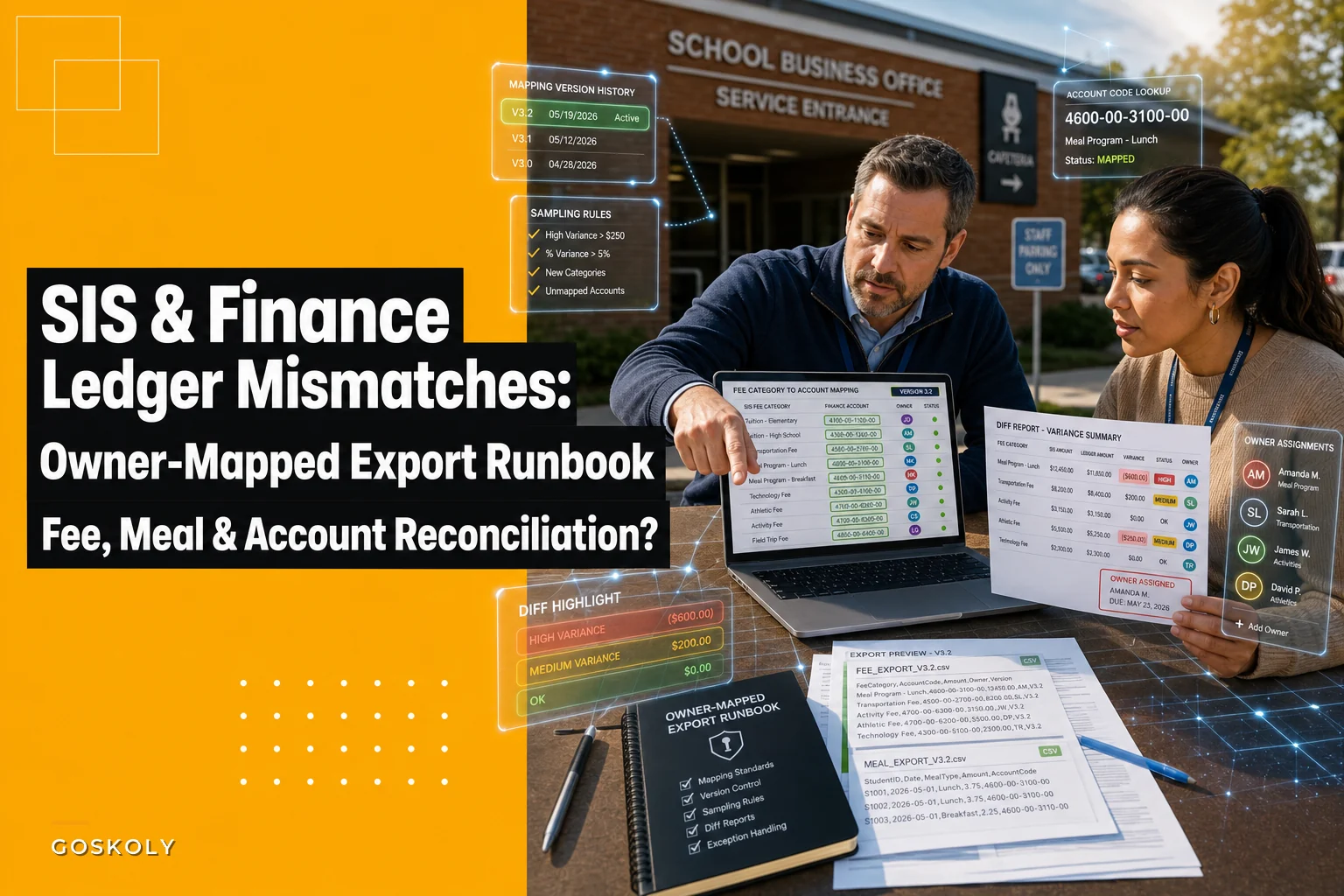

The gap between your SIS and your finance system almost never announces itself. It shows up three days before the audit, when the meal-fund balance in your food service module reads $14,280 and the general ledger says $11,940, and nobody can explain the $2,340 difference without a two-hour meeting and four spreadsheets.
If you run business office operations for a district, this is the reconciliation that quietly eats a full week every close cycle. Fees assessed in the SIS don't tie to revenue posted in finance. Meal account credits get keyed twice. A refund gets processed in the SIS but never reverses the receivable. And because the two systems were never designed to talk in accounting terms, the mismatch grows a little every month until someone forces a full re-tie.
This runbook is about SIS finance reconciliation K-12 specifically — the fee, meal, and student account layer where the SIS holds the assessment and the finance system holds the money. Not payroll, not procurement. Just the place where student-level charges are supposed to become ledger entries and frequently don't.
Where the mismatch actually starts
The root problem is that an SIS thinks in students and a general ledger thinks in accounts. When a student is assessed a $45 lab fee, the SIS records it against that student's fee record. Finance wants it as a credit to revenue account 4200-Lab-Fees with a receivable offset. Nobody at either end is thinking about how those two representations reconcile — they're just doing their job.
The breakage happens at the mapping boundary. A typical example looks like this:
-
A new fee type gets created mid-year in the SIS — say "STEM Materials" — and nobody adds it to the finance mapping table. It posts to a default suspense account or falls out of the export entirely.
-
Meal account deposits get recorded gross in the SIS but net of processing fees in finance, so the two balances drift by exactly the card processor's cut each month.
-
A fee waiver reduces the SIS assessment but the original charge already exported to finance, leaving a receivable that will never be collected and never reversed.
None of these are dramatic individually. Each is a few hundred dollars. But across a district with 8–12 fee types and 6,000 students, the drift compounds into a five-figure reconciliation problem by spring.
What comes up repeatedly across school business offices is that reconciliation almost always fails at the definition level, not the math level. The math is fine. The two systems just disagree about what a "meal credit" or a "refunded fee" means, and no one wrote that agreement down.
The owner-mapped export: the artifact that fixes half the problem
Before you touch a single transaction, you need one document that maps every SIS fee and account category to a specific finance account, with a named owner for each mapping. This is the artifact that prevents most of the drift, and most districts don't have it in a usable form.
Eliminate administrative overload.
GoSkoly helps you manage schedules, attendance, and communications seamlessly.
- Unified student and staff management
- Automated attendance tracking
- Integrated communication tools
No credit card required
Here's the structure that actually holds up under audit:
| SIS Field / Category | Finance Account | Direction | Owner | Notes |
|---|---|---|---|---|
| Lab Fee (fee_type 12) | 4200 – Lab Revenue | Credit | Business Mgr | Waivers reverse to 4200 |
| Meal Deposit | 2150 – Meal Liability | Credit | Nutrition Coord | Recorded gross; fees to 5310 |
| Meal Charge (negative bal) | 1310 – Meal Receivable | Debit | Nutrition Coord | Aged >60d flagged |
| Field Trip Fee | 4230 – Activity Revenue | Credit | Activity Acct | Refundable until trip date |
| Fee Waiver | 4200 – (contra) | Debit | Business Mgr | Must match original charge |
| Returned Payment | 1300 – AR / 5320 – Bank Fee | Split | Business Mgr | NSF fee posts separately |
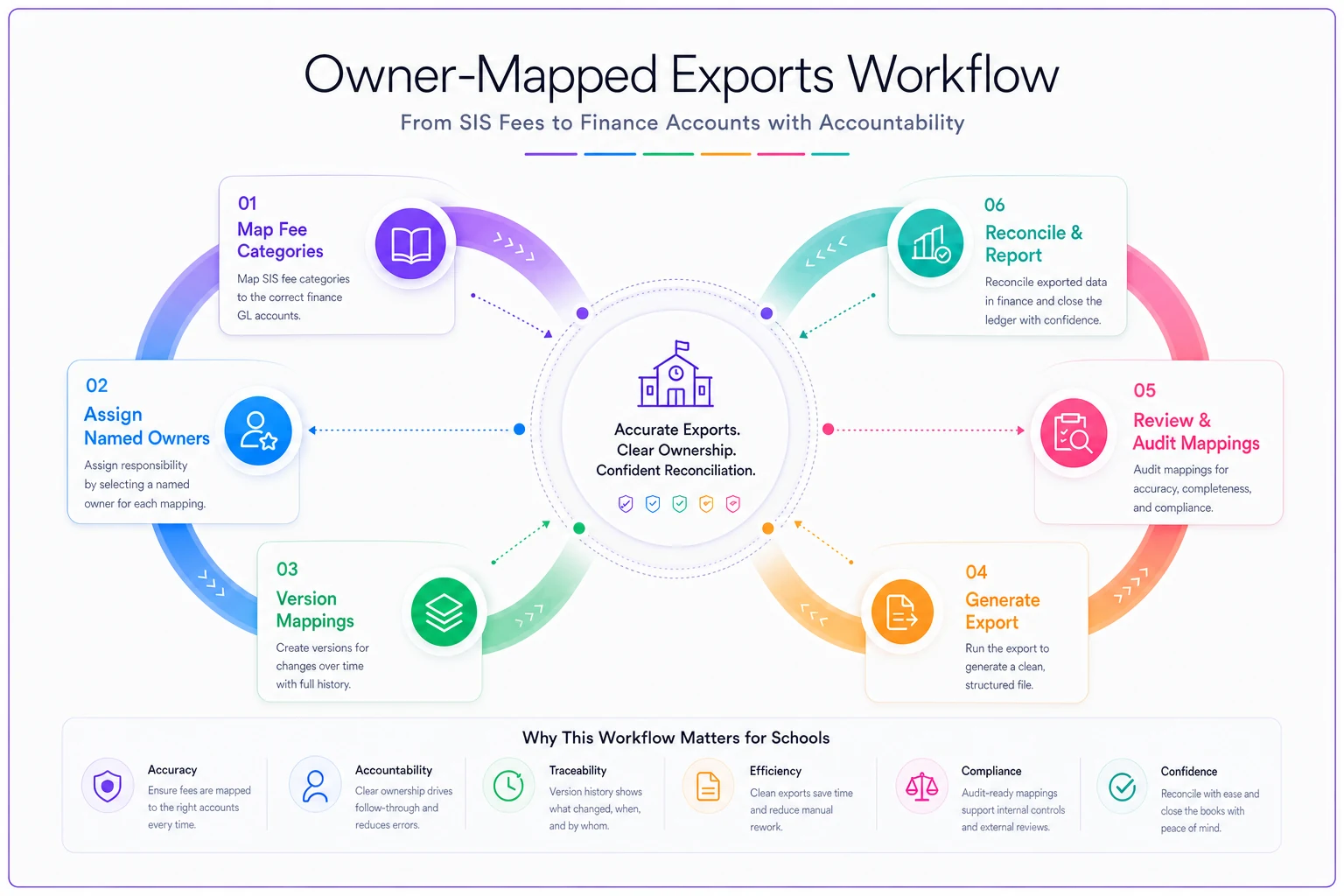
A simple diagram like this helps non-technical stakeholders see who owns each mapping and how exports flow to the GL.
The owner column is the part people skip and the part that matters most. When the STEM Materials fee shows up unmapped in April, the question "who decides where this posts?" has a name attached instead of a shrug. This is the same owner-mapping discipline that makes audit preparation with owner-mapped exports and automated evidence assembly survivable — the reconciliation is just the same principle applied to money instead of documents.
One detail worth stating plainly: the mapping table has to be versioned. When a mapping changes mid-year, you need to know which version was in effect for the March export, or you'll reconcile March against April's rules and chase a phantom variance for a day.
Sampling rules: don't reconcile everything, reconcile the right things
A full transaction-by-transaction tie of 40,000 fee lines is a waste of a business office's time and it doesn't scale. The districts that keep this under control use sampling rules to decide what gets a full trace and what gets a balance-level check.
-
Full trace, every close any fee category where the SIS-to-finance variance exceeds $500 or 2% of the category total, whichever is smaller.
-
Full trace, every close all fee waivers and refunds, no matter the amount — these are the highest-error, lowest-volume transactions and they're where fraud and honest mistakes both hide.
-
Sampled trace (10–15 records) meal deposits and routine fees where the category balance ties within tolerance. If the sample is clean, you accept the balance.
-
Balance-only check categories under $1,000 total with a clean history — verify the totals match and move on.
The insight here is a bit counterintuitive: the biggest dollars usually aren't the biggest risk. Meal deposits are high-volume but low-error because they flow through an automated feed. The $80 refunds, keyed by hand, are where most of your exceptions live. Spend your tracing time where the errors actually are, not where the money is.
Start your sampling thresholds by focusing on refunds and waivers first — they're the highest-risk, lowest-volume items.
A mistake that comes up constantly is business offices reconciling meal balances line-by-line every month — thousands of clean records — while never sampling the refund queue where the real breaks accumulate.
Diff reports: what a useful variance report actually shows
When your export and your ledger disagree, the diff report is what tells you where without a manual hunt. A bad diff report says "meal fund off by $2,340." A useful one categorizes the variance so you know which playbook to run.
A good diff report groups every variance into one of a handful of buckets:
-
In SIS, not in finance — assessed but never posted (usually a missing mapping)
-
In finance, not in SIS — posted with no SIS source (usually a manual JE that should have been a fee correction)
-
Amount mismatch — same transaction, different value (usually gross-vs-net on meal processing)
-
Timing — correct on both sides, posted in different periods (usually a month-end cutoff)
-
Sign error — a refund posted as a charge or a waiver posted as revenue
> AMOUNT_MISMATCH | Meal Deposits | SIS: $8,420.00 | GL: $8,166.40 | Δ $253.60 | Likely: processor fee (5310) | Owner: Nutrition Coord
That one line tells the reconciler what happened, the probable cause, and who owns the fix — no meeting required. The difference between a district that closes in two days and one that closes in two weeks is almost entirely whether the diff report classifies variances or just reports a number.
For a broader look at how vague reporting causes exactly this kind of confusion, the patterns in common KPI and reporting pitfalls map directly onto why an unclassified variance report wastes so much staff time.
Exception-handling playbooks
Every recurring variance type needs a playbook — a short, written sequence that says exactly who does what. Without them, each exception gets solved from scratch by whoever happens to notice it, and the fix quality depends entirely on that person's memory.
Here are the four that cover most of the volume.
Playbook A — Unmapped fee type
-
Diff report flags a fee category posting to suspense or missing from finance.
-
Business Manager confirms it's a new or renamed SIS fee type.
-
Add the mapping to the versioned table; note the effective date.
-
Reclass any transactions already posted to suspense.
-
Re-run the export for the affected period.
Playbook B — Gross/net meal drift
-
Amount-mismatch on meal deposits equal to processor fees.
-
Nutrition Coordinator confirms fee schedule against processor statement.
-
Post the fee difference to 5310; leave the gross deposit intact.
-
Document the standing adjustment so it's not re-investigated next month.
Playbook C — Refund without reversal
-
Refund appears in SIS with an open receivable still on the books.
-
Business Manager verifies refund was actually issued.
-
Reverse the original receivable; confirm the fee record shows zero balance.
-
Flag the student account so a re-assessment doesn't re-trigger the charge.
Playbook D — Waiver posted as revenue
-
Sign-error flag
a fee waiver reduced the SIS balance but revenue in finance stayed full.
-
Post a contra entry to the original revenue account.
-
Confirm the waiver amount matches the original charge exactly — partial waivers are the common trap.
The pattern across all four: confirm the source, fix the ledger, then close the loop back to the SIS so the same transaction can't break again next cycle. Most reconciliation processes stop at step two and wonder why the same $200 refund shows up broken every month.
A short real scenario
A mid-sized district — around 6,400 students, K–8 — was closing their student activity and meal funds manually every month. The business office ran two people through roughly three days each close, mostly tracing meal deposits and hunting for a recurring variance that hovered somewhere between $1,800 and $2,600.
Once they built the owner-mapped table and the diff-report buckets, two things surfaced fairly quickly. The recurring meal variance was almost entirely the card processor's fee, which had never been mapped to an expense account — a standing gross/net difference, not an error at all. The actual errors were clustered in refunds: about 15–20 a month, roughly a third of which never reversed the underlying receivable.
They stopped line-tracing clean meal records and moved that time to a full trace on every refund and waiver. Close time dropped from around six person-days to under two, and the unexplained variance at year-end came in under $300 instead of the previous year's four-figure re-tie. Nothing exotic — they just reconciled the risky transactions and sampled the safe ones.
When to formalize this — and when not to bother
This full apparatus makes sense when you have multiple fee types, a meal program running through a processor, and more than a couple thousand students. Below that, the mapping table alone is probably enough and the sampling rules are overkill.
When it's worth building the full runbook:
-
You have 6+ fee categories mapping to different revenue accounts
-
Meal funds flow through a payment processor that nets fees
-
Your close currently takes more than two days on student accounts
-
You've had an audit finding on fee revenue or meal fund reconciliation
When it's not worth it:
-
Single fee type, small enrollment, no processor
-
Finance and SIS are already the same platform with a native tie-out
-
Your variances are consistently under a few hundred dollars and explained same-day
Who should skip the sampling layer entirely: very small districts where a full trace takes an afternoon. Sampling exists to save time at scale; if the full reconciliation is already fast, sampling just adds a policy you have to maintain for no real benefit.
Where automation earns its place
The manual version of this works — the scenario above proves it. But the parts that break down at scale are exactly the mechanical, repeatable ones: pulling the export in the mapped format, classifying every variance into the right bucket, and flagging the exceptions that need a human decision. That's where an operational platform with light automation actually pays off, because it removes the transcription and classification work without removing the judgment.
The judgment — deciding where a new fee type posts, whether a refund was legitimate, how to handle a partial waiver — stays with your business office. Software should hand your reconciler a clean, bucketed diff report with owners already attached, so the two days of close time go to deciding instead of hunting. When automation drifts past that line and starts auto-posting corrections nobody reviewed, that's when you end up with silent errors that surface at audit.
The reconciliation between your SIS and your ledger isn't really an accounting problem. It's a definitions problem wearing an accounting problem's clothes. Write down what each fee means, who owns it, and how each variance type gets fixed — and the mismatch stops being a spring-close emergency and becomes a twenty-minute review.
The reconciliation between your SIS and your ledger isn't really an accounting problem. It's a definitions problem wearing an accounting problem's clothes. Write down what each fee means, who owns it, and how each variance type gets fixed — and the mismatch stops being a spring-close emergency and becomes a twenty-minute review.
Ready to optimize your school operations?
Join hundreds of schools using GoSkoly to save time, improve collaboration, and enhance student outcomes.