

Most finance directors can tell you their books balance. Fewer can tell you why they balance, line by line, back to the events that generated each dollar. That gap—between a clean-looking general ledger and the messy stream of enrollments, fee assessments, meal charges, grant draws, and refunds that actually produced those numbers—is where district finance quietly falls apart.
Your chart of accounts and your student information system are two different models of the same reality, maintained by two different teams, updated on two different schedules. When they agree, it's often by luck or heroic manual effort at month-end. When they disagree, nobody notices until an auditor, a grant monitor, or a parent with a disputed balance forces the question.
This article is about treating district finance SIS alignment as a system, not a quarterly cleanup. The goal isn't a one-time reconciliation. It's an operating model where a fee code in the SIS maps to a known account, where grant spending gets scored for anomalies before it's booked, where every reconciliation has a named owner and a runnable schedule, and where a diff report is something you glance at weekly instead of dread at year-end.
The real problem isn't the mismatch. It's that nobody owns the mapping.
When SIS and finance numbers don't line up, the first instinct is to hunt for the specific error—a duplicate charge, a miscoded refund, a meal payment that landed in the wrong fund. That's fine for firefighting. But the recurring cause is almost always structural: the mapping between SIS events and the chart of accounts lives in someone's head, or a spreadsheet, or nowhere at all.
Here's what that looks like in practice. A registrar adds a new activity fee for a robotics club. She picks a fee category in the SIS that seems close enough. Finance sees the revenue land in a general "student activities" account because that's where the closest existing fee already routed. Three months later, the robotics grant coordinator asks how much fee revenue offset the program, and nobody can answer without manually pulling receipts—because the fee was never mapped to the grant's tracking code.
No single person did anything wrong. The registrar wasn't told there was a mapping standard. Finance wasn't told a new fee existed. The grant coordinator assumed the SIS "just knew." This pattern shows up across districts of every size—the operational knowledge of which SIS event should hit which account is distributed, informal, and never written down as a maintained artifact.
The fix starts with making that mapping an explicit, owned object. Not a memory. A table.
Chart of accounts to SIS events: the mapping nobody wants to build
The single most useful artifact for district finance SIS alignment is a crosswalk that ties each SIS financial event to its destination account, its fund, and its expected direction. Boring to build. Enormously clarifying once it exists.
Eliminate administrative overload.
GoSkoly helps you manage schedules, attendance, and communications seamlessly.
- Unified student and staff management
- Automated attendance tracking
- Integrated communication tools
No credit card required
A workable version looks like this:
| SIS Event | Fee/Charge Code | GL Account | Fund | Grant Code (if any) | Expected Sign | Owner |
|---|---|---|---|---|---|---|
| Enrollment fee assessed | ENR-100 | 4110 Tuition & Fees | General | — | Credit (revenue) | Registrar |
| Meal charge posted | MEAL-STD | 4520 Food Service Sales | Food Svc | — | Credit | Nutrition Svcs |
| Meal payment received | MEAL-PAY | 1010 Cash | Food Svc | — | Debit | Cashier |
| Free/reduced meal served | MEAL-FR | 4551 NSLP Reimb. | Food Svc | NSLP-24 | Credit (accrued) | Nutrition Svcs |
| Field trip fee | ACT-FT | 4130 Activity Fees | General | — | Credit | Site Bookkeeper |
| Title I tutoring stipend | — | 5110 Salaries | Special Rev | TI-A-24 | Debit (expense) | Grant Mgr |
| Fee waiver applied | WVR-100 | 4110 (contra) | General | — | Debit (reduction) | Registrar |
| Refund issued | RFD-100 | varies by original | varies | varies | Reverses original | Site Bookkeeper |
Two columns do most of the heavy lifting and get skipped most often: Expected Sign and Owner. The sign tells your reconciliation logic what "normal" looks like—that's how you catch a refund that was booked as revenue. The owner is who gets the ticket when a row breaks.
Worth calling out specifically: refunds and waivers are where mappings almost always rot. A refund has to reverse whatever the original charge did, but if the original was miscoded, the refund cheerfully reverses the wrong account, creating two errors that partially cancel and hide each other. When you build the crosswalk, spend disproportionate time on the reversal and contra rows. That's where the quiet damage accumulates.
Spend disproportionate time on reversal and contra rows; those are where quiet damage accumulates.
The cleanup itself isn't covered by a single entry in the crosswalk—it's an operational discipline: the crosswalk maps things, the owner sees breaks, and the reconciliation schedule turns that into routine work.
Anomaly scoring for grant codes, because grants are where the audit risk lives
General fund miscodes are annoying. Grant miscodes are dangerous. A dollar spent against the wrong grant code can trigger a disallowed cost, a clawback, or a finding that follows the district for years. This is the part of the operating model that deserves real attention rather than a spreadsheet formula.
The idea behind anomaly scoring is straightforward: instead of reviewing every grant transaction (impossible) or reviewing none until audit season (reckless), you score each transaction against what's normal for that grant and surface the outliers for human review. Rules that consistently earn their keep:
-
Period boundary flags. A charge dated after the grant's period of availability but booked to the grant. This is the number-one cause of disallowed costs, and it's trivially detectable.
-
Category drift. A grant that historically spends 90% on salaries suddenly showing a large supply purchase. Might be legitimate. Should be looked at.
-
Round-number and threshold clustering. A run of purchases at $4,999 against a grant with a $5,000 approval threshold. Not proof of anything—but a pattern worth a glance.
-
Object code mismatch. An expense object code that doesn't appear in the grant's approved budget. Should never post silently.
-
Velocity spikes. A grant that draws down 40% of its remaining balance in the final two weeks of the period. Sometimes real, often a scramble that generates errors.
The output isn't a verdict. It's a ranked worklist. A transaction that trips three rules floats to the top; one that trips a low-weight rule sits at the bottom and might get sampled rather than reviewed. What matters operationally is that the scoring runs before the close, not during an audit. You want to catch the period-boundary charge in week one, when it can be moved—not in month eleven, when it becomes a finding.
A realistic anomaly score might weight period-boundary violations heavily (they're almost always real problems), object-code mismatches moderately, and round-number clustering lightly (lots of false positives). Tune the weights against your own history. The first few months of scores will tell you which rules are noise in your district and which are signal.
The owner matrix: turning "someone should check" into "this person, by this date"
A crosswalk tells you where money should go. An anomaly score tells you what looks wrong. Neither does anything if no human is accountable for acting on it. This is where an owner matrix comes in—it's the connective tissue between the finance side and the SIS side.
The mistake most districts make is assigning ownership by system rather than by reconciliation. "Finance owns the GL, the SIS team owns the SIS." That sounds clean and guarantees that every cross-system break falls into the gap between two owners. Cross-system reconciliations need cross-system owners, or at minimum a named owner per reconciliation who has authority to pull people from both sides.
-
The primary owner who runs the reconciliation and holds the outcome
-
The data owners on each side who can explain and fix source records
-
The escalation path when a break can't be resolved at the owner level
-
The cadence the reconciliation runs on
If you've already built a cross-system responsibility structure, this extends naturally from it—the broader logic of mapping owners to SLAs across systems is covered in the district systems operating model and cross-system responsibility matrix, and the finance-specific version is just that framework pointed at reconciliation streams.
One thing worth flagging: ownership tends to be crystal clear during the school year and dissolves over the summer, exactly when year-end reconciliation and grant closeout happen. Bookkeepers change sites, the SIS team is mid-rollover, and the person who understood the meal-fund reconciliation is now at a different campus. Build the matrix with summer coverage explicitly named, or plan to rediscover every mapping in July.
Runnable reconciliation schedules, not heroic month-ends
Reconciliation done once a month, by hand, at close, is where errors go to become permanent. By the time you find a mismatch in October's books, the source data has moved, the people involved have forgotten the context, and the fix is archaeology. The alternative is a schedule of smaller, runnable reconciliations that catch drift while it's still cheap to correct.
-
Daily (automated) Cash receipts in the SIS versus deposits recorded in finance. Any single-day variance over a small threshold gets flagged same-day. Cash discrepancies are almost always easier to solve the day they happen.
-
Weekly Fee assessments and waivers in the SIS versus the corresponding revenue and contra accounts. This is where new-fee mapping gaps surface fast, before three months of transactions pile up.
-
Weekly Grant anomaly worklist review. Not the whole ledger—just the scored outliers.
-
Monthly Meal fund reconciliation (charges, payments, reimbursements, balances) and a full SIS-to-GL revenue tie-out. The detailed mechanics of fee, meal, and account reconciliation are worked through in the runbook for when SIS and finance ledgers don't match, which pairs well with this cadence.
-
Per grant period Full grant reconciliation against the approved budget, run before the period closes, not at report submission.
-
Annually Year-end tie-out with evidence assembled as you go rather than reconstructed—closely related to the way owner-mapped exports support audit preparation.
The word doing the work here is runnable. A reconciliation you can only perform if a specific senior person spends a full day pulling reports is not a schedule—it's a dependency. The goal is reconciliations defined precisely enough that they run on time whether or not the most experienced person is available. This is exactly the kind of repetitive, rule-based comparison work that AI-assisted operational software handles well: pulling both sides, matching on keys, scoring the residual, and handing a clean exception list to the owner instead of a pile of raw data. The human judgment stays where it belongs—on the exceptions—and the mechanical matching stops eating a bookkeeper's week.
Here's a simple visual workflow for a runnable reconciliation schedule.
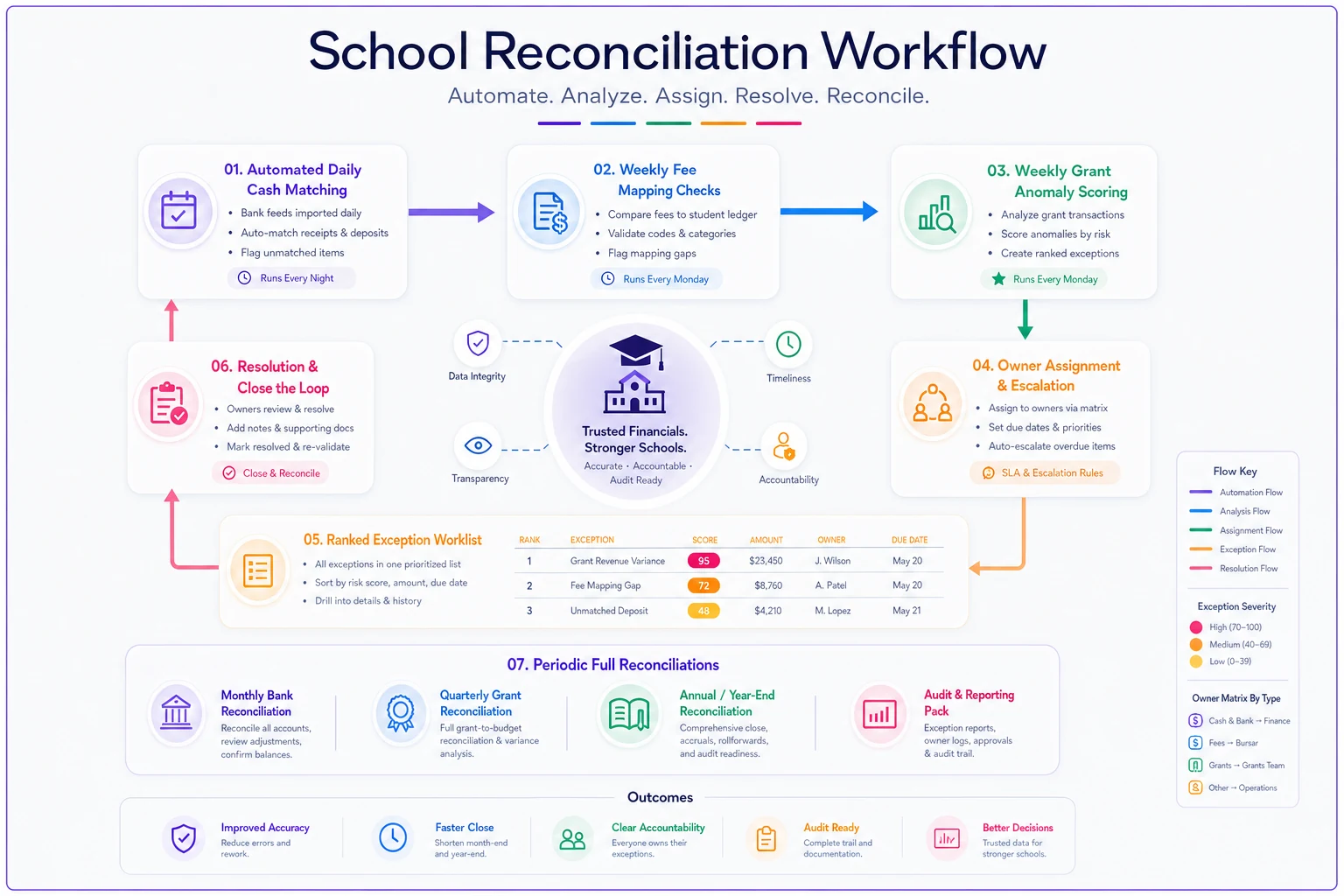
The image shows automation producing a clean exception list that owners act on, minimizing ad-hoc manual pulls.
What a good diff report actually shows
Most "reconciliation reports" are two totals and a difference. That tells you that something's wrong, not what. A useful diff report is line-level and directional. A sample structure:
Weekly Fee Reconciliation Diff — Site 04 — Week of Oct 6
-
- Matched 312 assessments, $18,940 — tie out clean.
-
- In SIS, not in GL 4 assessments, $265 total. Cause: new "Drama Club" fee (code ACT-DR) created Oct 2, not yet mapped to a GL account. Owner: Site Bookkeeper. Action: map ACT-DR → 4130.
-
- In GL, not in SIS 1 entry, $50. Cause: manual journal entry, no source SIS event. Owner: Finance. Action: verify or reverse.
-
- Sign mismatch 2 refunds ($90) booked as revenue instead of contra. Owner: Site Bookkeeper. Action: reclassify.
-
- Amount mismatch 1 assessment, SIS $75 / GL $57. Likely partial waiver not reflected in GL. Owner: Registrar + Finance.
The difference between this and a two-number summary is significant. This report tells each owner exactly what to do without a meeting. It categorizes breaks by type—missing on one side, sign wrong, amount off—because those categories map to different root causes and different fixes. And it names owners inline, so the report is the work assignment.
A small but important detail: a diff report should also show what matched. Seeing "312 matched cleanly" builds trust in the process and makes the exceptions feel manageable rather than alarming. A report that only shows problems trains people to dread opening it.
Acceptance tests: how you know the alignment actually works
You can't manage alignment you can't verify. Acceptance tests are the checks that confirm your mapping and reconciliation are doing their job—the same discipline you'd apply to any data integration. Run these when you set up the model and re-run them whenever the chart of accounts or SIS fee structure changes:
-
- [ ] Every active SIS fee/charge code maps to exactly one GL account (no unmapped codes, no ambiguous ones)
-
- [ ] Every mapping has an owner and an expected sign
-
- [ ] A test refund correctly reverses the exact account its original charge hit
-
- [ ] A test waiver reduces revenue via the contra account, not by deleting the assessment
-
- [ ] A grant charge dated outside the period of availability triggers an anomaly flag
-
- [ ] An expense with an object code not in the grant budget triggers a flag
-
- [ ] The daily cash reconciliation flags a deliberately introduced $20 test variance
-
- [ ] Every reconciliation stream in the schedule has a named owner and a named summer backup
-
- [ ] A diff report generated for a known-clean period shows zero unexplained exceptions
That last test is the one people skip and regret. If you can't produce a clean diff for a period you know is clean, your reconciliation logic has a false-positive problem, and owners will start ignoring the reports. Getting to a genuinely clean baseline is the proof that the system works—everything after that is signal.
A real scenario: the meal fund that was "fine" for two years
A mid-sized district—around 6,800 students across nine sites—ran its food service fund the way most do: monthly reconciliation at close, handled by one experienced bookkeeper. The books balanced every month. Nobody worried about it.
The problem surfaced during a routine NSLP review. Free-and-reduced meal reimbursements had been accruing to the food service fund correctly, but a subset of à la carte sales at two sites had been miscoded to the general fund's activity account since a POS integration change roughly two years earlier. Each month's mismatch was small—a few hundred dollars—and it sat below the threshold anyone eyeballed at close. Over two years it added up to somewhere in the range of $14k–$18k sitting in the wrong fund, with the corresponding question of whether federal reimbursement calculations had been affected.
The cleanup itself wasn't catastrophic. The cost was everything around it: the staff time to reconstruct two years of transactions, the anxiety of a federal review, and the credibility hit of not being able to explain the district's own numbers on the spot.
What changed after: they built the crosswalk (the à la carte code had simply never been mapped after the POS change), moved à la carte reconciliation to a weekly cadence with a $50 variance flag, and added an acceptance test that fails if any active POS code is unmapped. The next integration change did create a new unmapped code—caught within a week instead of two years. Same failure mode, three-day fix instead of a review finding.
When this level of rigor makes sense, and when it's overkill
Not every district needs the full apparatus on day one.
This makes sense when: you manage multiple funds and grants, you've had (or fear) an audit finding, you run meal programs and activity fees across several sites, or you've ever spent more than a day answering "where did this money come from?" Multi-site, multi-grant districts hit the coordination ceiling fast, and manual month-end reconciliation stops scaling around the point where no single person can hold all the mappings in their head.
This is more than you need when: you're a small single-site operation with a handful of fee types and one fund, where the bookkeeper genuinely can eyeball the whole picture. Building a formal owner matrix and anomaly scoring for six fee codes is process for its own sake. Start with the crosswalk—even three sites benefit from writing the mapping down—and add cadence and scoring as complexity grows.
Who should be careful: districts mid-way through an SIS or ERP migration. Building an elaborate mapping against a system you're about to replace wastes effort. Do the crosswalk during the migration, as part of the data design, so alignment is built in rather than bolted on afterward.
The system view
SIS and finance drift apart not because of incompetence or bad software. It's that they model the same events differently, get maintained by different people on different clocks, and the connective tissue between them—the mapping, the ownership, the schedule—usually exists only as tribal knowledge. Every specific mismatch you chase is a symptom of that missing connective layer.
Making alignment reliable means turning the implicit into artifacts: a crosswalk that anyone can read, anomaly scoring that surfaces risk before close, an owner matrix that names accountable humans on both sides, a runnable schedule that catches drift while it's cheap, diff reports that assign work instead of just reporting problems, and acceptance tests that prove the whole thing holds. None of these are exotic. What's hard is treating them as a maintained system rather than a year-end scramble—and that shift, more than any single tool, is what separates districts that can explain their numbers from those that hope the books just happen to balance.
Making alignment reliable means turning the implicit into artifacts: a crosswalk that anyone can read, anomaly scoring that surfaces risk before close, an owner matrix that names accountable humans on both sides, a runnable schedule that catches drift while it's cheap, diff reports that assign work instead of just reporting problems, and acceptance tests that prove the whole thing holds. None of these are exotic. What's hard is treating them as a maintained system rather than a year-end scramble—and that shift, more than any single tool, is what separates districts that can explain their numbers from those that hope the books just happen to balance.
Ready to optimize your school operations?
Join hundreds of schools using GoSkoly to save time, improve collaboration, and enhance student outcomes.