

Most schools don't lose their textbook budget to theft. They lose it to friction. A checkout process that takes ninety seconds per student in a class of thirty means the teacher gives up by October and starts writing names on a legal pad. That legal pad is the reason your end-of-term reconciliation is a mess, and it's the reason your auditor is asking questions you can't answer.
This piece is narrowly about one thing: running textbook and consumables inventory K-12 in a way that's fast enough to actually get used, and clean enough to survive an audit. Not asset tracking for laptops and Chromebooks — that's a different problem with different rules. This is about the boring, high-volume stuff: paperback novels for English, lab consumables, calculators, art supplies, the library, and the classroom sets that circulate all year and vanish in June.
Why checkout friction is the actual root cause
Walk into any middle school in the first week of a new semester and you'll see the same pattern. The library or book room has a "system," but the system assumes someone has time to scan every item and confirm every student ID. In practice, a teacher handing out a class set of 32 copies of The Giver is not going to scan 32 barcodes while the bell is ringing.
-
The teacher batches everything under their own name ("Room 214 has 32 copies") and loses the student-level trail entirely.
-
The teacher skips the system and tracks it on paper, which never makes it back into the record.
Both break reconciliation. The first means you know a room had 32 books but not who has the 4 that never came back. The second means your system says 32 books are still on the shelf when they're scattered across 32 backpacks.
The failure isn't usually the software — it's that the checkout step demands more effort than the value it returns at the moment of checkout. Nobody feels the pain in September. They feel it in June, when it's too late to fix.
The condition problem hiding underneath
There's a second layer people ignore: condition. A book checked out with a cracked spine and water damage comes back the same way, and now there's a fight over who owes a replacement fee. Without a condition sign-off at checkout, every damaged return becomes a dispute the front office loses by default. Schools eat the replacement cost because they can't prove the item left in good shape.
Design the checkout for the person doing it, not the auditor
The fix starts with accepting a hard truth: the person doing the checkout doesn't care about your audit. They care about getting through the line. If your process serves the auditor first, it won't get used — and then you have nothing to give the auditor anyway.
Eliminate administrative overload.
GoSkoly helps you manage schedules, attendance, and communications seamlessly.
- Unified student and staff management
- Automated attendance tracking
- Integrated communication tools
No credit card required
-
Default the common case. Most checkouts are a full class set to a known roster. The template should let a teacher select "assign class set to Period 3 roster" in one action, then auto-generate individual student records behind the scenes. The teacher does one thing; the system produces thirty auditable records.
-
Make condition a tap, not an essay. Three states — Good, Fair, Damaged — with an optional photo for anything flagged Fair or Damaged. Nobody writes a paragraph. A Damaged flag at checkout is what protects you at return.
-
Delay the barcode where possible. For consumables and low-value items, don't require unique item scans. Track by quantity and lot, not by individual barcode. You do not need to serialize 400 protractors.
Here's a comparison of how much friction each approach actually adds at the moment of handout:
| Approach | Time per student | Gets used consistently? | Reconciliation quality |
|---|---|---|---|
| Individual barcode scan + ID scan | 60–90 sec | Rarely past October | High if used, but usually abandoned |
| Paper roster, entered later | ~10 sec | Sometimes | Poor — entry rarely happens |
| Class-set template + roster auto-expand | 5–15 sec total | Yes | High and student-level |
| Quantity/lot tracking (consumables) | Near zero | Yes | Good enough for the item type |
The middle two rows are where most schools live. The bottom two are where they should be.
Sampling rules: stop trying to count everything
The instinct at end-of-term is to do a full physical count of everything. For a library with 12,000 items and a book room with another 8,000, a full count is a fantasy. It doesn't happen, or it happens badly, and the numbers get fudged to close the books.
The better move is risk-based sampling — standard practice in real inventory audits and it works fine here.
The logic is simple: full-count the high-value, high-loss categories, and sample the low-value, high-volume ones. A cracked calculator set worth $1,800 gets counted item by item. A tub of glue sticks does not.
-
Full count anything with a unit replacement cost above a threshold you set (say, $40+), plus anything with a historical loss rate above roughly 15%.
-
Sample count consumables and low-value items. Count a random 10–20% of locations, extrapolate, and escalate to a full count only if sampled variance exceeds a set band — for example, if sampled shrinkage runs above 8%, that category gets a full count.
-
Trust-but-verify on class sets count returned class sets fully at return time, because that's the natural checkpoint. You're already holding the box.
Sampling isn't about being lazy — it's about spending your limited counting hours where the money actually is. A full count that never finishes is worth less than a sample count that does.
The reconciliation export nobody can argue with
This is where it all pays off — or falls apart. Reconciliation at end-of-term should produce a clean, defensible export that ties every discrepancy back to evidence. Not a spreadsheet someone typed up from memory in July.
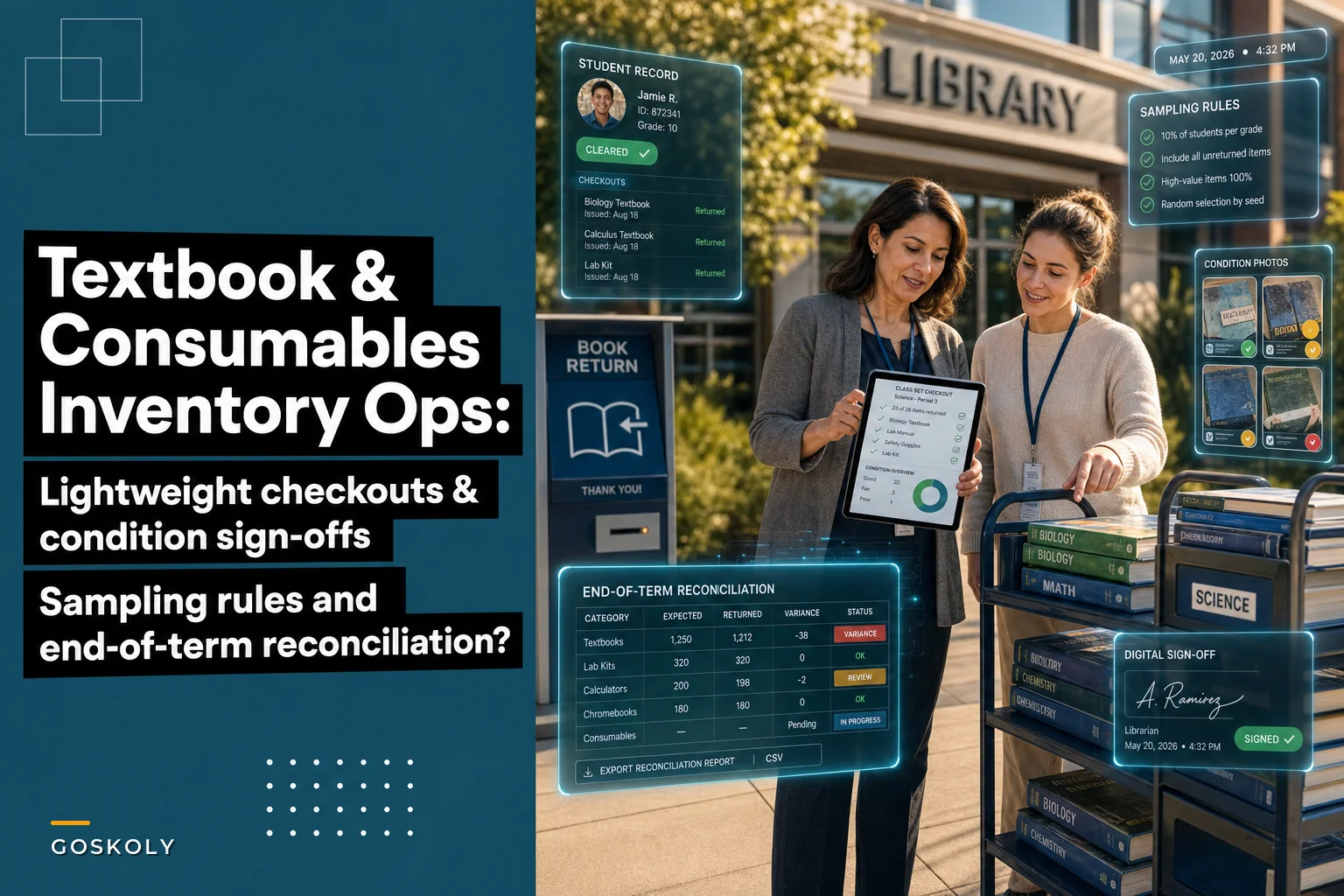
A strong reconciliation export for textbook and consumables inventory K-12 includes, per line item:
-
Item and category
-
Expected quantity (from checkouts/returns)
-
Actual counted or sampled quantity
-
Variance and variance reason (returned damaged, lost, never checked in, count-in-progress)
-
Condition-at-checkout vs condition-at-return, with a photo reference if one exists
-
Who signed off, and when
Those last two points are what convert a number into evidence. When a parent disputes a $22 replacement fee, the condition photo and sign-off timestamp end the conversation. When an auditor asks why 14 copies of a title are missing, "checked out to Period 4, not returned, teacher notified 6/12" is an answer. "Not sure" is not.
This connects directly to how you'd assemble evidence for a broader review. If you've already set up owner-mapped exports the way we covered in School Audit Preparation: Owner-Mapped Exports and Automated Evidence Assembly, your inventory reconciliation should feed the same evidence structure — same ownership assignments, same timestamped trail — instead of being a separate one-off scramble.
A short workflow that actually holds together
At checkout, the teacher picks the class-set template, selects the roster, and taps a condition state. The system expands that into student-level records with condition and timestamp attached. Throughout the term, one-off returns and re-issues update those records. At end-of-term, returned sets are counted fully at the point of return, condition is compared against checkout condition, and anything flagged generates a discrepancy line automatically. Consumables get sampled per the rules above. The reconciliation export pulls all of it — expected, actual, variance, reason, sign-off — into one file mapped to the person responsible for each category.
A quick visual of that workflow:
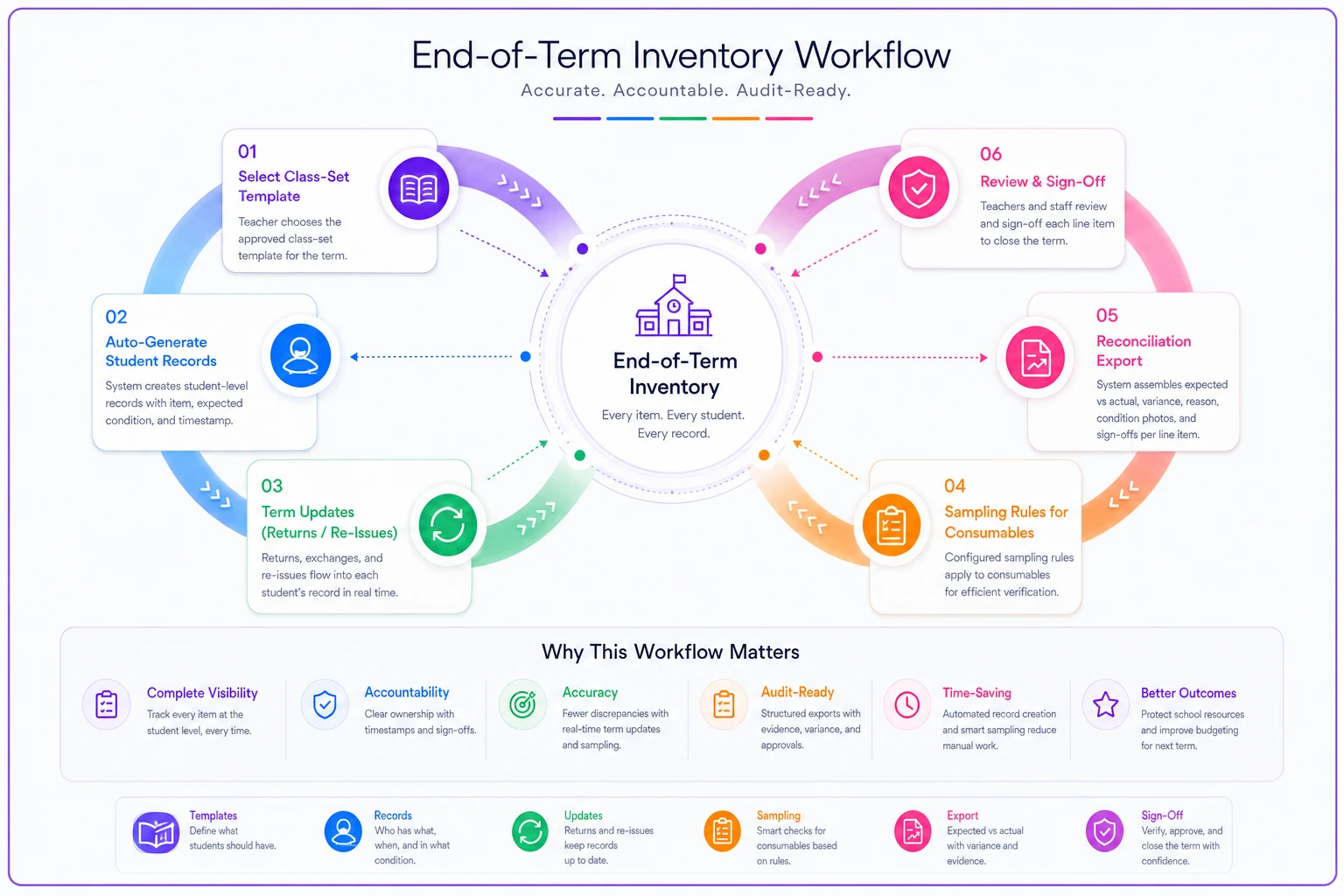
The whole point is that no one is reconstructing anything from memory. The record was built passively, as a byproduct of a checkout process fast enough that people actually used it.
A realistic example of what changes
A mid-sized middle school, roughly 700 students, with a book room running about 8,000 circulating items plus a library. Before cleaning this up, their annual "lost and unaccounted" replacement spend ran somewhere around $9k–$12k, and the June reconciliation took a librarian and two aides most of a week — mostly arguing over damage claims they couldn't prove.
After switching to class-set templates with condition sign-offs and moving consumables to sampled counts, two things shifted. First, reconciliation dropped to about two days because they stopped full-counting everything and had actual student-level trails. Second — and this was the bigger surprise — replacement spend dropped by roughly a third, not because fewer books walked off, but because they could now bill accurately and prove condition. The damage disputes they used to lose by default, they started winning.
Nothing dramatic. Just the difference between having evidence and not having it.
When this makes sense — and when it doesn't
This approach is worth the setup effort when you're handling high volume with low-to-medium unit value: class sets, library circulation, lab and art consumables. That's exactly where full serialized tracking collapses under its own weight.
When it's a bad idea: don't apply quantity/lot tracking and sampling to genuinely high-value or accountability-sensitive items. Devices, instruments, and anything with a serial number and a theft risk still need individual tracking. Sampling a cabinet of graphing calculators is how you end up explaining a $2,000 gap you can't source.
Who should not do this: a very small school with a single teacher-librarian handling a few hundred items. If a full count genuinely takes an afternoon, the overhead of templates and sampling rules isn't worth it. This is a solution for scale and volume, not for every context.
A checklist to sanity-check your current setup
Run through this before next term:
-
- [ ] Can a teacher check out a full class set in under 30 seconds total?
-
- [ ] Is condition captured at checkout, with at least a Good/Fair/Damaged state?
-
- [ ] Are consumables tracked by quantity/lot rather than individual barcodes?
-
- [ ] Do you have a written threshold for what gets full-counted vs sampled?
-
- [ ] Does your reconciliation export include a variance reason for every discrepancy, not just a number?
-
- [ ] Can you tie any single discrepancy back to a sign-off and timestamp?
-
- [ ] Does the inventory evidence feed into the same audit structure as the rest of your operations?
If you're answering "no" to more than two of these, your June reconciliation is going to be a fight — and you'll probably lose the damage disputes again.
The takeaway
Textbook and consumables inventory falls apart not because schools are careless, but because the checkout step was designed for the auditor instead of the teacher, so it quietly stopped being used. Fix the friction first. Make checkout fast, make condition a single tap, sample the low-value stuff instead of pretending you'll count all of it, and build a reconciliation export where every discrepancy carries its own evidence.
Do that, and end-of-term stops being a week of guesswork and finger-pointing. If you want to see how this fits into the wider picture of running your administrative systems without everything living in someone's head, the approach lines up closely with the ideas in A Modular Operations Playbook for School Administrative Systems — same principle applies: the record should build itself from the work people are already doing, not from a separate task nobody has time for.
Textbook and consumables inventory falls apart not because schools are careless, but because the checkout step was designed for the auditor instead of the teacher, so it quietly stopped being used. Fix the friction first. Make checkout fast, make condition a single tap, sample the low-value stuff instead of pretending you'll count all of it, and build a reconciliation export where every discrepancy carries its own evidence.
Do that, and end-of-term stops being a week of guesswork and finger-pointing. If you want to see how this fits into the wider picture of running your administrative systems without everything living in someone's head, the approach lines up closely with the ideas in A Modular Operations Playbook for School Administrative Systems — same principle applies: the record should build itself from the work people are already doing, not from a separate task nobody has time for.
Ready to optimize your school operations?
Join hundreds of schools using GoSkoly to save time, improve collaboration, and enhance student outcomes.