


Grant money is the one place in a district where a small data mistake turns into a real financial loss. A roster gets cleaned up three weeks late, a program code gets entered wrong on a handful of students, an enrollment event never maps to the right funding bucket — and six months later you're explaining to a state auditor why your Title I count doesn't tie to your claim. Nobody set out to make an error. The problem is that the path from a SIS event to a funding dollar runs through four or five teams who each think someone else owns the reconciliation.
The SIS to grants lifecycle in K-12 isn't a single workflow. It's a chain of handoffs — enrollment, eligibility flags, attendance, program participation, finance coding, and claim submission — and the failures almost always happen in the seams between those steps, not inside any one of them. This article walks through how that chain actually works when it's healthy, where it breaks as a district scales, and what a unified, auditable funding lifecycle looks like instead of the pile of disconnected runbooks most districts are living with.
The core problem: your funding chain has no single source of truth
The pattern that shows up repeatedly goes something like this. The SIS holds the events — a student enrolls, qualifies for free/reduced lunch, gets flagged as EL, enters a Title I program, transfers out. Finance holds the money and the claims. Grants and federal programs staff hold the eligibility rules. And somewhere in the middle, a mapping — usually a spreadsheet someone built in 2019 — decides which SIS events feed which funding bucket.
That spreadsheet is the real system of record, and almost nobody treats it like one.
When a new program starts, someone adds a row. When the state changes a reporting category, someone edits a cell. When the person who built it retires, the logic leaves with them. The mapping between "what happened to a student" and "what we can claim" lives in tribal knowledge instead of a maintained, versioned artifact. That's the root cause behind most funding reconciliation pain — not bad data entry, but the absence of a canonical mapping from SIS events to funding categories.
A healthy funding lifecycle has one authoritative answer to a simple question: when this event happens in the SIS, which grant bucket does it affect, and under what rule? Most districts can't answer that without three people on a call.
Why this breaks across almost every district
The reasons are structural, not about competence. A few show up consistently:
Eliminate administrative overload.
GoSkoly helps you manage schedules, attendance, and communications seamlessly.
- Unified student and staff management
- Automated attendance tracking
- Integrated communication tools
No credit card required
Ownership is split by system, but funding flows across systems. The SIS team owns enrollment accuracy. Finance owns the claim. Federal programs owns eligibility. None of them owns the translation between those three, so it falls into a gap. Everyone assumes the handoff is clean because their own piece looks fine.
Eligibility rules change faster than documentation. State per-pupil categories, Title allocations, grant-specific count dates — these shift year to year. The mapping that was correct last October is subtly wrong this October, and nobody re-validated it because last year's claim went through fine.
Count-date snapshots don't match live data. A funding claim is a photo taken on a specific day. The SIS keeps changing after that — late enrollments, backdated withdrawals, corrected eligibility. If you don't freeze and store the snapshot that justified the claim, you can never reconstruct why the numbers were what they were. This is the exact failure that makes audits miserable.
Forecasting is divorced from operations. Finance forecasts grant revenue off last year's numbers plus a guess. The actual drivers — enrollment trends, eligibility rates, program participation — live in the SIS and move in real time. By the time finance learns that EL enrollment dropped 8%, the forecast has been wrong for a quarter.
What actually breaks at scale
A single school with 400 students can run this on relationships and memory. One person knows the kids, knows the programs, catches the errors. The lifecycle "works" because it's small enough to hold in a head.
| Scale factor | What it looks like small | What breaks at scale |
|---|---|---|
| Event-to-bucket mapping | One spreadsheet, one owner | Dozens of program codes, no one knows the full set of rules |
| Count-date snapshots | Pulled manually, maybe saved | Multiple count dates per grant, snapshots overwritten or lost |
| Eligibility corrections | Caught by hand before claim | Backdated changes slip in after claim; no audit trail |
| Forecast updates | Annual, informal | Needed quarterly, but no cadence or data feed exists |
| Reconciliation | One person ties it out | Siloed runbooks per program; nothing reconciles end-to-end |
Districts don't fail at funding because they're careless — they fail because a system built for 400 students is still running at 14,000, and the cracks that were invisible at small scale become six-figure variances.
A concrete example: a mid-size district running three federal programs plus state categorical funding. Their EL funding claim was built off a count-date pull that someone did by hand each fall. One year the person who normally ran it was out, a colleague did it two days late, and the snapshot caught a batch of late withdrawals that the on-time pull wouldn't have. The claim came in roughly $40k–$55k under what they were actually entitled to. Nobody noticed until a reconciliation months later, and by then re-filing meant a painful amendment. The error wasn't in the data — it was in the absence of a defined, repeatable snapshot process.
The building blocks of an auditable funding lifecycle
Fixing this isn't about one tool or one policy. It's about turning four loose practices into maintained operational assets. These are the pieces worth building deliberately.
1. Canonical mappings from SIS events to funding buckets
This is the foundation. Every SIS event that could affect funding — enrollment, program entry/exit, eligibility flag changes, attendance thresholds — needs an explicit, documented mapping to the funding category it touches and the rule that governs it.
Treat the mapping like code—version, review, and date changes so you can always answer why a claim looked the way it did.
2. Count-date snapshots that get frozen and stored
For every funding claim, capture the exact SIS state on the count date and store it immutably. Not "we can re-run the query" — an actual frozen snapshot, because the live data will have moved. The snapshot is the evidence that justifies the claim. If you can't produce it on demand, your audit prep becomes archaeology.
This ties directly into owner-mapped exports and automated evidence assembly — the snapshot is the evidence package for that grant, and it should be assembled the moment the claim is filed, not reconstructed under audit pressure.
3. Cadence templates for forecast updates
Forecasting grant revenue once a year guarantees you're wrong for most of the year. Build a standing cadence — quarterly at minimum — where the forecast gets refreshed against actual SIS drivers: current enrollment, current eligibility rates, current program participation versus the assumptions baked into the claim.
A good cadence template specifies:
-
What gets pulled (enrollment counts, eligibility percentages by program, participation rates)
-
Who reviews it (finance plus federal programs together, not separately)
-
What triggers an alarm (a driver moving more than a set threshold from the forecast assumption)
-
What gets documented (the delta, the suspected cause, the revised projection)
The point isn't precision. It's catching a diverging trend in month two instead of month eight.
4. Claim-preflight dashboards
Before a claim goes out, it should pass a preflight check — the same way you wouldn't file state reporting without validation. A preflight dashboard surfaces the things that quietly sink claims:
-
Students in a funding bucket who no longer meet the eligibility rule
-
Eligibility flags changed after the count date
-
Program codes that don't map to any funding category
-
Counts that don't tie between the SIS snapshot and the finance ledger
-
Mapping versions that changed since the last claim without review
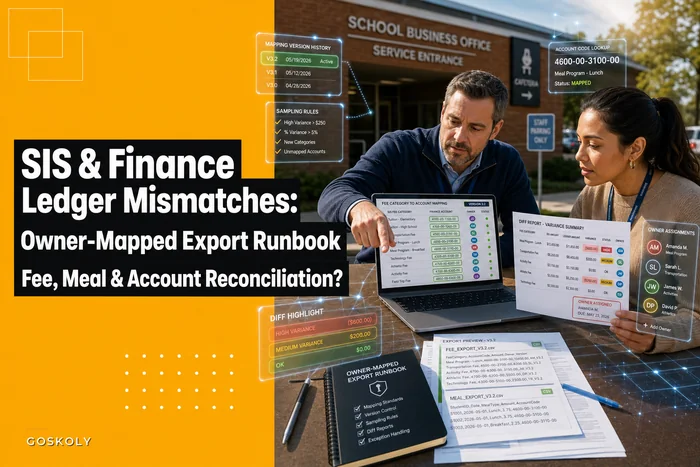
A lot of this overlaps with the general problem of SIS and finance ledgers not matching — the preflight is where you catch those mismatches before they become part of a submitted, legally-attested claim rather than after.
5. Governance checkpoints that unify the siloed runbooks
Most districts have a reconciliation runbook per program — one for Title I, one for state categorical, one for EL, each owned by a different person, none of them talking to each other. Governance checkpoints are the connective tissue: defined moments in the fiscal calendar where all the funding streams reconcile against the same canonical mapping and the same snapshot discipline.
A checkpoint isn't a meeting. It's a gate: the claim doesn't advance until the preflight passes, the snapshot is stored, and the mapping version is confirmed current. That's what turns a stack of disconnected runbooks into a single auditable lifecycle.
A simple end-to-end workflow
Here's how the pieces fit together across one grant cycle:
-
Event capture — A SIS event occurs (student enters a Title I program). The canonical mapping already knows this event feeds a specific funding bucket under a specific rule.
-
Pre-count validation — In the weeks before the count date, a validation run checks that every student in the bucket still meets the rule and that no program codes are orphaned.
-
Count-date snapshot — On the count date, the SIS state is frozen and stored immutably, tagged to the grant and the mapping version used.
-
Claim preflight — Before submission, the preflight dashboard runs every check; anything flagged gets resolved or documented as an exception.
-
Governance checkpoint — The claim gate confirms snapshot stored, preflight clean, mapping version current. Only then does it advance.
-
Forecast refresh — On the quarterly cadence, actuals from the snapshot feed back into the revenue forecast, and divergences get flagged early.
-
Audit-ready assembly — The snapshot, mapping version, and preflight results are already packaged as the evidence trail. No reconstruction needed.
A simple visual of that workflow:
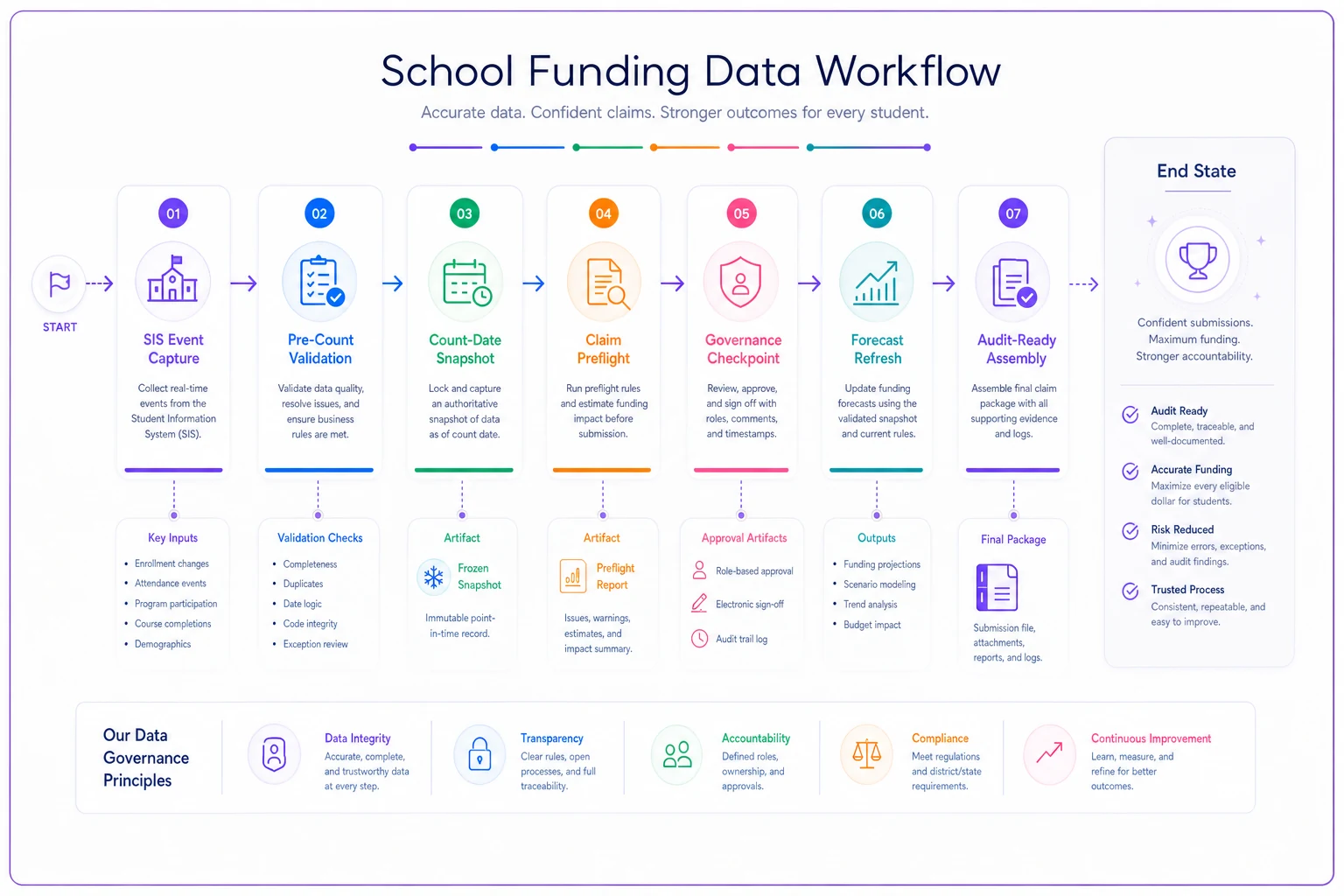
What makes this a system rather than a checklist is that each step produces the input for the next and the evidence for later. The snapshot that justifies the claim is the same snapshot that feeds the forecast and the same one an auditor sees. One source of truth, used everywhere.
Where software earns its place — and where it doesn't
A lot of this can start in spreadsheets, and honestly it should, until the volume makes that unsafe. The question is when to move the mapping, snapshots, and preflight checks into an operational platform that enforces them automatically.
AI-assisted operational software helps most where the work is repetitive validation and reconciliation that humans do slowly and inconsistently — running preflight checks across thousands of students, flagging eligibility changes that happened after a count date, catching a program code that maps to nothing, comparing SIS snapshots against finance ledgers without someone hand-tracing rows. Automating those checks means the governance checkpoint actually holds, because the system won't let a claim pass with an unresolved exception. It also makes the forecast cadence sustainable — the data pull that used to eat a full day happens on schedule without anyone needing to remember it.
What software should not do is own the judgment. The canonical mapping still needs a human who understands the eligibility rules to approve each version. A forecast divergence still needs someone to interpret why EL enrollment dropped. Automation enforces the discipline; it doesn't replace the expertise.
When to invest in this — and when to wait
This makes sense when:
-
You run multiple funding streams with different count dates and rules
-
Your district has grown past the point where one person can hold the whole mapping in their head
-
You've had an audit finding, an amended claim, or an unexplained variance in the last two or three years
-
Your forecast and your actuals routinely drift apart during the year
This is overkill when:
-
You're a single small school with one or two straightforward funding sources
-
The same person owns enrollment, eligibility, and claims end to end, and has for years
-
Your volume is low enough that manual reconciliation genuinely catches everything
Who should be careful rushing this: a district mid-way through a SIS migration or a finance system change. Build the canonical mapping after the systems stabilize, not during the chaos — otherwise you're versioning a moving target.
A realistic before-and-after
A district running four federal and state funding streams across roughly a dozen campuses had each program reconciled separately — each on its own spreadsheet, each by a different staff member. Count-date snapshots were pulled manually and sometimes overwritten. Audit prep took the better part of two months every year because nobody could cleanly show why a given claim matched a given roster on a given date.
They did three things: built a single versioned mapping of SIS events to funding buckets, froze and stored count-date snapshots automatically, and put a preflight gate in front of every claim. Nothing exotic.
The first year, the preflight caught a batch of students whose eligibility had lapsed after the count date but who were still sitting in the claim — a correction worth somewhere in the low five figures before it became a finding. Audit prep dropped from a multi-week scramble to a few days of pulling already-assembled evidence. And the quarterly forecast refresh caught an enrollment dip early enough that finance adjusted the revenue projection before it blew a hole in the budget mid-year. None of these were dramatic wins. They were the quiet result of the chain finally being connected end to end.
The real takeaway
The funding lifecycle fails in the handoffs, not the steps. Every district has competent people running enrollment, eligibility, and finance — and funding still goes sideways because no one owns the translation between them, and no one treats the mapping, the snapshots, and the forecast as maintained assets instead of annual improvisation.
Getting the SIS to grants lifecycle in K-12 right isn't about working harder inside each silo. It's about building the connective tissue — the canonical mapping, the frozen snapshots, the preflight gate, the forecast cadence, the governance checkpoints — that turns five disconnected runbooks into one auditable chain you can actually defend. Do that, and the audit stops being archaeology, the forecast stops being a guess, and the money you're entitled to stops leaking out through the seams.
Ready to optimize your school operations?
Join hundreds of schools using GoSkoly to save time, improve collaboration, and enhance student outcomes.