

Most residency cases don't fall apart because the registrar was wrong. They fall apart because the registrar was right but couldn't prove it. A principal "knew" the kid actually lived two districts over, the attendance office had a hunch, somebody saw the car with out-of-county plates in the pickup line — and then the family's attorney asked one simple question: "What's your documentation?" and the whole thing collapsed into a he-said-she-said that the district quietly dropped.
That's the gap this runbook is built to close. Not detection as a gut feeling. Detection as a repeatable process that produces a clean, defensible evidence packet an auditor or district counsel can actually use — and that survives an appeal hearing without the registrar looking like they targeted a family.
This is scoped tight on purpose. It's not about enrollment fraud in general, not about immigration status, not about custody disputes. It's about one thing: residency fraud detection K-12 at the registrar's desk, from the first anomaly flag to the referral packet you hand to legal.
Start with the sampling problem, because that's where most districts get this wrong
The mistake that quietly poisons a lot of residency programs: districts either investigate nobody or they investigate based on who "looks" suspicious. The first approach means fraud runs unchecked and your inter-district tuition dollars walk out the door. The second approach is how you end up in a discrimination complaint, because "who looks suspicious" is almost never evenly distributed across your enrollment.
A defensible program needs a sampling heuristic that is neutral, documented, and triggered by data — not by a hunch. The point isn't to catch everyone. The point is to make your selection method explainable later. If counsel asks "why did you review this family and not the one next door," you need an answer that isn't "the attendance clerk had a feeling."
What tends to work in practice is a layered flag system where a case only moves forward if it hits a scoring threshold, not a single trigger. A single out-of-zone data point is noise. Three stacked flags is a signal.
-
Address shared with a commercial or non-residential parcel (verify against the county assessor's property-type field, not just a street match)
-
Address matches more than a set number of currently enrolled students across unrelated families (apartment complexes will naturally cluster, so set the threshold above normal density)
-
Transportation pattern mismatch — student is consistently picked up/dropped at an address different from the one on file, logged by the bus or car-line system
-
Emergency contact and "home" address in different attendance zones on the same enrollment record
-
Re-enrollment after a "move" with no corresponding change in utility documentation
-
Mail returns from the registered address
The scoring approach matters because it protects you. When every reviewed case had to clear the same numeric bar, the selection stops being about the student and starts being about the record. That's the difference between an audit finding and a lawsuit.
One pattern worth flagging specifically: the highest false-positive source is almost always families in genuine transition — doubling up with relatives, recently displaced, or living in a situation that may actually trigger McKinney-Vento protections. Your sampling heuristic needs a hard carve-out so that a potential homelessness indicator stops the fraud track and routes to the homeless liaison instead. Running a McKinney-Vento-eligible family through a fraud investigation is both wrong and legally radioactive.
Capture evidence like you'll have to defend it, because you will
The single biggest failure in residency cases is sloppy evidence. Not missing evidence — sloppy. A screenshot with no date. A surveillance note with no observer name. A utility bill saved to someone's desktop and never timestamped. Any of those, and a halfway-decent attorney gets the whole thing thrown out.
Eliminate administrative overload.
GoSkoly helps you manage schedules, attendance, and communications seamlessly.
- Unified student and staff management
- Automated attendance tracking
- Integrated communication tools
No credit card required
Every piece of evidence needs the same four properties: it must be dated, attributed, source-identified, and tamper-evident. If you can't say who collected it, when, from where, and prove it hasn't been edited since, it isn't evidence. It's a story.
Standardize this with a capture template so the registrar isn't inventing the format mid-investigation. A minimum evidence record should contain:
| Field | Why it matters |
|---|---|
| Case ID | Links every artifact to one file; prevents loose documents |
| Date & time of capture | Establishes timeline and recency |
| Collected by (name + role) | Attribution; needed if the person must testify |
| Source type | Utility bill, assessor record, bus log, observation, etc. |
| Source authority | Who issued it (the gas company, the county, the carrier) |
| Document hash / file checksum | Proves the file wasn't altered after capture |
| Chain-of-custody note | Who handled it after collection and when |
| Relevance note | One line: what this proves about residency |
That checksum row trips people up, so to be concrete: when you save a scanned utility bill as a PDF, generate a hash of that file and record it. If anyone later claims the document was edited, you compare hashes. This feels like overkill right up until the appeal hearing, where it's the thing that makes counsel relax.
-
Primary documents beat secondary ones. A current utility bill in the parent's name outweighs a lease copy, which outweighs a verbal statement. Rank your evidence and lead the packet with the strongest.
-
Observation is supporting, never primary. Someone seeing a car in another district is corroboration. It is not proof of residence and should never be the foundation of a case.
-
Keep the raw version of everything. Redact for distribution, but never overwrite the original. The redaction and the original both live in the case file.
-
Timestamp the gap. If you observed something on three separate days, that pattern is stronger than one sighting — but only if each observation is independently logged.
If your district already runs a disciplined approach to exports and record assembly, that muscle memory carries over directly. The same thinking behind owner-mapped exports and automated evidence assembly for audits applies here: the evidence has to assemble into a package, cleanly attributed, without someone frantically reconstructing it the night before a hearing.
The escalation tiers — and why skipping them gets cases dismissed
A residency case shouldn't go from "clerk notices something" to "family gets a dis-enrollment letter" in one jump. That's not just unfair — it's procedurally fragile. Every skipped step is a due-process argument the family's attorney gets for free.
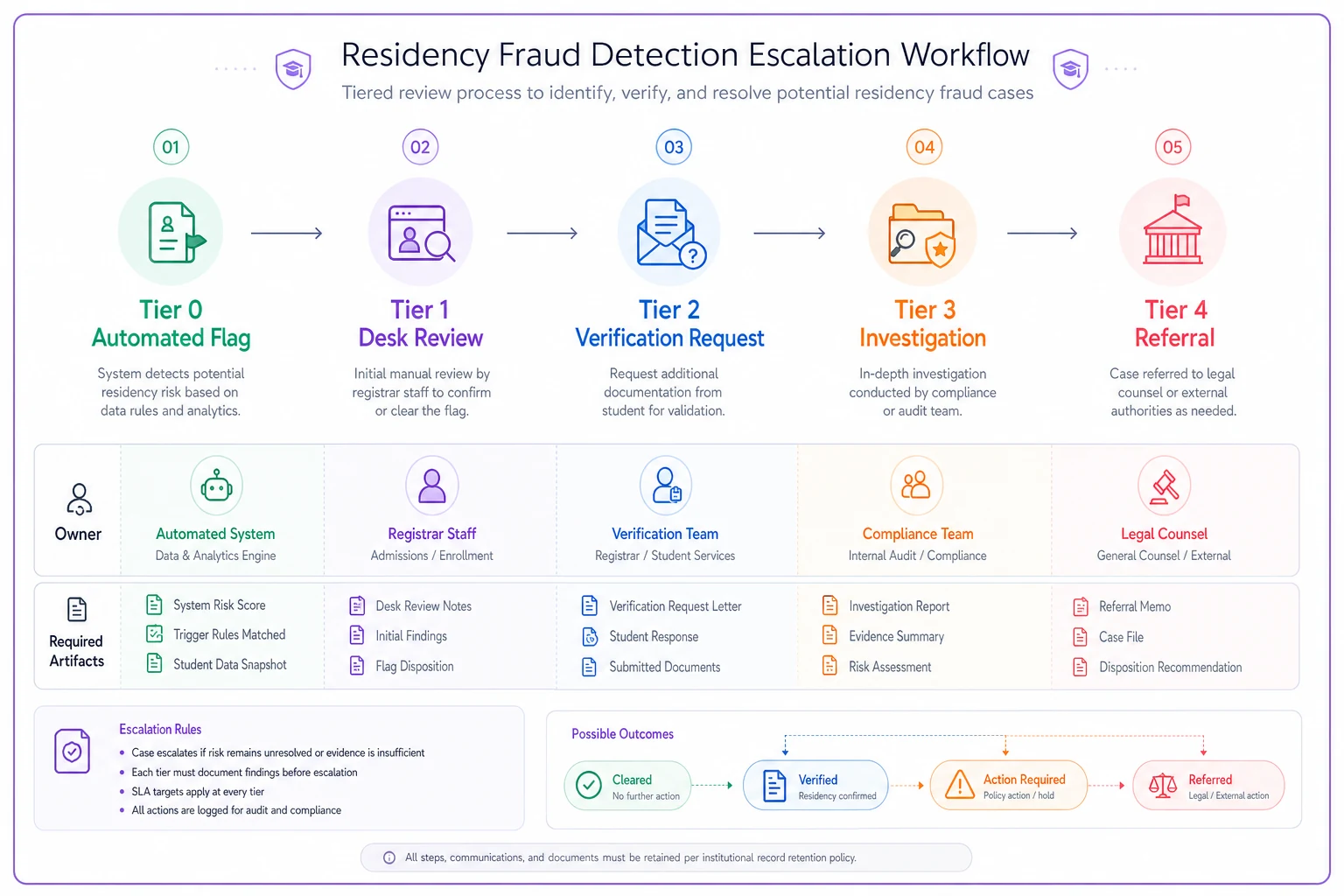
Build the escalation as discrete tiers, each with its own owner, its own required actions, and a defined exit — either the case closes clean or it advances with documentation.
The tiered path:
-
Tier 0 — Flag. The data trigger fires or a staff member submits a concern through a structured form (never a hallway comment). Nothing is actioned yet. The flag is logged with its source. If it fails the scoring threshold, it closes here and that closure is recorded.
-
Tier 1 — Desk review. The registrar pulls the enrollment record, re-verifies the documents on file, and cross-checks against neutral public data (assessor, address validation). No contact with the family yet. Many cases die here because the paperwork actually checks out — and that closure is just as important to record as an escalation.
-
Tier 2 — Verification request. The district contacts the family and requests current residency documentation, using the same standardized request every flagged family receives. Identical wording, identical deadline, identical acceptable-document list. Uniformity here is your discrimination defense. Give a real response window and document the send and any response.
-
Tier 3 — Investigation. Only if Tier 2 is unresolved or the documents provided don't hold up. This is where supporting evidence — observation logs, carrier records, mail returns — gets assembled into the case file under the capture template. This tier has a named owner above the registrar, typically a district-level administrator, because the decisions here carry real consequences.
-
Tier 4 — Referral. The case packet goes to counsel and/or the auditor for a tuition-recovery or dis-enrollment determination. The registrar doesn't make the final legal call; they hand over a complete, defensible file.
Keep a simple timestamped log entry for each tier transition so you can show the escalation trail without hunting through multiple systems.
The non-negotiable rule: a case cannot skip a tier. If Tier 2 was never properly sent, Tier 4 is dead on arrival. Each tier should produce a timestamped record of entry, the actions taken, and the exit decision. When that trail exists, an appeal becomes a review of the record. When it doesn't, the appeal becomes a referendum on the registrar's credibility.
One operational detail worth emphasizing: close the loop on cleared cases as explicitly as flagged ones. A program that only documents the families it pursued, and quietly forgets the ones it cleared, looks like targeting. A program that documents both looks like a process.
A simple diagram helps show the handoff between owners at each tier.
When that trail exists, an appeal becomes a review of the record. When it doesn't, the appeal becomes a referendum on the registrar's credibility.
The referral packet: what auditors and legal actually want
When a case reaches Tier 4, the quality of your packet determines whether anything happens. Counsel and auditors are not going to go digging through folders. If it isn't in the packet, assembled and labeled, it effectively doesn't exist.
A templated referral packet forces consistency and stops the registrar from sending a different bundle every time. Every packet should contain, in this order:
-
Cover summary — one page
student/family identifiers, the residency claim on file, the alleged actual residence, and the bottom-line determination being requested (tuition recovery, dis-enrollment, or both).
-
Timeline — the escalation history, tier by tier, with dates. This is the first thing counsel reads and the thing that proves due process.
-
Evidence index — every artifact listed with its capture-template metadata and relevance note.
-
Primary evidence — the strongest residency documents, redacted for distribution.
-
Supporting evidence — observation logs, carrier records, assessor data.
-
Standardized correspondence — copies of the exact verification request sent, with proof of delivery and any family response.
-
McKinney-Vento screening note — explicit confirmation the case was screened for homelessness indicators and cleared, with the date. This single page heads off the most damaging possible objection.
The timeline and the McKinney-Vento note are the two pages that decide whether counsel moves forward. Everything else supports; those two protect the district.
A real scenario: the apartment-cluster case
A mid-sized suburban district — around 11,000 students — kept losing residency cases at the appeal stage despite being fairly confident they were right. Their process was essentially: attendance office flags a family, registrar sends a letter, family appeals, district folds because the file was thin.
They rebuilt around sampling scores and tiered escalation. The first clean catch under the new process came from an address that matched nine enrolled students across six unrelated families — well above that complex's normal density — combined with mail returns on three of those records.
Under the old approach, that's a letter and a coin flip. Under the new one: Tier 1 confirmed the documents on file were stale, Tier 2 sent the identical verification request to all affected families, four responded with valid current documentation and were cleared and documented, and two didn't respond at all. Those two advanced to Tier 3, where assessor records showed the registered address was a commercial mailbox facility, not a residence.
The referral packet on those two cases was complete — timeline, evidence index, standardized correspondence, checksummed documents, McKinney-Vento clearance. Both resolved in the district's favor without a contested hearing, because the families' representatives looked at the packet and saw there was nothing to fight. Recoverable tuition on the two confirmed cases ran into the mid five figures, but the registrar's team said the bigger shift was that appeals stopped being terrifying. The file did the arguing.
When this level of rigor makes sense — and when it doesn't
This makes sense when your district borders higher-cost or higher-demand attendance zones, when you're carrying meaningful inter-district tuition exposure, or when you've already lost cases you believed were valid. If you've ever dropped a residency concern specifically because you couldn't prove it, you need this.
This is overkill when you're a small, geographically isolated district with negligible boundary pressure and a handful of enrollment changes a year. Building a five-tier escalation for three cases annually is process for its own sake. A simple documented checklist is enough.
Who should not run this at the registrar level alone: any district without a named administrator above the registrar owning Tier 3 and legal owning Tier 4. Residency determinations carry real consequences for families, and a single clerk making the full call — without escalation owners and without the McKinney-Vento carve-out — is exactly how a district ends up defending a civil rights complaint instead of recovering tuition. If you can't staff the tiers, don't run the program; tighten your enrollment verification at intake instead.
Where the record-keeping quietly decides everything
The theme running through all of this is boring and it's the whole game: a residency case is only as strong as its trail. Detection is the easy part. Districts are usually right about who's gaming residency. What they lack is the disciplined, timestamped, attributed record that turns "we're pretty sure" into "here's the file."
That discipline isn't unique to residency work. The same operational habits that keep your enrollment records clean in the first place — accurate addresses, deduplicated families, owned data — reduce false flags before they ever start. Districts that stay on top of enrollment-season roster cleansing with owner-assigned duplicate resolution tend to generate far fewer phantom residency flags, because their address data is actually trustworthy. Half of residency noise is really just dirty records pretending to be fraud.
Get the sampling neutral, capture the evidence like it's headed to a hearing, run the tiers without skipping, and template the packet so legal can act. Do that, and the question "what's your documentation?" stops being the moment your case dies — and starts being the moment it holds.
Ready to optimize your school operations?
Join hundreds of schools using GoSkoly to save time, improve collaboration, and enhance student outcomes.