
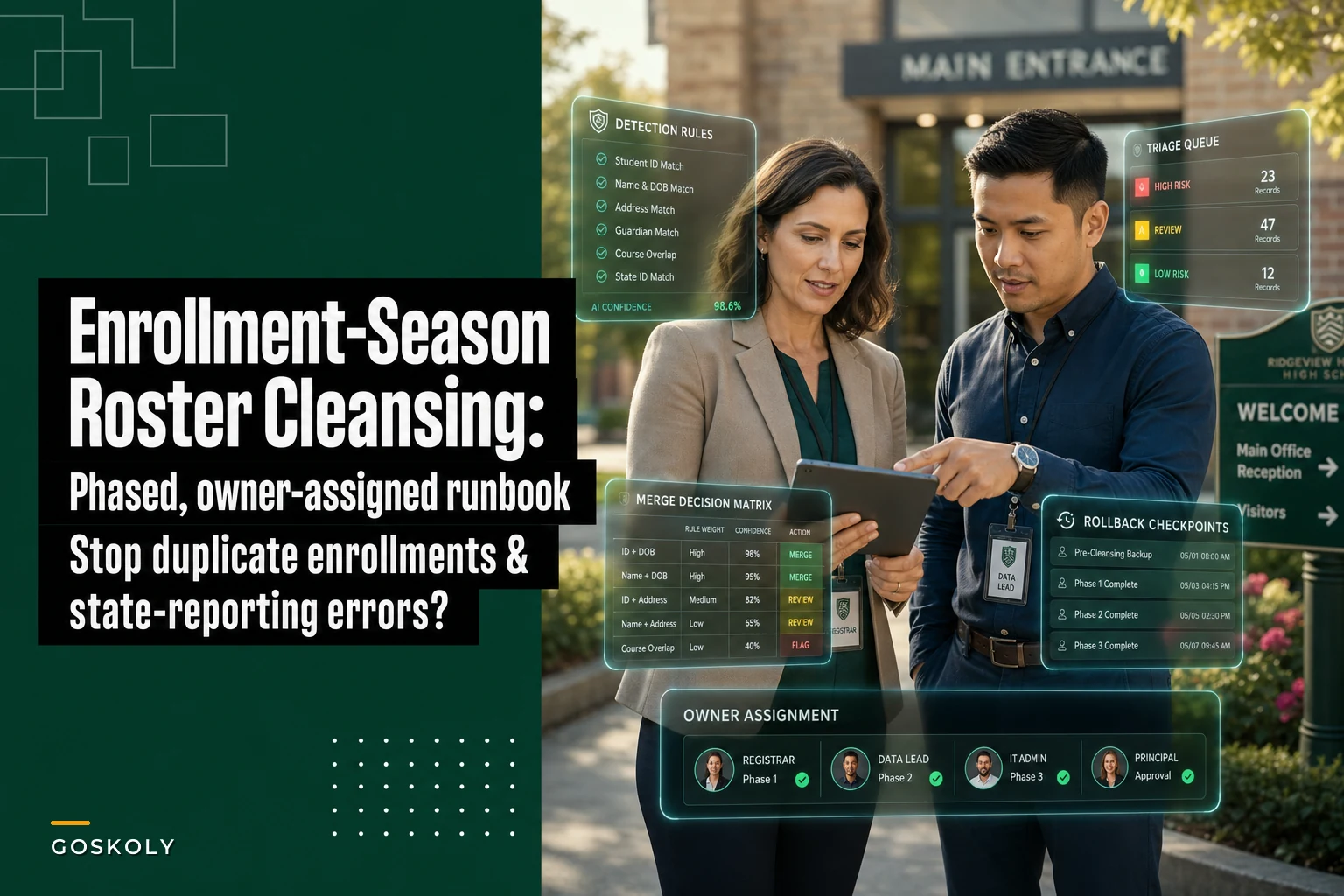

August enrollment chaos creates duplicate student records faster than most districts can catch them. Multiple staff members entering data, parents submitting forms through different channels, transfers arriving mid-process — suddenly you've got the same student existing three times across your systems with different ID numbers, conflicting demographic data, and enrollment dates that don't match.
The real damage shows up months later when state reporting deadlines hit. Attendance counts are inflated. Funding calculations break. Special education rosters show ghost students. Testing accommodations get assigned to duplicates while real students miss services. And when the state audit arrives, you're explaining why Madison Chen appears enrolled in both third and fourth grade simultaneously with two different birth dates.
Most districts discover these problems too late — after submitting reports, after funding gets questioned, after compliance officers start asking uncomfortable questions. Roster cleansing needs to happen systematically during enrollment season, not as emergency cleanup in October.
The Detection Problem: Finding Duplicates Before They Corrupt Your Data
Duplicate detection in student information systems fails because most schools rely on exact name matching. But enrollment season duplicates rarely match perfectly. A parent fills out the online form as "Jonathan Smith" while office staff enters "Jon Smith" from the paper form. The transfer paperwork shows "Jonathan R. Smith Jr." Nobody catches it until three different lunch accounts exist for the same kid.
Phase 1 Detection Rules (Run Daily During Enrollment)
-
Soundex matching on last names + first three letters of first name
-
Birth date matching with one-digit variance (typos)
-
Address matching ignoring apartment numbers
-
Parent phone number matching across households
Phase 2 Detection Rules (Run Weekly)
-
Previous school matching for transfers
-
Emergency contact overlap analysis
-
Sibling relationship patterns
-
State ID number partial matching (last 4 digits)
Set up detection to run automatically overnight and generate morning reports. During enrollment season, roughly 3-7% of new entries will flag as potential duplicates. That percentage jumps to 12-15% for students transferring between schools in the same district.
Detection rules also need different thresholds depending on enrollment type. New kindergarten students require looser matching since parents often use nicknames on initial forms. High school transfers need tighter matching since their records come with more historical data to verify against.
Triage Queues: Who Reviews What and When
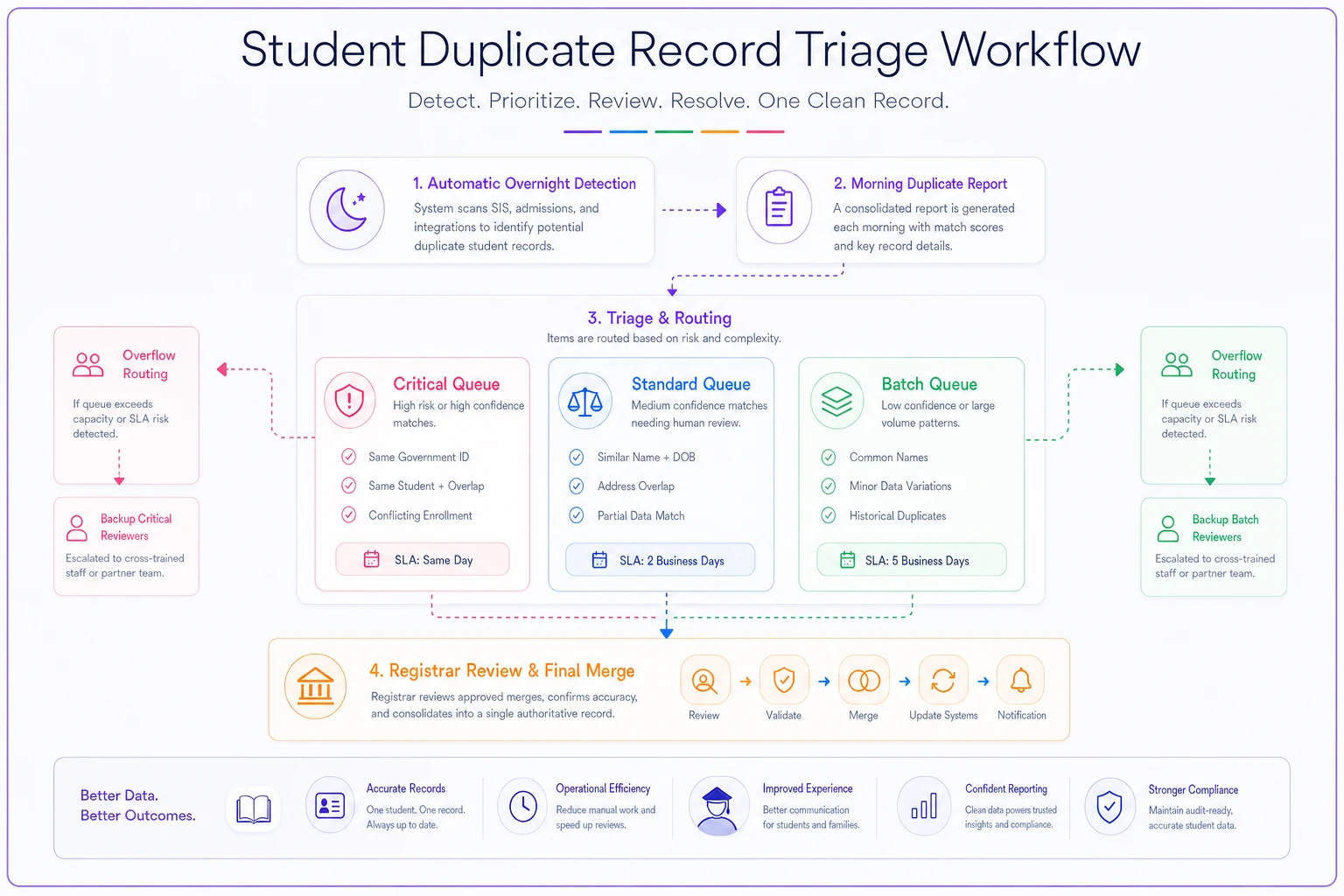
Detected duplicates need immediate triage, but dumping everything into one queue creates paralysis. A district processing 400 new enrollments daily might generate 30-50 potential duplicate flags. Nobody can carefully review that many cases while also handling walk-in registrations.
Eliminate administrative overload.
GoSkoly helps you manage schedules, attendance, and communications seamlessly.
- Unified student and staff management
- Automated attendance tracking
- Integrated communication tools
No credit card required
Structure triage queues by confidence level and impact:
Critical Queue (Same Day Review)
-
High confidence matches (90%+ probability)
-
Special education students
-
Transportation-dependent students
-
Students with medical alerts
Standard Queue (24-Hour Review)
-
Medium confidence matches (70-89%)
-
General education students
-
Within-district transfers
Batch Queue (Weekly Review)
-
Low confidence matches (50-69%)
-
Demographic-only conflicts
-
Historical duplicate patterns
Assign queue ownership based on data access and decision authority. The registrar handles Critical Queue items since they can immediately verify against official documents. School secretaries manage Standard Queue for their building's students. The data analyst reviews Batch Queue patterns to identify systematic issues.
During peak enrollment — typically the two weeks before school starts — you'll need backup assignments. When the primary reviewer has more than 15 items in their queue, overflow should automatically route to a designated backup. This prevents bottlenecks when someone calls in sick during the busiest days.
Automate overflow routing thresholds so backups kick in before reviewers exceed 12–15 items to avoid last-minute handoffs.
Visualizing the triage flow helps teams understand routing and ownership.
This prevents bottlenecks when someone calls in sick during the busiest days.
The Merge Decision Matrix: When to Combine, When to Keep Separate
Not every duplicate should be merged. Sometimes you actually have twins with similar names. Sometimes divorced parents each try to enroll the same child. Sometimes the old record needs to stay separate for historical reporting requirements.
Your merge decision matrix needs clear rules:
| Scenario | Detection Signal | Verification Required | Merge Decision | Owner |
|---|---|---|---|---|
| Same student, different names | Name variant + matching birthdate + same address | Parent contact or birth certificate | Merge to most complete record | Registrar |
| Transfer duplicate | Previous school match + similar demographics | Transcript review | Merge to receiving school record | Receiving school secretary |
| Twin false positive | Same lastname + birthdate + address | Visual inspection of records | Keep separate, flag as verified twins | Data analyst |
| Custody duplicate | Different addresses + same student ID | Court documents | Keep most recent, archive other | Principal/Registrar |
| Historical student returning | Inactive record + new enrollment | Previous ID verification | Reactivate old record, merge new data | Registrar |
The matrix prevents common merge mistakes. In one district, staff merged all "Rodriguez, Maria" entries with similar birthdates and accidentally combined three different students into one record with twelve parents and six addresses. The state reporting system rejected everything, requiring manual reconstruction of each student's actual data.
Verification requirements should also match the risk level. High-stakes merges — special education students, custody situations — require document verification. Low-risk merges like spelling corrections or nickname standardization can proceed with basic demographic matching.
Rollback Checkpoints: Protecting Against Bad Merges
Every merge needs a rollback checkpoint. When someone accidentally combines the wrong records three days before state reporting, you need to undo the damage without losing subsequent updates.
Pre-Merge Checkpoint
-
Full record backup of both entities
-
Relationship mapping (courses, grades, attendance)
-
Document attachments and notes
-
Timestamp and user ID of merge decision
Post-Merge Verification (24 hours later)
-
Flag any subsequent conflicts
-
Parent portal access issues
-
Schedule conflicts
-
Transportation route problems
Weekly Rollback Window
-
Keep merge history for 7 days minimum
-
Allow one-click restoration
-
Preserve post-merge updates separately
-
Generate audit trail for compliance
A solid rollback system saved one district from disaster when they merged two students with identical names who were actually cousins living at the same address. The merge combined their grades, creating a student who somehow took Algebra I and Pre-Algebra simultaneously. The teacher noticed when printing rosters, and the rollback restored both records within minutes.
Build rollback triggers into the process too. If a merged student suddenly shows impossible scheduling — two classes same period, conflicting grade levels, or overlapping IEP services — the system should flag for immediate review. These conflicts often point to a bad merge that needs reversing.
Timeline Alignment with Enrollment Peaks
Roster cleansing isn't steady throughout the year. The workload follows predictable patterns that your runbook needs to accommodate:
Pre-Peak Preparation (July)
-
Update detection rules with previous year's patterns
-
Train backup reviewers on queue procedures
-
Test merge/rollback processes
-
Clear previous year's provisional records
Peak Enrollment (August 1-20)
-
Daily detection runs at 6 AM
-
Morning triage from 7-9 AM
-
Afternoon merge processing 2-4 PM
-
Emergency queue checks every 2 hours
Stabilization Period (August 21-31)
-
Shift to twice-weekly detection
-
Batch process remaining queues
-
Review merge audit trails
-
Document systematic issues
Pre-Reporting Cleanup (September 15-30)
-
Final duplicate sweep before October 1 count
-
Verify all special population rosters
-
Lock critical demographic fields
-
Generate pre-submission reports
The timeline changes for year-round schools or districts with spring enrollment for magnets and charters. Some districts also see secondary spikes in January when semester transfers process, requiring another round of intensive cleansing.
State Reporting Impact: Why Clean Rosters Matter
State reporting errors from duplicate students compound quickly. A district with 10,000 students and a 2% duplicate rate reports 10,200 students for funding. The state audit catches the inflation, triggers a funding review, and suddenly you're paying back a significant chunk in overpayments from the previous year while your current year budget gets frozen pending investigation.
The audit preparation process becomes significantly easier when your roster stays clean throughout enrollment season. Clean rosters also support better data governance practices across all district systems.
Specific reporting impacts from uncleaned rosters:
Attendance Rate Calculations
Duplicates make absent students disappear. If Johnny exists twice and attends under one ID while the duplicate stays home, your chronic absenteeism rate looks better than reality. State education departments increasingly cross-reference attendance with enrollment, catching these discrepancies.
Special Education Child Count
Every duplicate special education student represents potential fraud in state reporting. Federal IDEA funding follows accurate counts. When duplicates inflate your numbers, you might receive excess funding that requires payback with penalties.
Assessment Participation
State testing participation rates determine school ratings. Duplicate students who don't test drag down participation percentages. Schools have lost their "exemplary" ratings over ghost students who couldn't take tests they were registered for.
Transportation Funding
Many states fund transportation by actual riders. Duplicate students create phantom bus routes, inflate rider counts, and trigger funding reviews when buses run half-empty despite full rosters.
Building Your Implementation Team
Roster cleansing requires clear ownership at every level. Generic "everyone's responsible" approaches fall apart immediately when enrollment peaks hit.
Core Team Structure:
Enrollment Season Lead (usually Registrar or Data Manager)
-
Owns the master runbook
-
Adjusts detection thresholds
-
Makes final merge decisions for complex cases
-
Interfaces with state reporting team
Building-Level Processors (Secretaries or Enrollment Clerks)
-
Review their school's detection queue daily
-
Verify against local documents
-
Execute approved merges
-
Flag systematic issues
Technical Validator (IT or Database Admin)
-
Maintains detection queries
-
Monitors system performance during peak loads
-
Manages backup/rollback infrastructure
-
Extracts audit reports
Overflow Support (Trained Backup Staff)
-
Steps in when queues exceed thresholds
-
Handles basic verification tasks
-
Documents edge cases for review
-
Provides coverage during absences
During the August peak, most districts need roughly one dedicated processor per 500 new enrollments. A district expecting 3,000 new students should have at least six staff members trained on the process, even if only three or four are working it on any given day.
Automation Opportunities in Roster Management
Manual duplicate detection and resolution creates bottlenecks exactly when schools can least afford them. Modern operational software reduces the manual burden significantly, though human verification remains essential for final merge decisions.
AI-powered detection can surface potential duplicates that traditional exact-match systems miss. The software learns from your historical merge patterns — recognizing that "Bobby" and "Robert" are the same student when other factors align, or that families at certain addresses tend to use nicknames on informal documents but legal names on official forms.
Workflow automation handles the routine parts: generating morning detection reports, routing items to appropriate queues, sending verification requests to parents, creating backup snapshots before merges, and alerting supervisors when queues back up. Staff can focus on actual decision-making rather than moving data between systems.
The most useful automation comes from pattern recognition. When the system notices that Bus #47's route includes three duplicate students supposedly living at the same address, it flags the pattern for investigation. Or when multiple duplicates emerge from the same feeder school, it identifies a systematic issue in how transfer records import — something a manual process would likely miss until reporting season.
Integration between enrollment, student information, and state reporting systems also prevents duplicates from corrupting downstream processes. Instead of discovering problems during October reporting, you catch them during August enrollment when fixes are still straightforward.
When This Runbook Makes Sense (And When It Doesn't)
This phased approach works for districts experiencing concentrated enrollment periods with 100+ new students arriving within a few weeks. The investment in detection rules, triage queues, and merge matrices pays off when you're processing volume that makes manual review impossible.
Small districts with steady, manageable enrollment might not need this complexity. If you're handling 10-15 new enrollments weekly, a simple manual review with one designated reviewer could be enough. Adding queues and phases might actually slow things down.
Districts with highly stable populations also see less benefit. If 95% of your students return year-over-year with minimal transfers, duplicates rarely emerge.
Consider this approach essential if you have:
-
500+ new enrollments during peak season
-
Multiple enrollment channels (online, paper, transfer)
-
Several staff members entering data simultaneously
-
Historical problems with state reporting accuracy
-
Previous audit findings related to enrollment inflation
Skip this approach if you have:
-
Fewer than 100 new students annually
-
Single-point enrollment processing
-
Stable student population
-
Strong existing data quality controls
-
Limited technical infrastructure
Consider this approach essential if you have: 500+ new enrollments during peak season, multiple enrollment channels, several staff entering data, historical reporting problems, or previous audit findings.
The Hidden Costs of Delayed Cleansing
Waiting until state reporting deadlines to clean rosters creates cascading problems. One district discovered 847 duplicate records two days before their October 1 count submission. The emergency cleanup required pulling twelve staff members from their regular duties, hiring temporary data entry support, and ultimately submitting provisional numbers that triggered a state review.
The overtime alone ran close to $19,000. Temporary staff added another $8,000. But the real damage came from the hurried fixes — legitimate students accidentally archived, siblings merged together, special education services disrupted. Parent complaints peaked in November when report cards went to wrong addresses and parent portal access broke for accounts that had been "merged away."
Daily processing of 20-30 potential duplicates takes one person about 90 minutes. Fixing 800 duplicates in 48 hours requires a crisis response team and still leaves errors behind.
The stress of emergency cleansing also drives turnover. Nobody wants to spend their weekend before a holiday untangling data problems that proper processes would have prevented. Losing an experienced registrar over repeated fire drills costs far more than any overtime budget.
Moving Forward with Your Roster Cleansing Process
Start small with basic detection rules and simple triage queues. You don't need perfect processes before beginning — even catching half your duplicates during enrollment beats finding all of them during crisis mode in October.
Document every merge decision and its outcome. These patterns become your training data for next year's enrollment season. The weird edge cases from this August become the standard procedures for next August.
Train one backup reviewer at a time rather than overwhelming everyone with new procedures simultaneously. Let each person master their queue before adding complexity.
Most importantly, treat roster cleansing as an operational priority, not a technical afterthought. Clean enrollment data enables everything else — accurate attendance tracking, proper service delivery, compliant state reporting, fair funding allocation. An hour spent properly merging duplicate records in August saves dozens of hours fixing downstream problems in October.
The roster cleansing process doesn't need to be perfect, but it needs to be consistent. Daily detection during peak enrollment, clear ownership of review queues, documented merge decisions, and reliable rollback procedures turn chaos into manageable workflow. State reporting becomes accurate, audits pass cleanly, and staff stop dreading enrollment season.
The difference between districts that handle enrollment well and those that struggle isn't technology or staffing — it's having a clear runbook that everyone actually follows when the August rush hits. Build it now, while you have time to think, and next enrollment season becomes an execution problem instead of a crisis.
The difference between districts that handle enrollment well and those that struggle isn't technology or staffing — it's having a clear runbook that everyone actually follows when the August rush hits. Build it now, while you have time to think, and next enrollment season becomes an execution problem instead of a crisis.
Ready to optimize your school operations?
Join hundreds of schools using GoSkoly to save time, improve collaboration, and enhance student outcomes.