



The dual-language kindergarten program is capped at 44 seats. By the second week of August, the SIS shows 46 enrolled, the front office thinks there are three open spots, and the program coordinator has already promised a seat to a family who transferred in from another district. Nobody lied. Nobody was careless. The counts just drifted — because three different people were making enrollment decisions against three different snapshots of the same program.
This is the part of enrollment that rarely gets a real process. Roster cleansing gets attention, admissions calendars get attention, but the decision layer — who is allowed to seat a student, under what rule, against which live count — usually lives in someone's head or a shared spreadsheet that everyone edits and nobody trusts. That gap is where over-enrollment, broken waitlist promises, and reconciliation nightmares come from.
This piece is intentionally narrow. It covers the mechanics of moving students into capped programs: owner-by-owner decision flows, waitlist automation rules, capacity manifests, and the reconciliation checks that tie everything back to your admissions calendar and audit extracts.
Why capped-program enrollment drifts out of sync
The core problem is that "capacity" isn't actually one number. It looks like one number, but in practice it fractures into several competing versions the moment enrollment gets busy.
A typical example: a magnet STEM program has 60 seats. But 6 are held for sibling priority, 4 are reserved for a pending lottery round, and 2 are soft holds a counselor made verbally for families still finishing paperwork. The real number of freely-assignable seats is 48, not 60 — but the SIS only knows about the 60 and the confirmed enrollments. Everyone else is working off memory.
When multiple people can seat students and the true available count is buried in exceptions, drift is basically guaranteed. It usually happens when:
-
Two staff members seat students within the same hour against a count that hasn't refreshed
-
A verbal or emailed hold never gets recorded anywhere the SIS can see
-
A waitlist offer goes out but the seat isn't decremented until the family formally accepts
-
A withdrawal frees a seat and nobody backfills it because no one owns the backfill trigger
None of these are exotic. They're the default state of any program that fills faster than it's being tracked.
The capacity manifest: one number, defined once
Before any automation or decision rules matter, you need a single artifact that defines what "full" actually means for each program. Call it a capacity manifest. It's not a complicated document — just an authoritative breakdown of every seat and what it's committed to.
Eliminate administrative overload.
GoSkoly helps you manage schedules, attendance, and communications seamlessly.
- Unified student and staff management
- Automated attendance tracking
- Integrated communication tools
No credit card required
A workable manifest per program includes:
| Field | Example (Dual-Language K) | Why it matters |
|---|---|---|
| Total physical capacity | 44 | Hard ceiling, room/ratio driven |
| Priority holds (sibling/staff) | 5 | Reserved, not freely assignable |
| Lottery-round reserves | 6 | Locked until round closes |
| Confirmed enrolled | 28 | Actually seated |
| Soft holds (dated) | 3 | Expire if not confirmed by date |
| Freely assignable now | 2 | 44 − 5 − 6 − 28 − 3 |
| Waitlist depth | 19 | For forecasting offers |
The number that should be visible to the person seating students is "freely assignable now" — not total capacity. When staff see "44" they mentally assume room. When they see "2," they behave completely differently. Showing the wrong number is the single most common cause of overfills.
Soft holds need an expiration date, always. An undated hold is just a permanent phantom seat that quietly shrinks your usable capacity for weeks. A dated hold — "expires Aug 12, 5 PM" — either converts or releases back into the assignable pool.
Owner-by-owner decision flows
Once capacity is defined, the question becomes who gets to act on it. This is where "everyone can enroll" quietly destroys accuracy — not because people are irresponsible, but because concurrent decisions against a shared count don't reconcile cleanly.
The fix isn't to centralize everything into one bottleneck. It's to assign clear decision ownership per decision type, so two people are never deciding the same seat.
A clean split for a mid-sized district program:
-
Confirmed enrollment (paperwork complete) Registrar owns. Only the registrar decrements the freely-assignable count.
-
Priority/sibling verification Enrollment coordinator owns. They validate eligibility and move a hold into confirmed, or release it.
-
Waitlist offers Program coordinator owns issuing the offer, but the offer doesn't decrement capacity — it decrements the waitlist and creates a dated soft hold.
-
Lottery reserves System-owned, released on a scheduled date tied to the admissions calendar.
-
Exceptions/appeals (over-cap requests) Principal or director owns, in writing, logged against the manifest.
The pattern worth internalizing: only one role should ever be able to convert a seat from "available" to "taken." Everyone else creates intents — offers, holds, requests — that route to that role. When you separate "expressing interest in a seat" from "committing a seat," concurrent activity stops colliding.
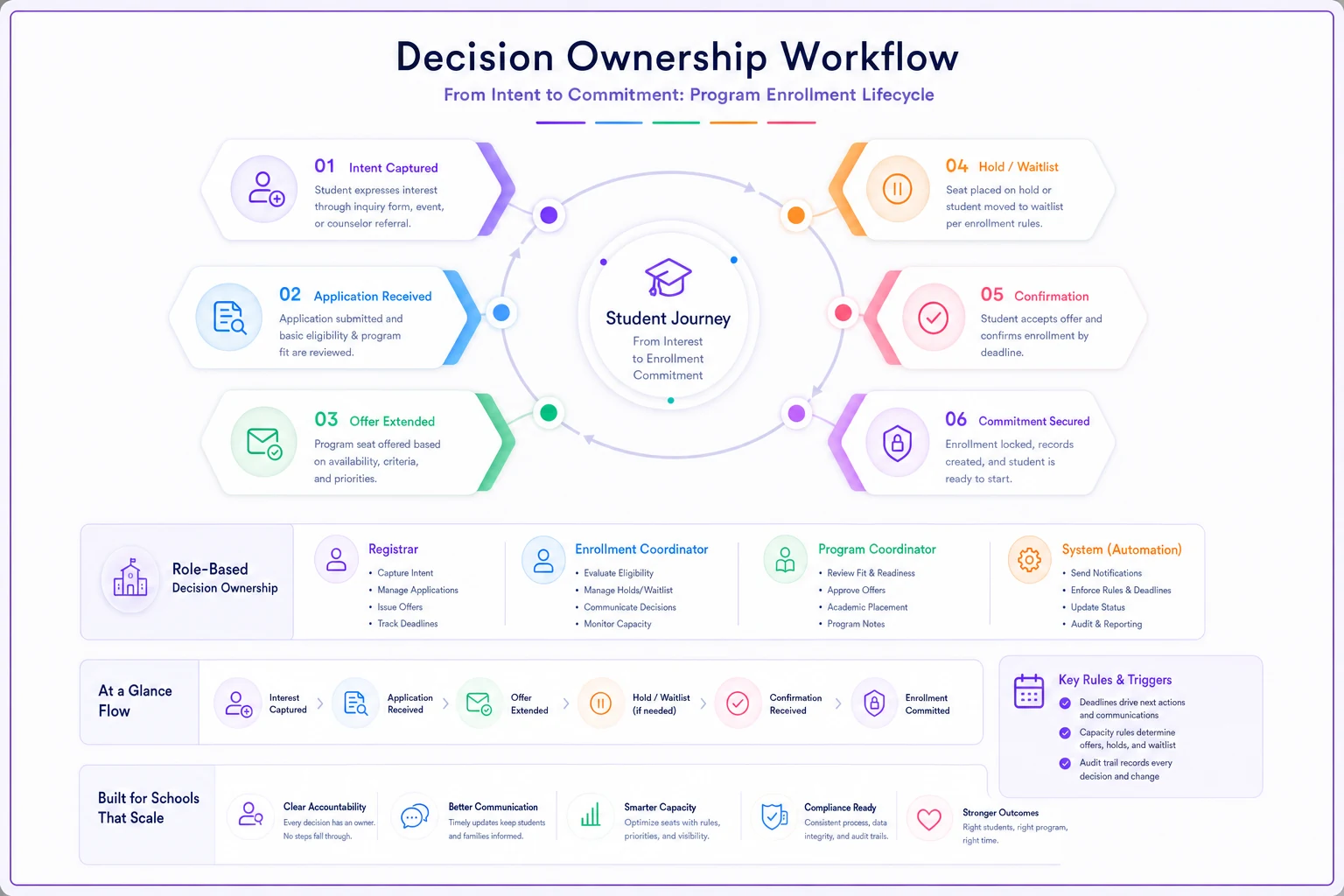
Simple diagram of the decision-ownership workflow.
This is the same owner-mapped discipline that makes messy rosters recoverable. If you've worked through an owner-assigned duplicate-resolution runbook, you already know the underlying principle: every record change has exactly one accountable owner, and the trail shows who did what.
Waitlist automation rules that don't create ghost offers
Waitlists break in a specific, predictable way: an offer goes out, the family takes four days to respond, and in that window the seat is neither held nor released. Either two families get offered the same seat, or it sits frozen while the program looks full.
Automation helps here, but only if the rules are explicit. Vague waitlist logic, once automated, is just faster chaos.
The rules that actually matter:
-
Offers create dated soft holds, not enrollments. An offer reserves the seat for a fixed window — 48 to 72 hours — and shows on the manifest as a soft hold.
-
Expiry auto-releases. If the family doesn't confirm by the deadline, the hold expires, the seat returns to assignable, and the next offer fires automatically.
-
One active offer per open seat. Never batch-offer a single seat to five families "to be safe." That's how you end up apologizing to four of them.
-
Rank is frozen at offer time. If a higher-priority student appears mid-window, they queue for the next seat — yanking an active offer breaks trust and creates disputes.
-
Every state change is timestamped and attributed. Offered, accepted, declined, expired — all logged.
Use a consistent 48–72 hour offer window so expirations and auto-offers stay predictable.
Where automation earns its keep is in the time-sensitive, easy-to-forget parts: watching expiry clocks, firing the next offer the instant a hold lapses, updating the assignable count without a human refreshing anything. Those are exactly the tasks that fall through the cracks during a 200-application week. A workflow platform that tracks hold expirations and triggers the next offer automatically removes the "we forgot to backfill" failure entirely — but the rules above have to exist first. The tooling enforces the policy; it can't invent one.
Reconciliation checks tied to the admissions calendar
Even with clean decision flows and solid waitlist rules, counts still need to be proven correct at fixed points. Reconciliation isn't a year-end event — it's a recurring check anchored to your admissions calendar milestones.
The milestones worth hard reconciliation:
-
Lottery close date Confirm reserves released or converted; assignable pool recalculated.
-
Priority/sibling verification deadline All holds either confirmed or released — zero lingering undated holds.
-
First day of school Enrolled count matches physical roster; no-shows flagged for backfill.
-
Count/census date (state reporting) SIS enrolled figure matches the manifest's confirmed figure, program by program.
At each milestone, run three checks:
-
Sum check Confirmed + holds + reserves + assignable = total capacity. If the arithmetic doesn't close, a seat is unaccounted for.
-
Orphan check Any student in the program not tied to a decision record — no offer, no priority, no lottery result? That's an unexplained seat.
-
Stale-hold check Any soft hold past its expiry still occupying capacity? Release it.
The common mistake is reconciling only against the SIS. The SIS tells you who's enrolled — it doesn't tell you why, or which promised offers are still outstanding. Reconciling the manifest against the SIS and the offer log is what catches the gaps.
When these checks feed clean audit extracts, count-date reporting stops being a scramble. The same evidence-assembly logic covered in owner-mapped exports and automated evidence assembly applies directly: if every seat maps to a dated, attributed decision, the extract practically writes itself.
A short real scenario
A district running four capped programs — dual-language K, two magnet strands, and an early-college pathway, roughly 210 seats combined — kept overfilling by two to four students per program each August. Every year it meant emergency section splits, a scramble for aides to meet ratios, and a few uncomfortable calls to families whose "offer" turned out not to be real.
The change wasn't dramatic. They defined a capacity manifest per program, moved to a single "assignable now" number visible to staff, made offers create dated 72-hour holds instead of instant enrollments, and ran the three reconciliation checks at each admissions-calendar milestone.
The following season, over-enrollment across all four programs dropped to essentially zero — one contested seat, resolved through the exception flow rather than after the fact. Waitlist offer turnaround tightened from "whenever someone remembered" to same-day auto-fire on expiry, and the count-date extract reconciled on the first pass instead of after a week of manual cross-checking. No new staff. Just clearer ownership and rules the counts couldn't drift around.
When this level of structure makes sense — and when it doesn't
This is worth building when you have genuinely capped programs with waitlists and priority rules — magnets, dual-language, specialized pathways, lotteries. The overhead of manifests and decision flows pays off precisely because seats are scarce and contested.
It's overkill for open-enrollment general classrooms where any student who registers gets a seat and capacity is soft. Forcing a manifest and offer-hold cycle onto uncapped enrollment just adds friction with no real payoff.
It's also a bad idea to attempt if you haven't sorted out who owns what first. Automating waitlist offers on top of a system where five people can all seat students against a stale count will make things worse, faster. Ownership and rules come first; automation second.
The through-line is simple: capacity drifts because "how full is this program" has too many answers held by too many people. Define the number once, let exactly one role commit a seat, make offers reserve rather than enroll, and check the arithmetic at every calendar milestone. Do that, and August stops being the month you apologize to families over seats that were never really open.
Ready to optimize your school operations?
Join hundreds of schools using GoSkoly to save time, improve collaboration, and enhance student outcomes.