

The messiest part of a field trip isn't the trip itself. It's the 72 hours before it — the stack of half-signed permission slips, the one parent who emailed a nut allergy update to a teacher who happens to be out sick that day, and the chaos at 7:40 AM when three buses are idling and nobody can confirm whether Marcus in Room 12 is actually cleared to go.
Most schools treat the field trip permission workflow like a paperwork chore. It isn't. It's a chain of custody problem. A signed consent form has to travel all the way to a specific seat on a specific bus, carrying medical information the driver and chaperones actually need — and it has to be provable afterward. That last part matters more than people admit. When something goes wrong on a trip, the first question is always: what did you know, and can you prove you acted on it?
This post walks through where that chain breaks, and how to build a pipeline where a medical flag on a consent form automatically shows up on the right manifest, in front of the right adult, with a trail you can hand to a lawyer or a nurse without scrambling.
The three handoffs where field trips actually fail
Forget the general "we lost some slips" complaint. The failures are specific, and they happen at three handoffs.
Handoff one: parent signature to central record. A parent signs, but the signature lives on paper in a teacher's tote bag, in an email thread, or in a Google Form nobody has reconciled against the class roster. Nobody knows the denominator. You have 58 signed slips and a class of 64 — but which six are missing? At 3 PM the day before, someone is squinting at a spreadsheet trying to reverse-engineer that list.
Handoff two: medical flag to the people on the ground. This is the dangerous one. The office knows Ava has an EpiPen and a bee-sting allergy because it's in the health record. But that fact has to reach the chaperone assigned to Ava's small group and the driver of Bus 2. In practice, medical info stays siloed in the nurse's system while the trip roster gets built somewhere else entirely. The two never talk. A diabetic student's care plan can be complete and current in the health record while the field trip manifest just says "Group C, Chaperone: Mr. Delgado" — no flag, nothing.
Handoff three: the plan to the actual boarding. You built clean bus assignments. Then on the morning of, two kids are absent, a parent shows up wanting to drive their own child, a chaperone calls out, and someone reshuffles seats on the curb with a pen. Now your manifest is fiction, and if anyone asks later who was on which bus, the honest answer is "we're not totally sure."
Each handoff loses information. The medical flag is the thing you can least afford to lose, and it's usually the thing that travels the worst.
Why the medical flag gets dropped
The core reason is that consent and health data live in different systems owned by different people, and the field trip sits between them with no clear owner.
Eliminate administrative overload.
GoSkoly helps you manage schedules, attendance, and communications seamlessly.
- Unified student and staff management
- Automated attendance tracking
- Integrated communication tools
No credit card required
The health record belongs to the nurse. The roster belongs to the teacher. The transportation manifest belongs to whoever coordinates buses. The permission slip belongs to nobody until it becomes a problem. So when a parent updates an allergy note two days before the trip, that update lands in the health system and stops. There's no rule wired in that says "any active medical flag for a student on an approved trip must appear on that trip's manifest." Without that rule, the update just sits there — technically correct and operationally useless.
There's also a timing problem people underestimate. Medical facts change after the permission is collected. A kid gets a new inhaler prescription. A concussion protocol goes into effect. A parent decides the night before that their child can't have the sunscreen the school provides. The permission slip is a snapshot; the medical picture is live. Any workflow that captures consent once and never re-checks against the current health record on trip morning will be wrong some percentage of the time — and you won't know which percentage until something happens.
What a clean pipeline actually looks like
The goal is a single path where a signed consent, a current medical flag, a chaperone assignment, and a bus seat are one connected record — not four disconnected ones.
-
Consent is issued against the roster, not blasted out blindly. The trip is created, eligible students are pulled from the class or grade roster, and every parent gets a request tied to their specific child. The denominator is known from day one. Outstanding slips are a live count, not a scavenger hunt the night before.
-
The consent form pulls the current medical picture at signing. When a parent signs, the system checks that student's active health flags — allergies, medications, care plans, mobility needs — and surfaces the relevant ones for confirmation. If the health record says "carries EpiPen," the parent confirms it's still current. This catches stale data early.
-
Approved students flow into grouping and bus assignment automatically. Only cleared students land on the manifest. Each student carries their medical flags with them into the grouping step, so when you assign Ava to Group C, the flag "bee-sting allergy, EpiPen in Bag 3" rides along with her.
-
Manifests are generated per bus and per chaperone group, flags included. The Bus 2 driver's sheet lists riders and any flag that matters in transit. The chaperone's group sheet lists their kids with medical notes and emergency contacts. Nobody has to cross-reference two documents.
-
A re-check runs the morning of the trip. Before boarding, the system re-pulls current health flags and attendance. If a flag changed overnight, it's highlighted. Absent kids drop off automatically. The manifest you print at 7:15 AM reflects reality at 7:15 AM.
-
On-day changes are logged, not scribbled. Swaps, no-shows, parent pickups, and chaperone substitutions get recorded against the manifest with a timestamp and a name attached. The final boarding list is an actual record.
The difference between this and the typical process isn't sophistication. It's that the medical flag never leaves the student as they move from "eligible" to "signed" to "grouped" to "seated."
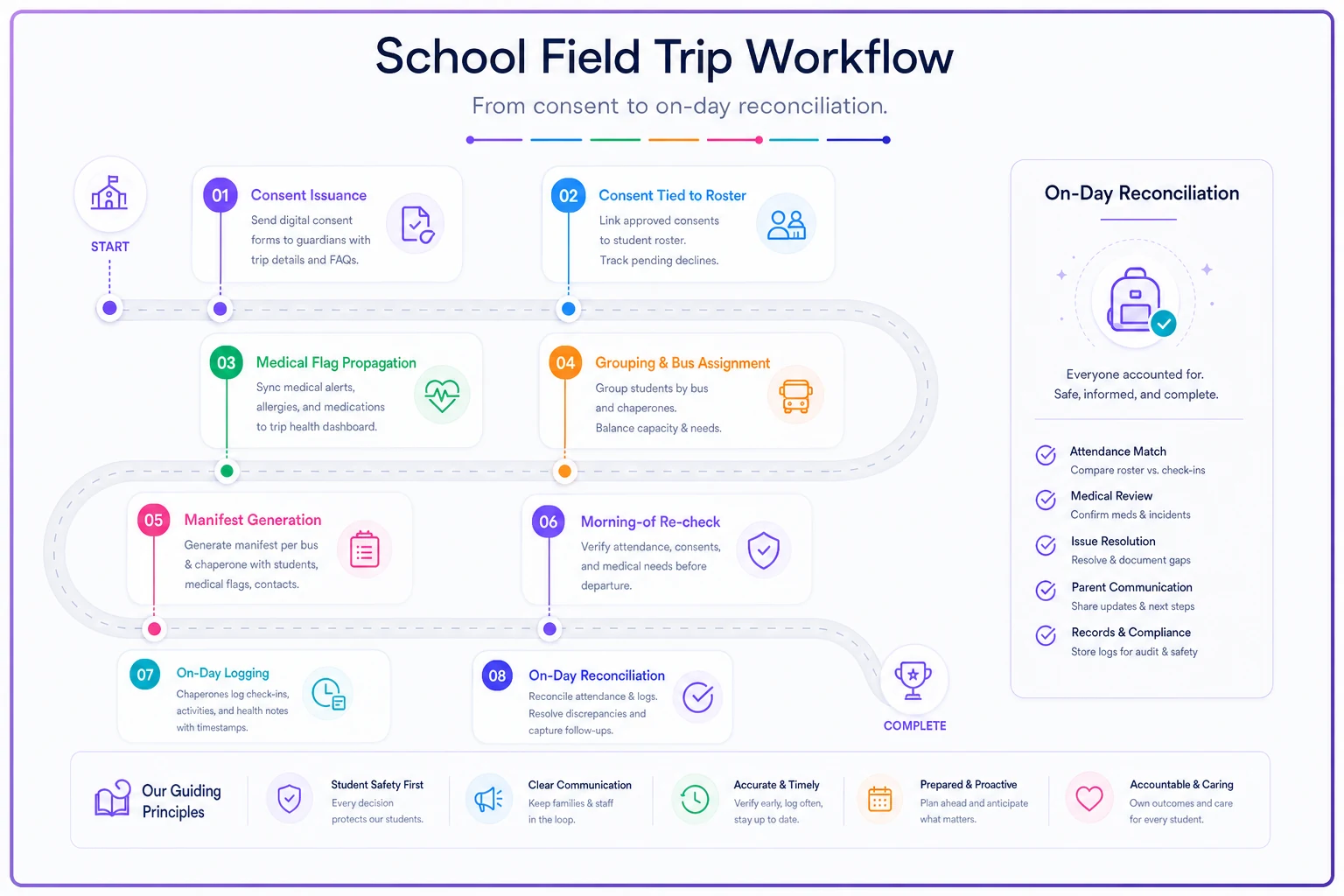
A quick visual of that pipeline helps make the handoffs obvious and where logging should occur.
Paper-and-spreadsheet vs. a connected pipeline
Paper-and-spreadsheet vs. a connected pipeline
| Stage | Typical process | Connected pipeline |
|---|---|---|
| Collecting consent | Paper slips + email + one Google Form | Requests tied to each student on the roster |
| Knowing who's missing | Manual count against class list | Live outstanding count |
| Medical flags | Sit in the nurse's system | Attach to the student through every step |
| Building manifests | Retyped from a roster | Generated from approved students |
| Last-minute medical update | Lands in health record, stops there | Surfaces on trip morning re-check |
| On-day changes | Pen edits on a printout | Timestamped log against the manifest |
| Proving what happened after | Reconstruct from memory | Auditable trail, exportable |
Every row in the "typical" column is a place where a medical flag can silently fall out of the chain.
A real scenario
A K–8 school runs an all-grade museum trip: roughly 240 students across four buses, around 30 chaperones. Under their old process, consent came in through a mix of paper and an online form, and the nurse maintained allergy and medication lists in a completely separate place.
The week before the trip, they had 22 outstanding slips they only discovered by hand-counting the night before — which forced a scramble of phone calls that morning. Two students with updated care plans, one new asthma action plan and one revised food allergy, had current information in the health record that never made it onto any chaperone sheet. On the morning of, five kids were absent and one parent pulled their child to drive separately, so the printed manifests got corrected by hand on the curb. When a chaperone later asked which bus a specific student rode home on, the office couldn't say with any real confidence.
After moving to a connected pipeline the following year, the outstanding-slip count was visible all week, so follow-ups happened on day three instead of at 6:45 AM. The two updated care plans appeared automatically on the correct chaperone group sheets because they were tied to the student, not the trip document. The morning re-check dropped the absent kids and logged the parent pickup as a formal change. Post-trip, the office could produce an exact boarding-and-return list per bus in under a minute. Nothing about the trip itself changed — the difference was entirely in what people knew and could prove.
The on-day reconciliation checklist
The morning of is where a good pipeline earns its keep. This is the checklist the trip coordinator should be able to run in about ten minutes, ideally off a generated sheet rather than memory:
-
Pull the current outstanding-consent count — anyone still unsigned does not board, full stop.
-
Re-check active medical flags against each approved student; highlight anything changed since signing.
-
Reconcile against this morning's attendance; remove absent students from every manifest.
-
Confirm each chaperone group has its sheet with medical notes and emergency contacts.
-
Confirm each bus manifest matches the sum of its assigned groups.
-
Log any parent-driven pickups as a formal change, not a verbal "yeah they're with me."
-
Record chaperone substitutions and reassign any affected students' flags to the new adult.
-
Verify EpiPens, inhalers, and medications physically match the flagged students boarding.
-
Timestamp the final boarding list per bus.
-
Run a shortened version of this for the return trip — return manifests fail more often than departure ones because people assume the departure plan is just automatically valid going back. It isn't.
Run the morning re-check from a tablet at the curb to capture attendance and flag changes with timestamps instead of pen edits.
That last point is worth sitting with. Return trips are where kids end up on the wrong bus, because everyone's tired and nobody thinks to re-check. A five-minute reconciliation before the return load prevents most of those situations.
Where the audit trail earns its keep
Most administrators think of audit trails as a compliance nicety — until the day a parent calls asking why their child was given a snack containing an allergen, or something happens off-site and the district's counsel needs to know exactly who was supervising whom.
A trip record that can answer "which adult was responsible for this student, what medical flags were active and visible at the time, and who was on which bus each direction" turns a defensive scramble into a two-minute export. This is the same discipline behind an auditable parent emergency communication workflow — the value isn't the manifest itself, it's being able to prove what was known and acted on, with timestamps, after the fact. And when audit season comes around, having trip consent and medical acknowledgment records that assemble themselves fits naturally into the broader approach of owner‑mapped exports and automated evidence assembly rather than a folder someone has to reconstruct from scratch.
The practical test: if a parent asked you tomorrow to show them the signed consent, the medical flags acknowledged at signing, the chaperone assigned to their child, and both bus manifests — could you produce it without scheduling a meeting? If not, the trail is the gap.
When this level of structure makes sense — and when it doesn't
When it's worth it: multi-bus trips, trips with students who have active medical care plans, overnight trips, and any trip where more than one class or grade is combined. The more students and the more moving parts, the faster manual reconciliation collapses. Anything crossing 100 students on multiple buses is past the point where a spreadsheet is a safe tool.
When it's overkill: a single-classroom walk to the library across the street, or a small local trip with one teacher and 20 kids who all have current, unremarkable health records. Wiring up a full pipeline for a ten-minute walk is process for its own sake.
Who should not skip it: anyone coordinating trips for students with life-threatening allergies, seizure disorders, diabetes, or mobility needs. For these students, the cost of a dropped flag is not a paperwork headache. That's the whole reason to connect the flag to the seat.
The one thing to fix first
If you change nothing else, wire in this single rule: no student boards a bus without their current medical flags visible to the adult responsible for them, checked on the morning of the trip. Everything else — the live consent counts, the generated manifests, the audit exports — is scaffolding around that one rule.
The field trip permission workflow isn't really about permission. It's about making sure the one fact that could hurt a child never gets lost somewhere between the office and the bus. Build the chain so the flag can't fall out, and the rest of the trip gets a lot less stressful.
If you change nothing else, wire in this single rule: no student boards a bus without their current medical flags visible to the adult responsible for them, checked on the morning of the trip. Everything else — the live consent counts, the generated manifests, the audit exports — is scaffolding around that one rule.
The field trip permission workflow isn't really about permission. It's about making sure the one fact that could hurt a child never gets lost somewhere between the office and the bus. Build the chain so the flag can't fall out, and the rest of the trip gets a lot less stressful.
Ready to optimize your school operations?
Join hundreds of schools using GoSkoly to save time, improve collaboration, and enhance student outcomes.