
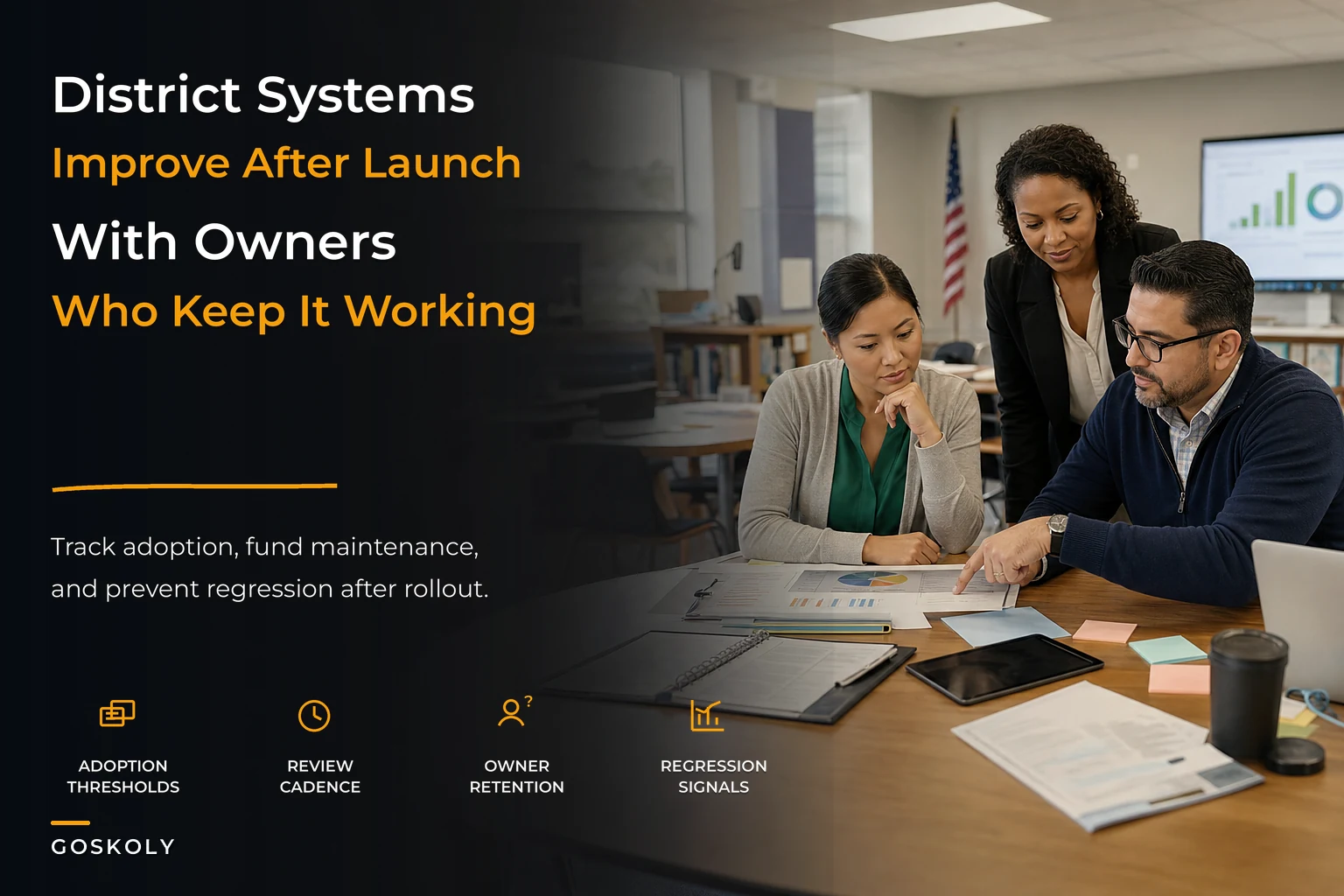

Most districts treat a system rollout like a construction project. There's a start date, a lot of activity in the middle, a ribbon-cutting once everyone's trained, and then everybody goes back to their normal jobs. The problem is that operational systems don't behave like buildings. They drift. A workflow that ran clean in April quietly rots by November because a key person moved schools, three new hires never got the same onboarding, and nobody noticed the exception queue growing until it was 400 items deep.
A continuous improvement plan for district systems is really about one thing: preventing the slow slide back to the old way of doing things once the excitement of launch wears off. The pilot proved the system can work. Sustainment is the harder, less glamorous question of whether it keeps working when nobody's watching closely.
This is the part almost every district underfunds — and it's what determines whether the money spent on a new attendance system, SIS integration, or reporting pipeline actually pays back over three years, or becomes another tool people quietly abandon while still paying the license fee.
Why systems regress after the pilot ends
The pilot phase has a lot of artificial advantages baked in. You hand-picked motivated staff. A project manager was checking dashboards daily. The vendor was still responsive because the contract was fresh. Leadership was paying attention. None of those conditions survive contact with a normal school year.
Regression rarely comes from one dramatic failure. It accumulates through small, boring losses:
-
The one person who really understood the reconciliation step retires or transfers.
-
A new principal has different priorities and quietly stops enforcing the workflow.
-
The vendor pushes an update that changes a screen, and nobody retrains front-office staff.
-
An edge case shows up that the pilot never covered, so people invent a manual workaround — which then becomes the norm.
Each of those is survivable on its own. The trouble is they compound. By the time someone runs a report and realizes the data is a mess, you're not fixing a system anymore — you're running a second rollout, except now with skeptical staff who remember the first one didn't stick.
The Change Management Playbook for District System Rollouts covers how to get adoption off the ground in the first place. Sustainment is the mirror image of that work: keeping adoption up once the initial push is gone.
Adoption KPIs that actually tell you something
The mistake most sustainment plans make is measuring activity instead of adoption. "Number of logins" tells you almost nothing. Someone can log in every day and still route half their work around the system.
Eliminate administrative overload.
GoSkoly helps you manage schedules, attendance, and communications seamlessly.
- Unified student and staff management
- Automated attendance tracking
- Integrated communication tools
No credit card required
You want metrics that show the workflow is being used the way it was designed, not just touched. A few that hold up over time:
| Metric | What it really measures | Warning threshold |
|---|---|---|
| % of transactions completed in-system | Whether shadow workflows are creeping back | Below ~85% of expected volume |
| Exception queue age | Whether problems are being resolved or ignored | Median age > 5 business days |
| Active owner coverage | Whether every workflow still has a real person accountable | Any workflow with no named owner |
| Rework rate | Records touched more than twice | Trending up 2+ months in a row |
| New-hire time-to-competency | Whether training survived past the pilot cohort | Doubling from baseline |
The one people ignore most is median exception queue age. A pile of unresolved exceptions is the earliest, clearest sign a system is regressing. When staff stop clearing that queue, it usually means they've already decided the system is optional — and that decision spreads fast.
For workflows that touch data quality — enrollment counts, state reporting feeds, grade imports — pair these adoption KPIs with the concrete data thresholds from the Data Quality SLOs for K-12 approach. Adoption and data quality are two sides of the same coin. A system people are quietly abandoning will show up as declining data quality weeks before anyone admits usage dropped.
Setting success thresholds that don't move
There's a pattern that quietly kills sustainment: success criteria that drift downward to match whatever the system is currently doing. The target was 95% of absences followed up within 24 hours. Six months later you're hitting 78%, and instead of fixing it, the number in the monthly report becomes 80% "to be more realistic." That's not adjusting expectations — that's institutionalizing failure.
Set your thresholds once, based on what the pilot actually proved was achievable, and treat any drop below them as an incident rather than a new normal. A workable structure uses three tiers:
-
Green — at or above the pilot-proven baseline. Routine monitoring only.
-
Yellow — a measurable dip (roughly 5–10% below baseline). Triggers a retrospective and a named owner to investigate within the month.
-
Red — a serious drop, or any metric with no named owner at all. Escalates to whoever sponsored the original project, not just the team running it day-to-day.
The point of the tiers isn't the colors. It's that a yellow reading forces a conversation before things turn red. Most regressions could have been caught early if someone had been obligated to look.
Retrospective cadence: how often, and who's in the room
Retrospectives are where sustainment either happens or doesn't. Most districts get the cadence wrong in both directions. Weekly is too much once the pilot ends — people stop showing up and the meeting dies. Annual is useless because a full year of drift is nearly impossible to unwind in a single session.
A cadence that tends to survive:
-
Monthly, 30 minutes, operational level. Just the people running the workflow. Review the KPIs. Anything yellow gets an owner and a due date. That's the whole meeting.
-
Quarterly, deeper, cross-functional. Bring in the people whose work connects to this system. A reconciliation issue in finance often traces back to how the front office is entering data. If those two groups never sit in the same room, the handoff gaps never get fixed.
-
Annual, strategic. Revisit whether the thresholds still make sense, whether the maintenance budget is realistic, and whether the system still fits how the district actually operates now versus at launch.
The single most useful discipline in any retro is asking "what did we work around this month?" People don't volunteer their workarounds — they think they're just being resourceful. But every workaround is a piece of the system quietly falling out of use. Surfacing them early is how you catch regression before it's baked in.
Worth protecting: keep the monthly retro boring and short. The moment it becomes a status theater meeting, attendance collapses and you lose your earliest warning signal.
Worth protecting: keep the monthly retro boring and short. The moment it becomes a status theater meeting, attendance collapses and you lose your earliest warning signal.
Budgeting for maintenance (the number everyone lowballs)
Districts routinely fund the rollout and forget the runway. The rough pattern for operational software is that annual sustainment costs land somewhere around 15–20% of the initial implementation cost per year — and that's before counting staff time. If a rollout cost roughly $80k to stand up, planning for something like $12k–$16k a year in ongoing maintenance isn't pessimistic, it's just realistic.
That budget isn't just license renewals. It needs to cover:
-
Retraining for turnover and role changes — this is the biggest hidden cost and the most frequently skipped.
-
Vendor change absorption — someone's time to test and communicate updates that change screens or logic.
-
Owner backfill — cross-training so the loss of one person doesn't take down a whole workflow.
-
Periodic cleanup — the reconciliation and de-duplication work that always accumulates over time.
-
A small contingency for edge cases the pilot never surfaced.
The mistake is treating maintenance as a budget line you can raid when things get tight. Cut it in year two, skip a training cycle, lose an owner, and the system regresses — then you pay far more in year three to rebuild it. The cheapest sustainment money you'll ever spend is the retraining you do before someone leaves.
Owner retention: the part that matters most
Every durable workflow has a named human who feels responsible for it. Not a department — a person. When that person leaves and the role isn't backfilled properly, the workflow degrades within a couple of months, almost without exception.
The real sustainment question isn't "is the software good?" It's "what happens when the owner walks out the door?"
-
Never have a single point of knowledge. Every workflow needs a primary and a backup who has actually done the work, not just read the documentation. If the backup has never cleared the exception queue themselves, they're not a real backup.
-
Write down the why, not just the how. Steps get outdated. The reasoning behind a step — "we check this because meal accounts and SIS drift apart mid-year" — survives longer and helps the next person make good decisions when the steps don't quite fit the situation.
-
Make ownership visible in the retrospective. If a workflow shows up every month with the same owner's name, leadership knows who to protect. If it shows "TBD," that's a red flag you can see coming.
-
Rotate deliberately, not by accident. Planned rotation, where you cross-train and hand off on purpose, builds resilience. Unplanned rotation — where someone just leaves — exposes it.
This connects directly to broader continuity planning. The School Operations Resilience Playbook treats the loss of a key person the same way it treats a system outage — because operationally, they cause the same damage. A workflow with no available owner is effectively down, whether or not the software is running.
When a continuous improvement plan makes sense — and when it's overkill
Not every system needs this level of structure. Applying a full sustainment plan to a low-stakes tool used by three people is a waste of time and will collapse under its own bureaucracy.
Worth the effort when:
-
The workflow touches money, compliance, or student records.
-
Multiple roles or campuses depend on the same system.
-
Regression would be expensive or hard to reverse — state reporting, reconciliation, enrollment.
Probably overkill when:
-
The tool is used by a single small team with low turnover.
-
The consequences of drift are minor and largely self-correcting.
-
The system is genuinely temporary or being phased out.
Who should not do this: districts that haven't actually finished a real rollout yet. If adoption never got off the ground, sustainment planning is premature. You're trying to maintain something that isn't running. Fix the rollout first.
A short real scenario
Here's what this actually looks like when it goes wrong — and then gets corrected. The sequence below isn't unusual; it's probably the most common failure pattern for district system rollouts that initially showed promise.
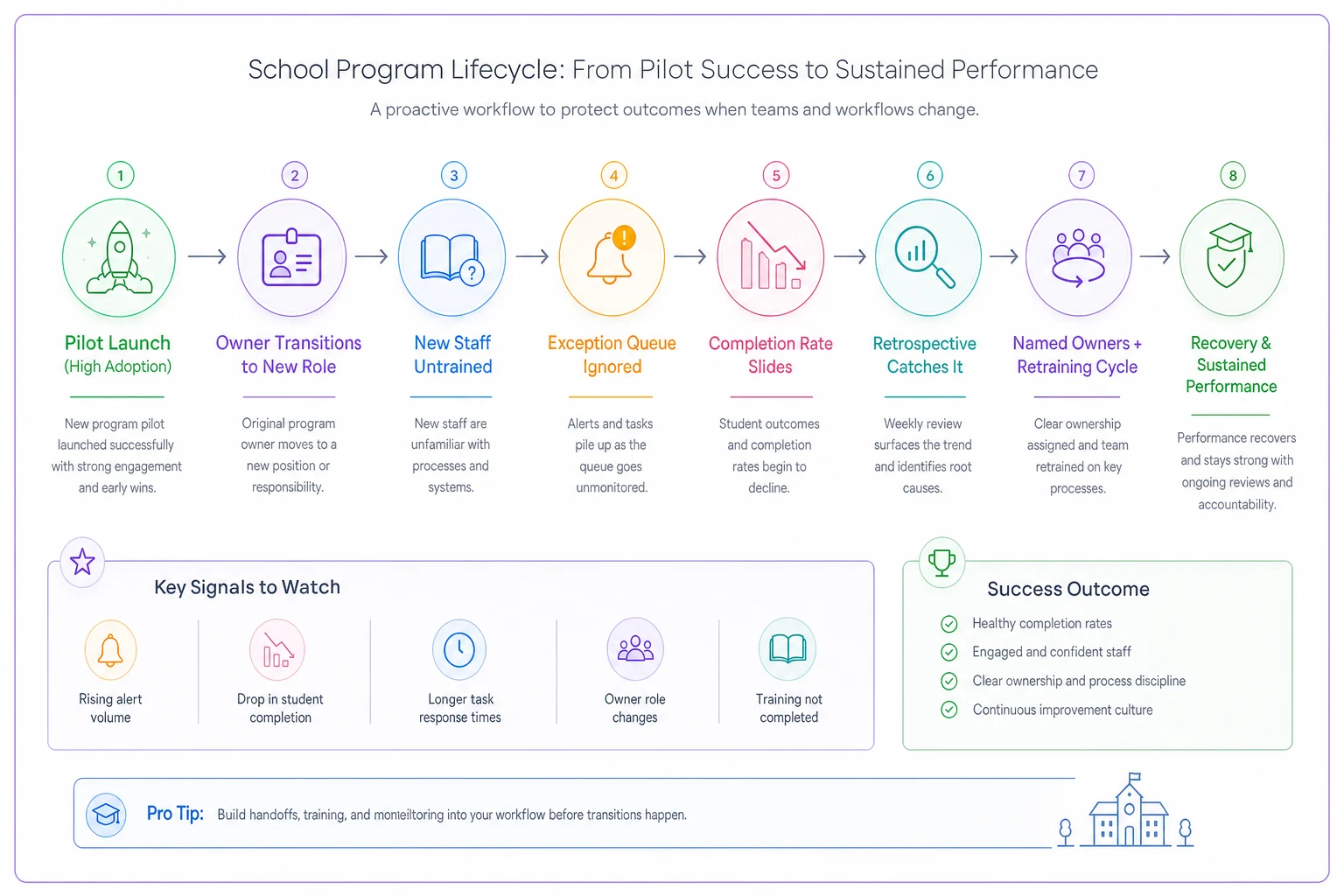
The graph above shows the typical regression and recovery flow for a district system rollout. It highlights the trigger points where intervention is most effective.
A mid-sized district — around a dozen schools — rolled out a new attendance follow-up workflow. The pilot went well: 24-hour follow-up completion hit the low 90s during launch, with a dedicated project lead watching it closely.
No sustainment plan was put in place. By the middle of the following year, that lead had moved into a different role. New front-office staff at three campuses had never been trained on the system, so they defaulted back to phone calls and sticky notes. Nobody was watching the exception queue. When someone finally pulled a report, 24-hour completion had slid into the low 60s, and the exception queue had over 500 stale items.
The fix wasn't new software. They set up a monthly 30-minute retro, assigned a named owner and backup per campus, budgeted a modest retraining cycle to account for turnover, and set a red threshold at anything below 85%. Within about two terms, completion recovered into the high 80s and held there — because now someone was obligated to notice before it slipped.
The tool was fine all along. The sustainment failed, silently, for the better part of a year.
The through-line
A continuous improvement plan for district systems isn't a document you file after launch. It's a small set of habits — measure real adoption, keep the thresholds fixed, meet monthly, fund maintenance honestly, and never let a workflow depend on one irreplaceable person.
None of it is complicated. It's just easy to skip, because nothing bad happens immediately when you do. That's exactly why regression is so common and so quiet. The systems that survive five or ten years in a district aren't the ones with the best launch — they're the ones somebody kept paying attention to after everyone else stopped looking.
Ready to optimize your school operations?
Join hundreds of schools using GoSkoly to save time, improve collaboration, and enhance student outcomes.