


Most after-school programs don't lose funding because they served too few kids. They lose it because they can't prove they served the kids they claim. The service happened — tutors showed up, snacks got handed out, 40-some students walked through the door — but when the funder asks for daily attendance that ties neatly back to the reimbursement claim, the numbers wobble. A sign-in sheet says 38. The billing spreadsheet says 42. The grant report says "average daily attendance of 45." Nobody's lying. The records just never agreed with each other in the first place.
That gap between what happened and what you can defend is where after-school attendance reconciliation lives. And it's almost always an operational problem, not a dishonesty problem.
Where the numbers quietly drift apart
Attendance gets recorded in at least three places, and each one has a slightly different purpose — so each one captures slightly different data.
-
The daily snapshot — the paper sign-in sheet or the tablet check-in at the door. This is the raw truth of who physically showed up.
-
The program roster — who's enrolled and eligible for the funded program (21st CCLC, state-funded ASES, a local foundation grant, whatever the source).
-
The funding claim — the aggregated number that goes to the funder, usually monthly, often built from a billing coordinator's spreadsheet.
Each handoff loses fidelity. A student signs in on paper, but staff forget to transfer the Friday sheet into the system. A kid attends but isn't yet in the funded roster because enrollment paperwork is pending — so their attendance either gets dropped or gets claimed against a program they're not eligible for. A grant requires students attend a minimum number of days per quarter to count, and nobody's tracking that threshold until the claim is already submitted.
In real operations, the drift usually looks like this: a program bills for 45 average daily attendance, but when you pull the actual daily snapshots and filter for funded-eligible students only, the defensible number is closer to 39. That six-student gap doesn't feel like much until you multiply it across 180 program days and a per-student-day reimbursement rate.
The eligibility layer everyone skips
Attendance and eligibility are two different questions, and most sign-in processes only answer the first one.
Eliminate administrative overload.
GoSkoly helps you manage schedules, attendance, and communications seamlessly.
- Unified student and staff management
- Automated attendance tracking
- Integrated communication tools
No credit card required
-
Their enrollment form or income documentation hasn't been processed, so they're not yet in the funded cohort.
-
The grant only funds students at a specific school site, and this kid transferred mid-year.
-
The funder requires a minimum dosage — say, 30+ days per semester or a certain number of hours per week — and the student falls short.
-
The student is enrolled in the program but attending on days funded by a different source, which is a common issue when a site blends two grants.
When the daily snapshot doesn't carry the eligibility flag with it, your billing coordinator ends up making eligibility calls from memory or from a stale roster. That's the single biggest source of clawbacks in after-school reconciliation — not inflated numbers, but unverified ones.
The fix is to treat eligibility as a field attached to every attendance record, not a separate list someone cross-checks later. Every daily snapshot should answer: present, and funded by whom?
What a defensible reconciliation actually looks like
Reconciliation isn't a monthly panic. It's a short, repeatable loop that catches drift while it's still cheap to fix. Here's the sequence that holds up:
-
Capture the daily snapshot at the point of service. Door check-in, timestamped, tied to a student ID — not a name scrawled on a sheet that gets typed in three days later.
-
Tag each attendance record with its funding source and eligibility status on the same day. If a student's eligibility is pending, flag it as pending rather than counting or dropping it silently.
-
Run a staff-to-program reconciliation. Match the staff who signed off on a session against the program that session was funded under. If a tutor logged a session for a grant they're not assigned to, that's a flag before it becomes a finding.
-
Reconcile daily snapshots against the funded roster weekly. Pull everyone present that week, filter for eligible-and-funded, and compare to what will be claimed. Investigate any gap above a small threshold — anything over 2–3 students per site is worth a look.
-
Apply sampling audit tests before submission. Don't check every record — check a random sample. Pull 15–20 student-days at random each month and verify the full chain: snapshot → roster → eligibility → claim line. If your sample is clean, your population is probably clean. If two of twenty fail, stop and dig.
-
Export a funder-ready package that shows the claim number and the underlying daily records supporting it, with eligibility flags intact.
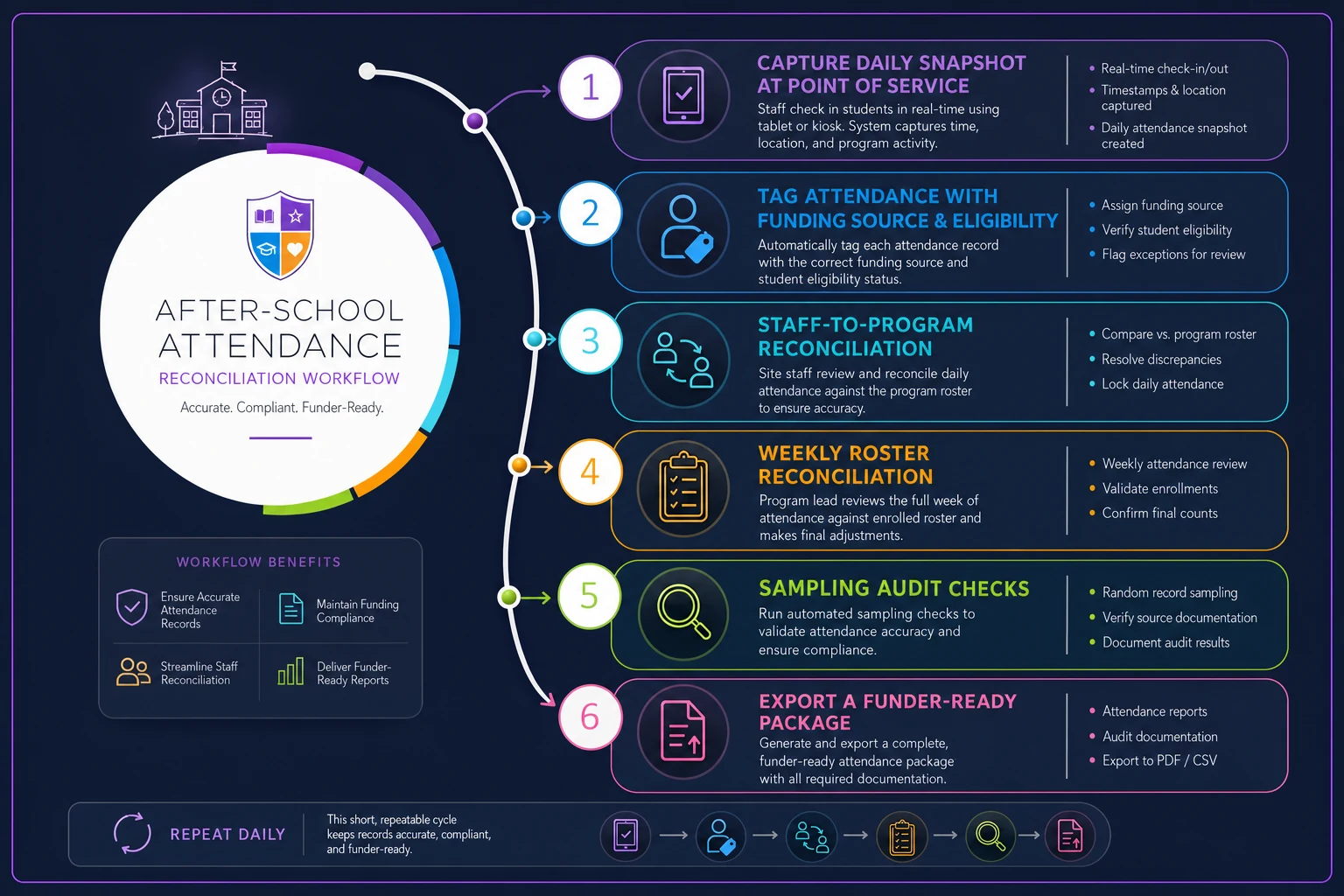
This graphic shows the reconciliation loop from check-in to funder-ready export.
The sampling step is the one most programs skip, and it's the one auditors respect most. A clean random sample is evidence that your whole process works — far stronger than a coordinator insisting the numbers are right.
The sampling test, in practice
Sampling works because it catches systematic errors cheaply. If your intake process is dropping every Friday sheet, a random 20-record sample will almost certainly catch a Friday that doesn't match — and you'll find the pattern in ten minutes instead of during an audit.
Here's a simple structure for a monthly sampling test:
| Check | What you're verifying | Pass condition |
|---|---|---|
| Snapshot exists | A timestamped check-in record exists for the claimed student-day | Record found |
| Roster match | The student was enrolled in the funded program on that date | Enrollment active |
| Eligibility valid | Documentation (income, site, consent) was complete on that date | No pending flags |
| Dosage | The student meets the funder's minimum-attendance requirement | Threshold met |
| Staff sign-off | A qualified staff member signed the session under the correct funding source | Signed, correct source |
| Claim line | The claim amount matches the rate × eligible days | Amounts reconcile |
If a sampled record fails any row, you don't just fix that record — you ask how many others have the same flaw. One failed eligibility check usually means a whole batch of students with the same pending-documentation problem.
Remediation: fix the record, then fix the cause
When reconciliation turns up a gap, the instinct is to quietly adjust the claim down and move on. That's half the job. The other half is figuring out why it happened so the same gap doesn't show up next month.
-
Identify the record and the gap type — missing snapshot, ineligible student, dosage shortfall, wrong funding source.
-
Correct the current claim before submission so you're never billing for something you can't defend.
-
Trace the root cause. A missing snapshot points to an intake process failure. An ineligible student points to an enrollment or documentation gap. A wrong funding source points to staff assignment confusion.
-
Assign an owner and a due date for the fix. "The front desk transfers Friday sheets by Monday noon" is an owner and a cadence. "We'll be more careful" is not.
-
Re-check next cycle to confirm the fix held.
When to escalate to the program owner
Not every discrepancy needs the director's attention. Set clear escalation rules so the right things rise and the small stuff gets handled without creating noise:
-
Fix at staff level a single missing snapshot, a one-off transcription error, a correctable same-week gap.
-
Escalate to the coordinator a recurring pattern (same day of week, same site, same staff member) or a gap above your per-site threshold.
-
Escalate to the program owner / director anything that affects a submitted claim, any eligibility issue touching more than a handful of students, or any discrepancy tied to a specific funding source's compliance terms.
The point of escalation rules isn't bureaucracy — it's making sure a $200 transcription fix doesn't consume a director's week, while a $6,000 eligibility pattern doesn't sit unnoticed in a coordinator's inbox.
A real scenario
A mid-sized nonprofit ran an after-school program across three elementary sites, funded by a blend of a state grant and a local foundation. Around 130 students enrolled. Their reconciliation was monthly, done in a spreadsheet, and the billing coordinator cross-checked attendance against a roster she kept in a separate file.
When they finally ran a sampling test, about 3 of every 20 sampled student-days failed — mostly students being claimed against the state grant who were only eligible under the foundation grant, plus a handful of Friday snapshots that never got entered. Extended across the year, the unsupported portion of their claims landed somewhere in the low-to-mid five figures. Enough that a routine monitoring visit would have triggered a clawback and a corrective action plan.
The fix wasn't dramatic. They moved check-in to a tablet at each door, attached a funding-source flag to every record, and shifted from a monthly scramble to a weekly roster reconciliation plus a 20-record monthly sample. Within two billing cycles, their sample failure rate dropped to near zero, and the claims they submitted matched the daily snapshots almost exactly. The bigger win was quieter: when the funder asked for backup documentation, the coordinator exported the supporting records in an afternoon instead of rebuilding them over a weekend.
Where tooling earns its keep
Small single-site programs can run all of this manually, and plenty do. But the drift multiplies with every site, every funding source, and every staff member who touches a sign-in sheet. That's where an operational platform with built-in attendance capture and reconciliation stops being a nice-to-have.
Attach funding-source flags at check-in so exports and sampling generate automatically.
The practical value isn't automation for its own sake — it's that the daily snapshot, the eligibility flag, and the funding source live in the same record from the moment a student checks in. Reconciliation becomes a report you run, not a file you rebuild. Sampling tests can be generated against actual data rather than reconstructed by hand. When the funder asks for proof, the export already ties each claim line back to its underlying daily records. The same logic that makes owner-mapped exports and automated evidence assembly work for a formal audit applies directly here — the strength of a funding claim is entirely in how fast and how cleanly you can produce the records behind it.
It's also worth noting how closely this connects to the daily attendance work most programs already do. The same check-in data that feeds your absence follow-up workflow is the raw material for your funding claims — if that capture is clean and consistent, reconciliation gets dramatically easier downstream.
When tight reconciliation is worth it — and when it isn't
Single site, one funding source, fewer than 30 kids — a weekly spreadsheet check is probably fine. The overhead of a formal sampling process would outweigh the risk.
But the moment you blend funding sources, operate across multiple sites, or report to a funder with dosage requirements and monitoring visits, loose reconciliation becomes a real liability. The cost of a clawback — repaid dollars plus a corrective action plan plus the reputational hit on your next grant application — is almost always larger than the cost of tightening the process before someone comes asking.
The goal isn't perfect records. It's records you can stand behind. When your daily snapshots, your eligibility flags, and your funding claims all tell the same story, an audit stops being something you dread and becomes something you can walk through in an afternoon.
Ready to optimize your school operations?
Join hundreds of schools using GoSkoly to save time, improve collaboration, and enhance student outcomes.