


Three weeks into the school year, Highland Middle School's attendance coordinator was drowning. 847 students, 92 already flagging for attendance issues, and she was manually calling parents one by one. By October, she'd given up on daily follow-ups entirely.
This breakdown happens in almost every district. Not because staff don't care—they're usually the ones staying late making calls—but because manual processes collapse once you hit more than 30-40 absent students per day.
The damage shows up months later. Students who missed critical algebra units in September are now failing. Parents who never got proper notification are shocked at conferences. Your chronic absenteeism rate keeps climbing while everyone argues about whose job the follow-up was supposed to be.
The Manual System Breaking Point
Schools start with good intentions. Attendance clerk marks absences in the morning. Someone calls unexcused absences by noon. No response? Follow up the next day. Three unexcused absences escalate to the counselor.
Works great until flu season hits. Monday: 67 absences to process. The clerk spends two hours just recording them. By the time calling starts, it's 11 AM. Maybe 15 calls get made before lunch duty. Another 10 in the afternoon between discipline issues. Tuesday brings 43 new absences plus yesterday's 42 uncompleted follow-ups.
By Wednesday, they're triaging—only calling the "problem" families while letting first-time absences slide. Students who might benefit most from early intervention get ignored because the system assumes they're fine.
Why Traditional Escalation Fails
One high school tried solving this with an elaborate escalation chart. Day 1: robo-call. Day 3: personal call from attendance. Day 5: counselor. Day 10: assistant principal. Day 15: truancy officer.
Eliminate administrative overload.
GoSkoly helps you manage schedules, attendance, and communications seamlessly.
- Unified student and staff management
- Automated attendance tracking
- Integrated communication tools
No credit card required
Two problems killed this immediately.
The handoffs destroyed information. The clerk's note about "mom said student has anxiety about PE" never reached the counselor. The counselor's discovery that the family lost transportation never made it to the assistant principal. Everyone started fresh, asking the same questions, frustrating parents who'd explained everything three times.
The rigid timeline ignored context. A straight-A student missing their first days got the same aggressive escalation as someone with 47 absences last year. Good students felt harassed. Struggling families felt targeted. Nobody felt supported.
Building Tiered Response Logic
Automated absence follow-up that actually reduces chronic absenteeism starts with recognizing patterns, not applying blanket policies.
A student with strong attendance missing two days needs different handling than someone who missed 18 days last semester. A kindergartener's absence means something different than a senior's.
Tier 1 - Good Standing Students (Less than 5 absences last semester) Lighter touch. Automated text day one, friendly check-in call day three if unexcused, counselor wellness check at day five. Message stays supportive: "We noticed Sam wasn't in class today and wanted to make sure everything's okay."
Tier 2 - Emerging Concern (5-10 absences last semester or pattern flags) Faster escalation, supportive tone. Text morning of absence, personal call same day if unexcused, counselor outreach by day two. Focus on early pattern intervention: "We've noticed some absence patterns and want to help before it affects Maria's learning."
Tier 3 - Chronic Risk (10+ absences or already flagged) Immediate multi-channel response. Text and call day one, counselor assigned as case manager immediately, support services offered proactively. But the messaging needs to acknowledge the relationship: "Hi Mrs. Johnson, it's Ms. Garcia again. I saw that Dante is out today. What can we do to help get him back on track?"
Message Templates That Get Responses
Generic robo-calls get ignored. Parents have trained themselves to tune out automated school spam. Templates need to feel personal even when they're automated.
First touch should be immediate but gentle. Within two hours of marked absence:
"Hi [Parent Name], we missed [Student] in [specific class] today. If they're sick, no action needed—we'll help them catch up when they return. If you need anything from us, reply HELP and someone will call you."
This acknowledges the absence specifically, assumes positive intent, offers support, and makes response easy. Response rates on this type run around 70%, versus 15% for standard "Your child was absent today" notifications.
Day two unexcused needs more urgency without judgment:
"[Student] has now missed two days of [specific content/test/project]. Their teacher [Teacher Name] wants to make sure they don't fall behind. Can we schedule a quick call today to discuss makeup work? Reply YES and we'll call within 2 hours."
By day three, you need human touch but can template the initial outreach:
"[Parent Name], this is [Staff Name] from [School]. I'm reaching out because [Student] has missed several days and I want to help. I have three quick questions about how we can support [him/her] better. Can we talk for 5 minutes today? I'm free at [specific times]."
Smart Handoff Rules
The biggest operational failure isn't initial contact—it's the handoff. When attendance clerks can't resolve issues, they need clear escalation paths that preserve context.
Case assignment should consider severity, cause, and capacity.
Severity routing: Tier 3 students go straight to assigned case managers. No bouncing between staff members. One middle school assigned every chronic absence student to one of four counselors at year start. That counselor owned every absence interaction for their students. Parents stopped getting conflicting information.
Cause routing: Medical absences route to the nurse. Transportation issues go to the social worker with bus passes and carpool lists. Mental health concerns trigger counselor involvement. Academic anxiety alerts the intervention specialist.
Route cases considering staff capacity to prevent dropped balls.
Handoffs need context. Not just "Johnny has missed 5 days," but:
-
Previous successful interventions
-
Parent communication preferences (text vs. call, morning vs. evening)
-
Documented barriers (transportation, work schedule, health)
-
Academic standing and missed assignments
-
Staff relationships that have worked
But most routing systems ignore capacity. If your counselor has 47 active cases, routing number 48 guarantees dropped balls. The system needs to balance load, maybe using assistant principals or intervention specialists when primary handlers are overwhelmed.
Tracking What Actually Matters
Schools obsess over attendance percentages but miss metrics that predict chronic absenteeism before it happens.
Response rate by channel and time: One district discovered 3 PM calls had 70% response versus 20% for 10 AM calls. Working parents couldn't answer during work. Shifting call times cut unresolved absences by half.
Time to first contact: Longer delays = less engagement. Track absences getting first touch within 2 hours, 4 hours, same day, next day. If same-day contact drops below 80%, your system's failing.
Resolution by tier: What percentage of Tier 1 students return after one touch? How many Tier 2 need counselor intervention? If Tier 1 regularly needs escalation, your tiering logic is wrong.
Pattern identification speed: A good student with three Monday absences in a row—does anyone notice? Track days between pattern emergence and intervention.
Re-engagement success rate: Of students receiving interventions, how many show improved attendance within two weeks? Below 40% success means you're focusing on enforcement instead of addressing root causes.
Implementation Timeline and Milestones
Rolling this out mid-year feels impossible. But waiting until summer means losing another year of students.
Start with one grade or school. Pick your highest-need population—usually middle school where patterns establish but aren't entrenched.
Weeks 1-2: Basic automated messaging for Tier 1 only. Getting immediate notification out for good students frees massive time for complex cases.
Weeks 3-4: Add Tier 2 logic and templates. Train counselors on handoffs. You'll hit edge cases immediately—honor student with anxiety, transfer student incorrectly flagged. Document these for refinement.
Weeks 5-6: Integrate Tier 3 case management. Expect resistance from staff with established systems. Let them keep personal touches while automation handles logistics they hate.
Weeks 7-8: Add pattern detection and proactive alerts. The system should flag concerning patterns before they become chronic.
Weeks 9-12: Refine based on data. Which templates work? Which handoffs fail? What patterns got missed?
A medium school (600 students) typically sees:
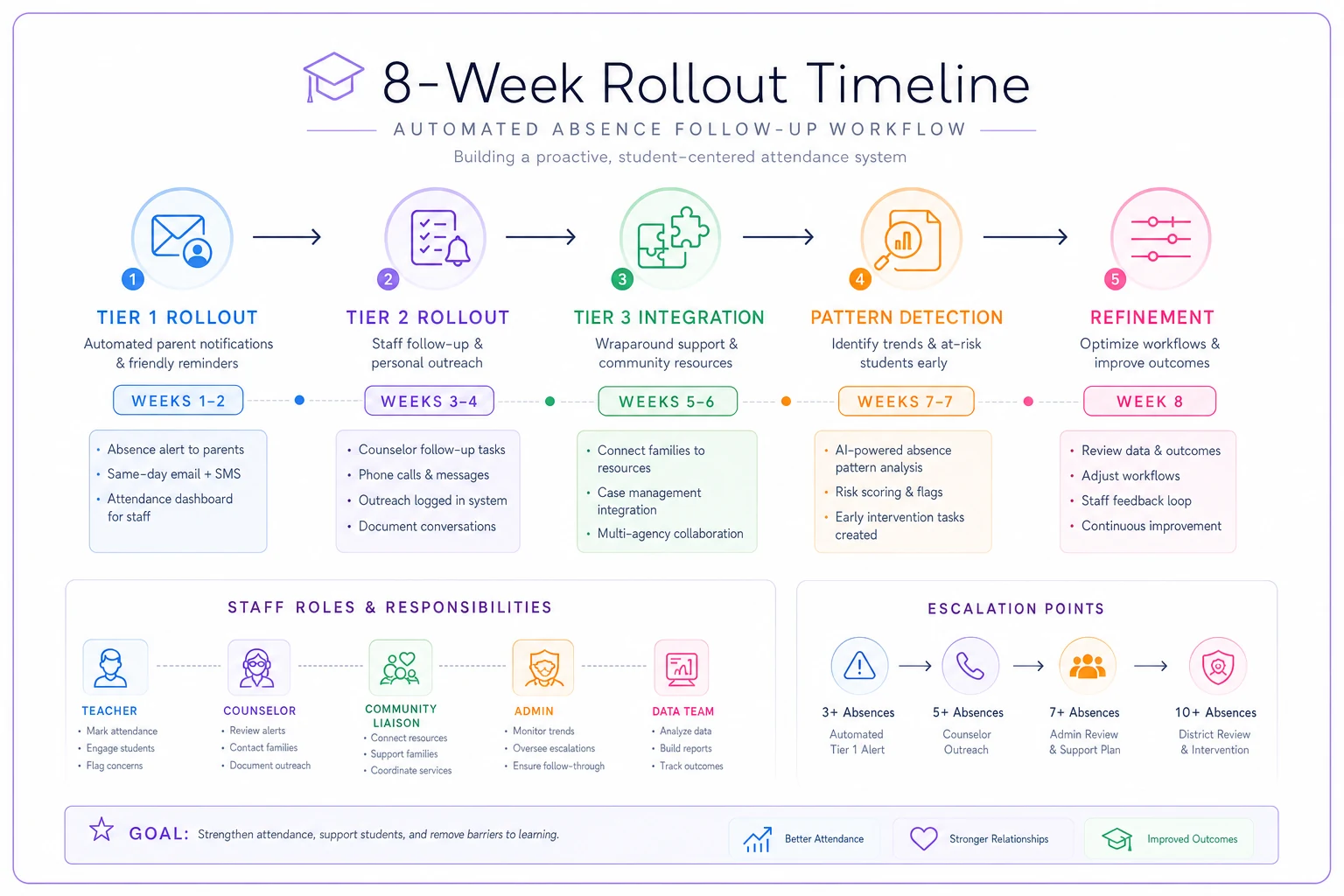
Here's a concise visual of the rollout stages and who owns each phase.
| Outcome |
|---|
| 60-70% reduction in manual phone time |
| 3x increase in same-day parent contact |
| 25-30% reduction in chronic absenteeism within one semester |
| 90% decrease in "surprise" chronic cases at semester end |
A medium school (600 students) typically sees:
Common Implementation Failures
Technology doesn't kill these initiatives. It's the human element—specifically, ignoring how school operations actually work.
Ignoring established relationships: Your clerk knows Maria's grandmother (not primary contact) actually gets her to school. The counselor knows calling Dad triggers conflict but Mom is supportive. If your system can't capture these relationship nuances, staff will abandon it.
Over-automating human moments: When absence relates to family death, automated templates feel cruel. Need override capabilities for sensitive situations. Better five human calls than one badly timed automated message.
Creating documentation burden: If staff log into three systems and fill five fields just to record a parent conversation, they won't do it. The system should extract information from natural interactions.
Assuming all absences are problems: Religious holidays, emergencies, medical procedures—legitimate absences don't need intervention. Bombarding these families with escalating messages breeds resentment.
Making the Financials Work
Average schools spend 2-3 hours daily on absence follow-up. At $25/hour for clerical staff, that's roughly $13,500 per year just in direct labor. Add counselor and administrator time, you're at $30,000+ annually per school.
But the real cost isn't labor—it's lost funding. Most states tie funding to attendance. In California, 1% attendance improvement can mean $50,000+ for medium schools. Texas loses $35-45 per day per absent student. Add academic costs. Students missing 10+ days need intervention services ($2,000-5,000 per student), summer school ($1,500), or grade retention ($10,000+ per year). Automated absence workflows cost $8,000-15,000 annually per school for software and setup. Preventing just five students from chronic absence pays for itself.
Beyond Basic Automation
The most successful implementations go beyond replacing manual calls. They use freed capacity for previously impossible interventions.
One district started morning check-in texts to chronic families: "Good morning! Just checking that Jamie is planning to come to school today. Reply Y if all good, or HELP if you need support." Sent at 6:30 AM, these prevented about 20% of absences by catching transportation or wake-up issues.
Another added positive reinforcement. After a chronic student attended five straight days, parents got: "Great news! Alex has been in school all week and their math teacher says they're really engaged. We're proud of the progress!" Parent engagement improved dramatically when communication wasn't always about problems.
Systems identify patterns humans miss. Monday absences might indicate custody arrangements. Wednesday absences could correlate with early-release days when parents can't arrange pickup. These insights drive policy changes addressing root causes.
Making It Sustainable
The best workflows become invisible. Staff forget they used to spend hours calling. Parents expect immediate communication. Students know absences get noticed.
This requires continuous refinement. Review templates each semester—do they still get responses? Check escalation paths monthly—are right people getting right cases? Scan for patterns weekly—what trends are emerging?
Keep the human element centered. Automation handles logistics so humans handle relationships. Your attendance clerk shouldn't spend time dialing—they should talk to parents. Your counselor shouldn't chase contact info—they should develop intervention plans.
Schools seeing dramatic chronic absenteeism reduction aren't those with the most sophisticated technology. They use automation to amplify human connection, not replace it. They catch problems early because systems watch patterns while staff build relationships. They resolve issues quickly because parents get timely, relevant communication instead of generic warnings.
Your automated absence workflow succeeds when nobody thinks about it anymore. Absences get addressed immediately. Parents feel supported, not surveilled. Students return quickly with needed help. Chronic absenteeism drops through consistent, caring, scalable intervention—not enforcement.
The manual system you're using will break. It's not if, but when—usually around October when absence rates spike and everyone's overwhelmed. The question is whether you'll build something better before that breakdown costs another group of students their academic year.
Ready to optimize your school operations?
Join hundreds of schools using GoSkoly to save time, improve collaboration, and enhance student outcomes.