

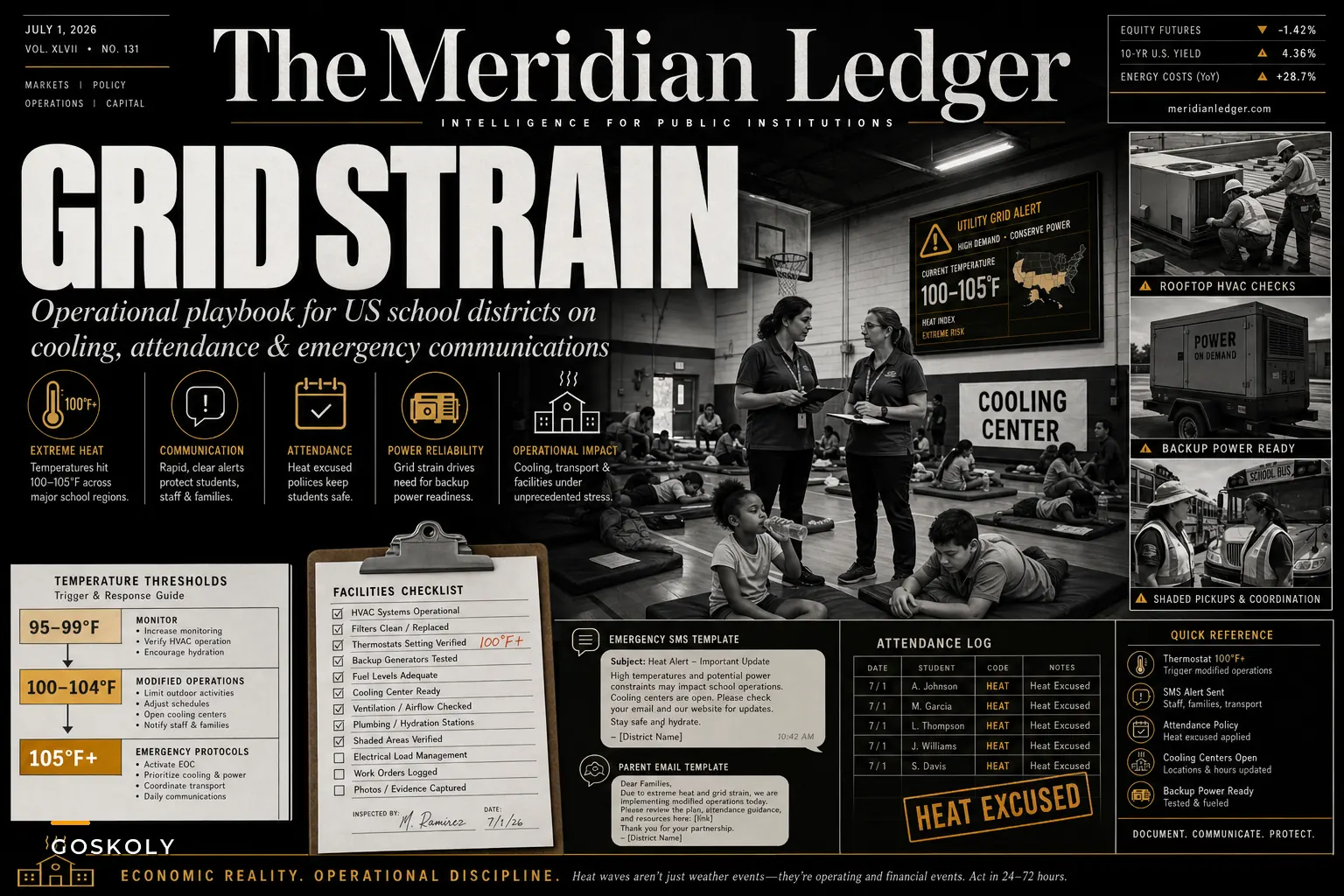

The heat wave stretching across the central and eastern United States right now isn't just uncomfortable — it's pushing electrical grids toward capacity limits that Reuters reports could set demand records. For school districts, that creates an immediate operational challenge that goes well beyond just cranking up the AC.
What makes heat wave operations particularly difficult is how many different systems fail at the same time. Your facilities team is dealing with HVAC units running at max capacity — and probably discovering which ones haven't been properly serviced in years. Your attendance office is fielding dozens of heat-related absence calls that don't fit neatly into existing excuse categories. And your communications team needs to push updates about schedule changes or building closures to thousands of families, fast.
The real problem isn't the heat itself. It's that most districts have never stress-tested their operations for this specific scenario. You've probably run fire drills and lockdown procedures, but when was the last time you simulated what happens when three buildings lose AC on the same day during summer school?
The cascade failure nobody plans for
Most district operational plans assume gradual degradation. A boiler fails in winter, you shift classes temporarily. A bus breaks down, you redistribute routes. Heat waves are different — multiple systems hit critical thresholds simultaneously, and the whole thing unravels faster than anyone expects.
Take attendance tracking during extreme heat. Your standard system probably has codes for illness, family emergency, transportation issues. But when temperatures hit 105°F, you're suddenly dealing with:
-
Students whose parents kept them home because their apartment has no AC.
-
Students who left mid-day sick from the heat.
-
Bus routes canceled because vehicles overheated.
-
Athletic practices moved or canceled, affecting after-school numbers.
-
Summer school sessions relocated to different buildings.
One district operations director described having nearly 50 different heat-related absence scenarios in a single week — none of which mapped cleanly to their attendance codes. Admin staff spent hours manually categorizing absences, creating documentation headaches for state reporting months later.
The facilities side gets even messier. Your maintenance team is probably tracking work orders in one system, budget impacts in another, and emergency contractor calls through email or phone. When you need to justify emergency cooling expenses or insurance claims later, reconstructing that paper trail is a nightmare.
What breaks first (it's not always the AC)
There's a pretty predictable pattern to how heat wave operational failures unfold:
Eliminate administrative overload.
GoSkoly helps you manage schedules, attendance, and communications seamlessly.
- Unified student and staff management
- Automated attendance tracking
- Integrated communication tools
No credit card required
Day 1-2: HVAC in older buildings starts struggling. Portable classrooms become uninhabitable by noon. IT equipment in poorly ventilated server rooms begins overheating. Day 3-4: Staff absences spike as employees deal with home cooling issues or childcare problems. Transportation delays mount as buses overheat or drivers call out. Food service struggles with refrigeration capacity and modified meal schedules. Day 5+: Communication systems get overwhelmed as parents demand updates. Administrative staff burns out from manual workarounds. Financial controls start to crack as emergency purchases bypass normal approval processes.
The buildings with the worst cooling are rarely your main campuses — they're the portables, the repurposed spaces, the administrative offices in that converted elementary school from 1952. These spaces often house critical functions like special education services, summer programs, or district technology infrastructure.
The enrollment time bomb
This is something a lot of administrators miss: extreme heat events in late summer directly damage fall enrollment operations.
Families who planned campus visits cancel. Registration events get postponed. New student orientation sessions see significant no-shows. Online systems crash as everyone tries to register remotely at the same time.
One suburban district found their enrollment down around 8% in September — not because families moved, but because the registration process fell apart during a late-August heat wave. Parents couldn't complete in-person requirements, documents didn't get processed, and follow-up communications got buried in the chaos of emergency notifications.
The financial hit came out to roughly $1.2 million in lost state funding they couldn't recover until the following year's reconciliation.
Building a heat wave response framework
Effective heat wave operations require pre-positioned resources and clear escalation triggers — not generic emergency plans, but specific protocols built around heat events.
Start with threshold definitions:
| Temperature Range | Operational Trigger | Response Level |
|---|---|---|
| 95-99°F | Enhanced monitoring | Facilities check HVAC every 2 hours |
| 100-104°F | Modified operations | Consider early release, relocate vulnerable spaces |
| 105°F+ | Emergency protocols | Potential closure, cooling centers, transport changes |
These aren't suggestions — they're automatic triggers that initiate specific workflows. When you hit 100°F, your operations center should already be executing predetermined actions, not sitting in a meeting debating what to do.
Your facilities team needs real-time visibility into:
-
Current temperature readings from each building
-
HVAC runtime and efficiency metrics
-
Backup generator fuel levels and testing status
-
Contractor availability and pre-negotiated emergency rates
-
Budget impact tracking for emergency expenses
The goal is removing any ambiguity about who does what and when. Ambiguity is expensive during a heat event.
Sync building temperature sensors with attendance systems to auto-assign heat-related codes.
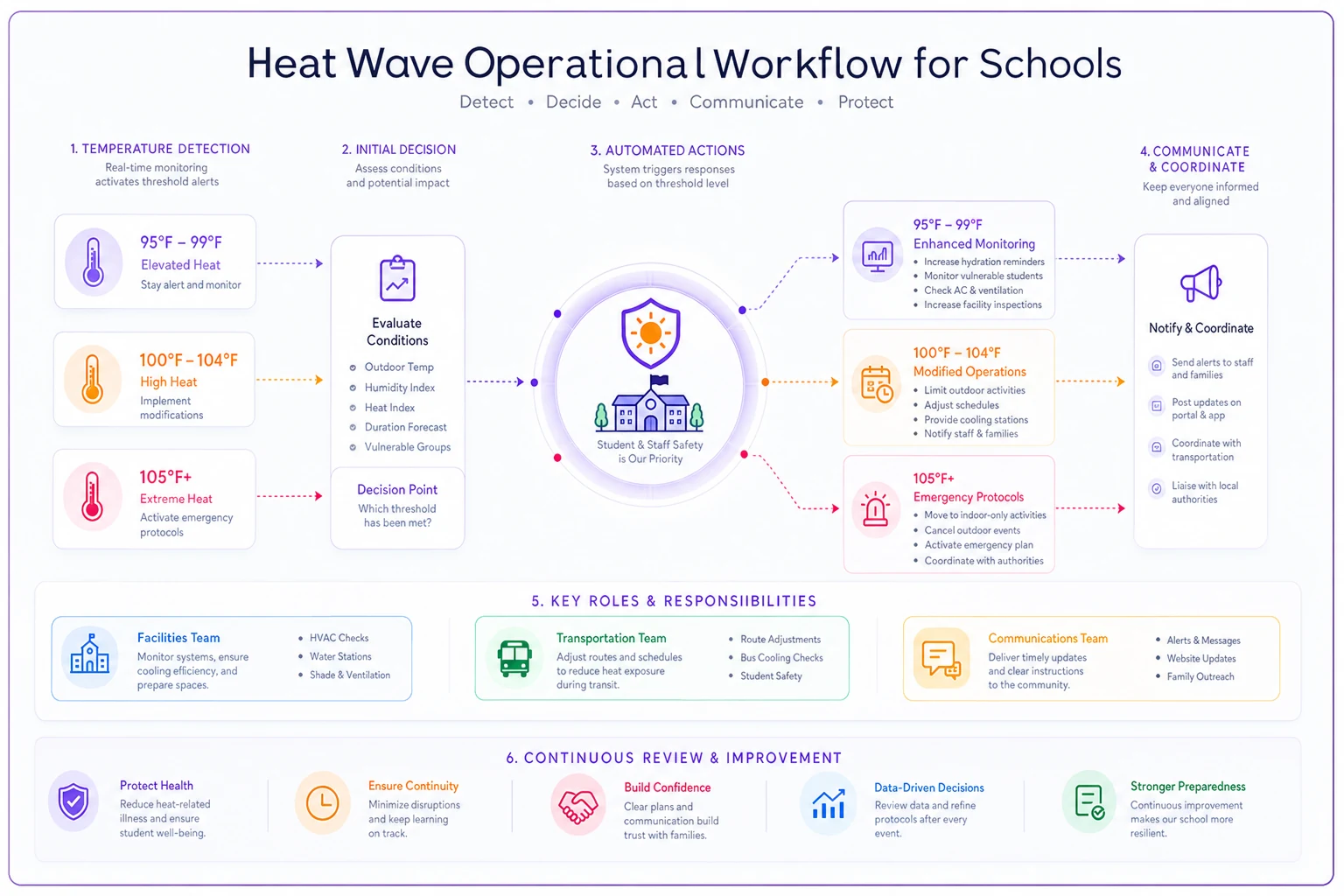
Visual workflow of threshold triggers and response actions.
The attendance documentation trap
State funding formulas don't care that your students missed school because their apartment hit 95°F inside. You need excused absences with proper documentation, or you lose Average Daily Attendance (ADA) funding.
Most districts haven't updated their attendance policies for extreme heat. You need specific protocols for:
Heat-related absence categories:
-
Building closure (excused, ADA protected)
-
Transportation failure (excused, requires documentation)
-
Health safety concern (parent discretion, may require follow-up)
-
Cooling center relocation (present, alternate site)
Documentation requirements:
-
Parent notification within 24 hours
-
Reason code assignment within 48 hours
-
State reporting classification within 5 days
-
Appeal process for funding protection
Districts that handle this well have automated workflows that pre-populate heat-related absence codes based on temperature data, building status, and transportation logs. Manual entry and post-event cleanup cost real money — and that's before you factor in the staff hours spent untangling it during reconciliation.
Emergency communications that actually work
During heat waves, normal communication channels start breaking down. Email gets ignored. Robocalls go to voicemail. Apps crash under load.
You need a tiered emergency communication system that can handle thousands of simultaneous messages across multiple channels. More importantly, you need confirmation tracking — knowing who received the message versus who actually acknowledged it.
The communication sequencing matters:
-
Initial advisory (T-24 hours)
Weather monitoring, potential impacts
-
Decision announcement (T-12 hours)
Closure/modification decision
-
Logistics details (T-6 hours)
Transportation changes, meal sites
-
Confirmation request (T-2 hours)
Acknowledge receipt, confirm plans
-
Post-event follow-up (T+24 hours)
Resume normal operations
Miss any of these windows and you get chaos — parents showing up at closed schools, buses running empty routes, staff unclear about reporting requirements.
The hidden cooling center complexity
When schools become cooling centers, operational complexity multiplies fast. You're running parallel operations — emergency community service alongside regular district functions.
Consider the liability and logistics:
-
Who's allowed in? (Students only? Families? General public?)
-
What spaces are accessible? (Classroom? Gym? Cafeteria?)
-
Who provides security? (School resource officers? District security? Local police?)
-
What about food service? (Free meals? Vending only? Outside food allowed?)
-
How do you track attendance? (For funding? For safety? For contact tracing?)
One district found out the hard way that their insurance specifically excluded "non-educational use of facilities" unless pre-approved. Their cooling center operation, while the right thing to do, created a significant liability gap they only discovered during an audit six months later. That's the kind of thing that keeps a CFO up at night.
Budget reality check
Heat waves punch holes in carefully planned budgets. Some real numbers:
Immediate costs:
-
Emergency HVAC repairs
$15,000-40,000 per building
-
Portable cooling units
$500-1,500 per day per unit
-
Overtime maintenance staff
$8,000-12,000 per week
-
Additional transportation runs
$3,000-5,000 per day
-
Emergency communications
$2,000-4,000 per event
Hidden costs:
-
Lost ADA funding from absences
$50-150 per student per day
-
Deferred maintenance creating future problems
$100,000+ per project
-
Staff turnover from burnout
$15,000-25,000 per replacement
-
Make-up days extending the school year
$75,000-125,000 per day
Districts that get through these events without destroying their budgets usually have two things working in their favor: pre-negotiated emergency contracts and automated cost tracking that captures expenses in real-time for reimbursement claims later.
Technology infrastructure nobody thinks about
Your servers are probably in a closet somewhere without dedicated cooling. During heat waves, IT infrastructure fails in pretty predictable ways:
Network equipment overheats and starts dropping packets. UPS backup batteries fail faster in high heat. Older computers in non-AC spaces shut down randomly. Digital display boards go dark. Security cameras stop recording.
One district lost three days of attendance data because their server room hit 95°F and corrupted the database during an automated backup. Recovery cost around $45,000 and hundreds of hours of manual reconstruction.
Your technology team needs temperature monitoring in every equipment space, automated alerts for threshold breaches, and clear shutdown and recovery procedures. More importantly, they need backup methods for critical operations — paper attendance sheets, manual communication trees, offline payment processing. The districts that hold up best during these events aren't necessarily better funded; they just have fallback plans that don't depend on everything working at once.
Post-event recovery operations
After the heat wave passes, the real work starts. You need systematic processes for:
Damage assessment:
-
Document every impacted system, even minor issues. Insurance claims and state or federal disaster assistance require comprehensive documentation.
-
Photos, temperature logs, work orders, contractor invoices — everything needs proper filing.
Attendance reconciliation:
-
Review every absence for proper coding.
-
Submit amended reports to state systems.
-
File funding protection requests.
-
Document parent communications for audit trails.
Financial recovery:
-
Compile emergency expenses.
-
Submit insurance claims.
-
Apply for disaster relief funds.
-
Adjust budgets for ongoing impacts.
-
Negotiate payment terms with vendors.
Lessons learned:
-
What failed first? What worked?
-
Which vendor relationships held up?
-
What policies need updating before next summer?
Districts that skip this recovery phase end up absorbing hundreds of thousands in preventable losses. It's not glamorous work, but it's where you either recover your costs or write them off permanently.
Making operations resilient
The difference between districts that handle heat waves well and those that don't usually isn't resources — it's operational sophistication. Districts that struggle tend to be reacting. Districts that hold up tend to have already decided what they're going to do before anything happens.
Modern school operations platforms can automate a lot of what's described here. Temperature data triggers workflow automation. Attendance systems adapt to emergency codes. Communication platforms handle multi-channel messaging with confirmation tracking. Budget systems capture emergency expenses with proper categorization. That kind of infrastructure doesn't eliminate the chaos, but it dramatically reduces how much of it lands on your staff.
The technology only works, though, if your underlying protocols assume failure, build in redundancy, and are clear about what matters most: student safety, regulatory compliance, and fiscal responsibility. Automation built on top of a broken process is still a broken process.
Practical next steps
If you're reading this during a heat wave, focus on immediate stabilization. If you're reading this before the next one, here's your preparation checklist:
Within 30 days:
-
Map all cooling-vulnerable spaces
-
Inventory HVAC system age and capacity
-
Review attendance policies for heat events
-
Test emergency communication systems
-
Identify pre-positioned supply needs
Within 60 days:
-
Negotiate emergency contractor agreements
-
Update insurance coverage documentation
-
Train staff on heat wave protocols
-
Configure automated monitoring alerts
-
Establish temperature threshold triggers
Within 90 days:
-
Run a tabletop exercise for a heat wave scenario
-
Integrate systems for automated workflows
-
Document cost recovery procedures
-
Update parent communication templates
-
Schedule preventive maintenance for all HVAC
The New York Times is already reporting this won't be the last stretch of extreme heat this summer. Districts that handle these events without falling apart don't treat heat as an emergency — they treat it as an operational scenario they've planned for, practiced, and systematized.
The gaps get exposed either way. The only question is whether you've done the work ahead of time or you're doing it under pressure while families are waiting for answers.
Ready to optimize your school operations?
Join hundreds of schools using GoSkoly to save time, improve collaboration, and enhance student outcomes.