

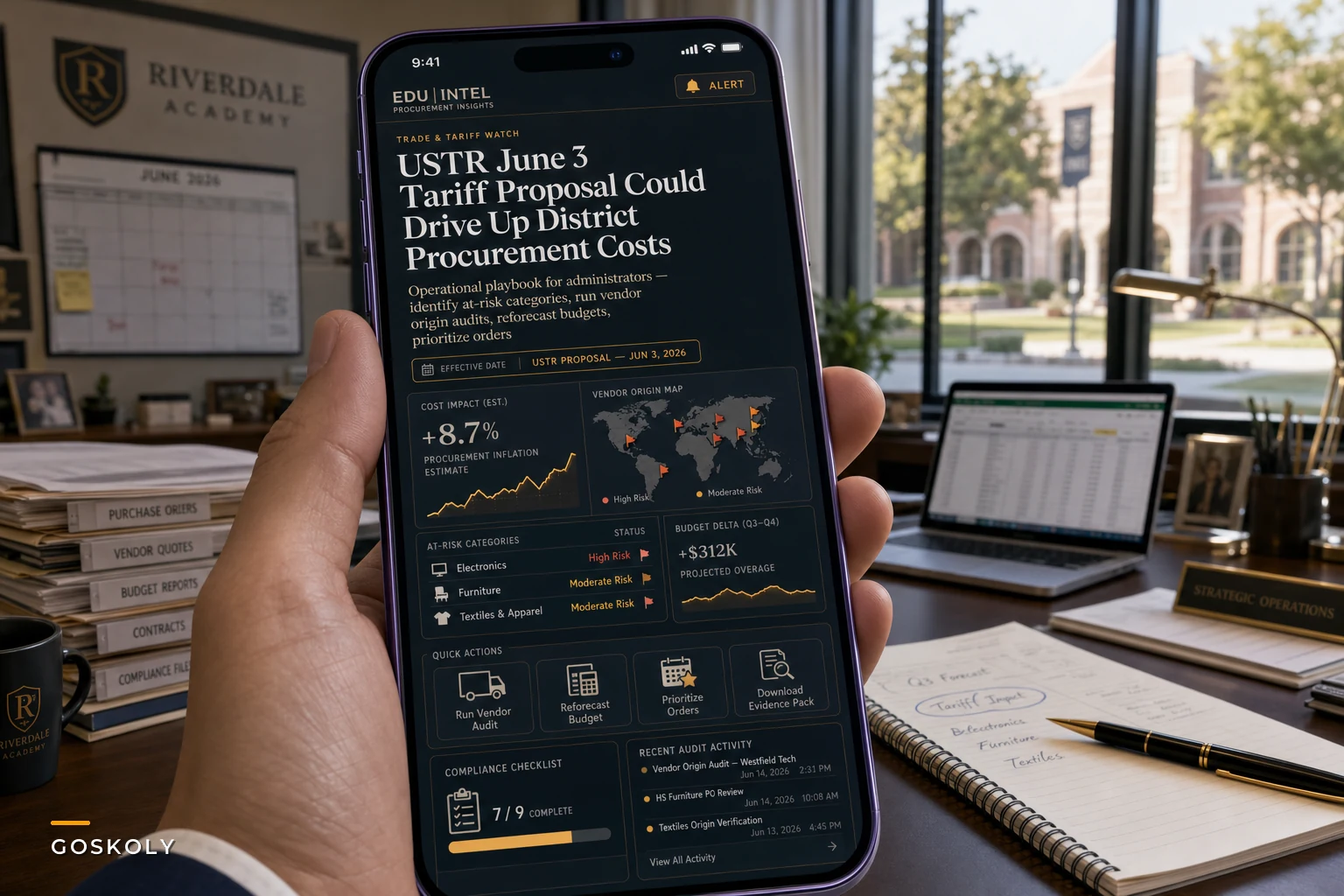

Last Tuesday, the procurement director at a mid-sized Texas district got an email from their main technology vendor. The message was simple but concerning: all pending orders would need price adjustments due to proposed import tariffs, potentially adding 10-12.5% to their costs. The district had just approved $18 million in technology purchases for the upcoming school year.
This scenario is playing out across the country. Reuters reported on June 3rd that the Office of the U.S. Trade Representative has proposed broad new import tariffs on goods from about 60 trading partners, citing forced-labor concerns. For school districts already navigating tight budgets, these tariffs could transform procurement from a routine process into a financial crisis.
The immediate procurement scramble
School procurement teams are dealing with an operational nightmare that goes beyond simple price increases. Districts typically lock in their major purchases between March and June for the following school year. With tariffs potentially taking effect before deliveries, administrators are scrambling to understand which orders might be affected.
The complexity multiplies when you realize most districts don't actually know the origin of their products. That laptop cart might be assembled in Mexico with components from Vietnam. The science lab equipment could come through a distributor who sources from multiple countries. Even basic supplies like uniforms and sports equipment often involve complex international supply chains.
One procurement officer in California described their current situation: they have roughly 400 active purchase orders for the upcoming year, totaling around $8.7 million. About 70% involve products that could be subject to the new tariffs, but vendors can't provide clear answers about final pricing or delivery dates. The district's legal counsel is now reviewing whether existing contracts can be modified mid-stream, while the finance team is modeling worst-case scenarios that show potential overruns of $870,000 to $1.1 million.
Budget amendments require board approval, which takes weeks. Meanwhile, teachers are planning curricula based on equipment that might not arrive. Maintenance schedules assume certain supplies will be available. Transportation routes are designed around expected enrollment, which could shift if programs get cut to cover cost overruns.
Beyond the price tag: compliance and documentation chaos
The tariff proposal isn't just about paying more — it's about proving where products come from and ensuring they meet compliance standards. School districts, already stretched thin on administrative capacity, now need to manage vendor certifications, origin documentation, and compliance tracking at a granular level.
Eliminate administrative overload.
GoSkoly helps you manage schedules, attendance, and communications seamlessly.
- Unified student and staff management
- Automated attendance tracking
- Integrated communication tools
No credit card required
Most districts run their procurement through basic spreadsheets or aging enterprise systems that weren't designed for this level of supply chain visibility. When auditors come calling (and they will, given the federal funding involved), districts need to demonstrate they've done proper due diligence on vendor compliance and origin verification.
The documentation burden is staggering. Each vendor relationship now requires:
-
Country of origin certificates for major components
-
Supply chain attestations regarding forced labor
-
Alternative sourcing plans if primary suppliers are affected
-
Price adjustment clauses and triggers
-
Compliance audit trails for federal programs
A district operations director in Ohio manages relationships with 127 vendors. Under the new requirements, each vendor needs updated documentation, creating roughly 635 new documents to track, store, and regularly update.
Their current system? A shared drive with folders organized by vendor name, where finding a specific compliance document from six months ago takes 20-30 minutes of searching.
The hidden operational costs nobody talks about
Import tariffs compound existing inefficiencies in ways that hurt. Districts often operate with procurement processes designed decades ago, when buying meant calling three local vendors and picking the lowest bid.
A district needs new Chromebooks. The IT director researches models, the curriculum team weighs in on specifications, the special education department has accessibility requirements, and the finance team needs to verify funding sources. The procurement officer then navigates state purchasing cooperatives, checks for existing contracts, requests quotes, manages the bid process if required, and handles board approval. This process, which should take weeks, often stretches to months.
Add tariff complexity, and that timeline doubles. Vendors need extra time to determine final pricing. Legal reviews take longer. Board presentations become more complex as administrators explain why the approved budget suddenly needs adjustment.
The opportunity cost is enormous — every hour spent managing tariff-related procurement issues is an hour not spent on educational outcomes.
Where districts actually get stuck
The real bottleneck isn't the tariffs themselves — it's the manual processes districts use to manage procurement. When everything runs through email chains, spreadsheets, and paper forms, adding another layer of complexity breaks the system.
Consider vendor management alone. Most districts maintain vendor information in multiple places: the finance system has payment details, procurement keeps contact information in spreadsheets, legal has contracts in filing cabinets, and compliance documentation lives in email attachments. When tariffs force you to quickly assess which vendors might be affected, gathering this information becomes a multi-day archaeological dig through various systems.
The same fragmentation affects budget tracking. The board approves a technology budget of $2 million. That money gets allocated across departments, tracked in different spreadsheets, committed through various purchase orders, and reconciled manually. When prices suddenly jump 10%, understanding the actual impact requires manually updating dozens of spreadsheets, re-calculating allocations, and somehow communicating changes to everyone involved.
A Florida district recently discovered they'd double-ordered furniture because two departments weren't coordinating their tariff-adjusted purchases. An Illinois district had to emergency-cancel a curriculum software renewal because the technology budget got consumed by tariff increases on hardware — but nobody noticed until teachers couldn't log in on the first day of school.
Building tariff-resilient procurement operations
Smart districts are using this crisis to modernize their entire procurement operation. Instead of just reacting to tariffs, they're building systems that can handle any supply chain disruption.
The first step is centralizing vendor data. Every vendor should have a single record that includes contracts, compliance documents, contact information, product origins, and purchase history. When tariffs change or new regulations emerge, you can quickly assess impact across all vendors instead of hunting through scattered files.
Next, implement approval workflows that actually work. Instead of routing paper forms or forwarding emails, create clear digital paths where purchase requests flow through necessary approvals with automatic notifications and escalations.
Budget tracking needs real-time visibility. Every stakeholder should see the same numbers, updated automatically as purchases are approved, modified, or delivered. When tariffs force a price adjustment, the budget impact should be immediately visible to decision-makers, not discovered weeks later during manual reconciliation.
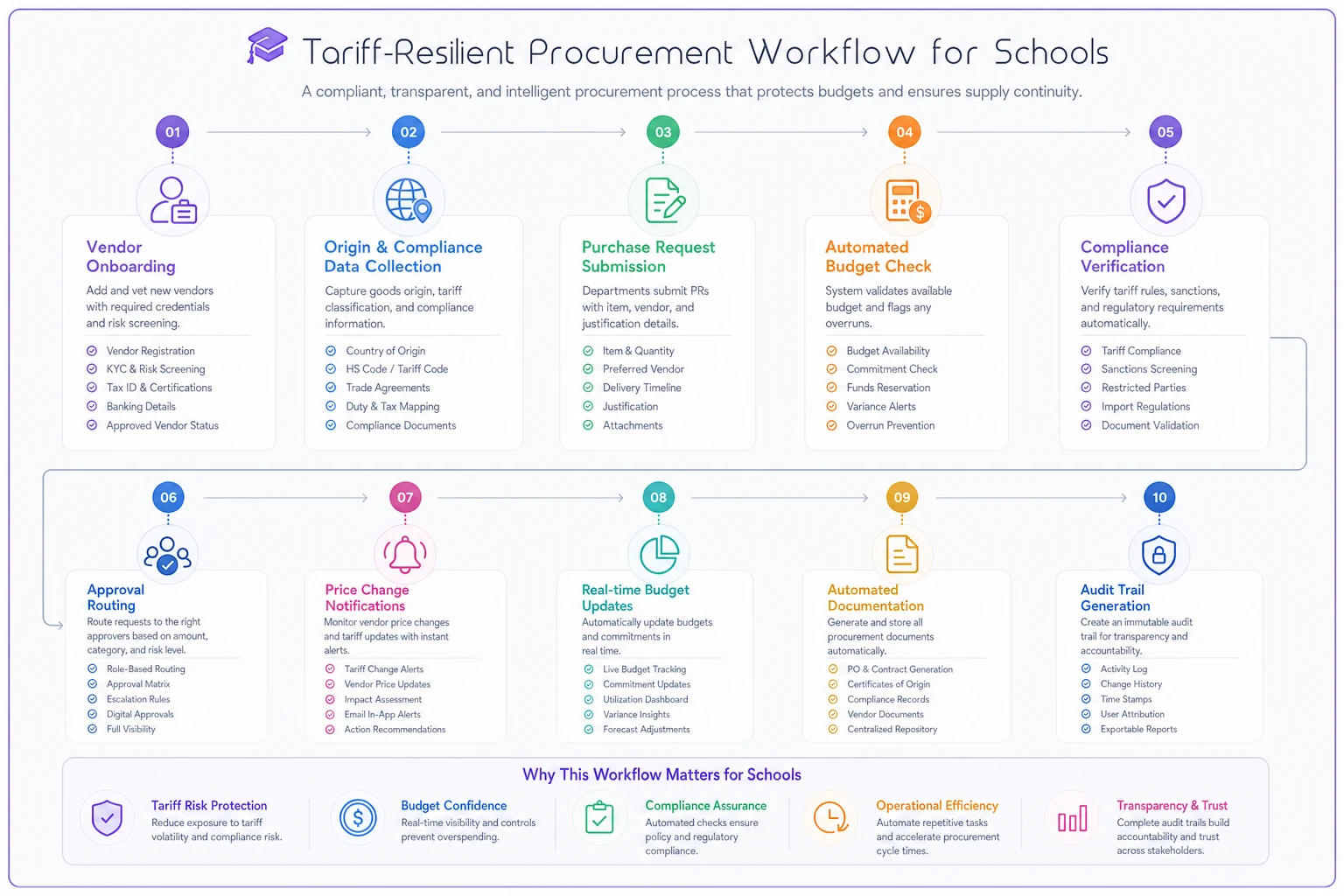
Workflow for Tariff-Resilient Procurement
The diagram below shows a suggested end-to-end workflow districts can adopt to manage vendor onboarding, compliance, approvals, and budget updates automatically.
| Traditional Procurement Timeline | Tariff-Impacted Timeline | Additional Steps Required |
|---|---|---|
| Needs assessment (2 weeks) | Needs assessment (2 weeks) | Origin analysis per vendor |
| Vendor research (1 week) | Vendor research (3 weeks) | Compliance verification |
| Quote collection (2 weeks) | Quote collection (4 weeks) | Tariff impact modeling |
| Budget approval (2 weeks) | Budget approval (3-4 weeks) | Contingency planning |
| Purchase order (1 week) | Purchase order (2 weeks) | Documentation assembly |
| Total: 8 weeks | Total: 14-15 weeks | +75% time increase |
Here's a practical workflow that works:
Pro-tip: Capture vendor origin and compliance data during onboarding to avoid scrambling when tariffs or regulations change.
-
Vendor onboarding captures origin and compliance data upfront
-
Purchase requests automatically check budget availability and vendor compliance
-
Price changes trigger notifications to affected stakeholders
-
Approval routing follows predetermined paths based on amount and type
-
Documentation automatically attaches to the vendor and purchase records
-
Budget updates happen in real-time as purchases are approved
-
Audit trails generate automatically for compliance reporting
When a vendor notifies you of a price change, the adjustment should trigger an automated review process, not sit in someone's inbox.
The automation opportunity most districts miss
Districts often think automation means expensive ERP systems that take years to implement. Modern operational software can transform procurement without massive upheaval. The key is starting with the workflows that hurt most.
Take vendor compliance tracking. Instead of manually requesting and filing certificates, automated systems can send requests, track responses, flag expiring documents, and maintain audit trails. When tariff regulations change, you can quickly identify affected vendors and request updated documentation without manual tracking.
Purchase approval workflows benefit enormously from automation. A teacher submits a request, the system checks budget availability, routes to the appropriate approver based on amount and category, notifies stakeholders of approval status, and creates the purchase order. What took days of email chains happens in hours.
The evidence assembly for audits becomes straightforward when documentation is automatically attached to transactions. Instead of scrambling to find receipts, contracts, and compliance certificates, everything is organized and exportable. Audit preparation shifts from weeks of document hunting to hours of review.
Budget reconciliation, typically a monthly ordeal, can happen continuously. As invoices arrive, they're matched to purchase orders, variances are flagged, and budgets update automatically. The CFO sees real-time spending against budget, not last month's numbers.
When to act (and when to wait)
Not every district should overhaul procurement systems right now. If you're managing under 50 vendors and $5 million in annual procurement, enhanced spreadsheets and better processes might suffice. Focus on documenting vendor origins, creating contingency plans, and improving communication flows.
But if you're handling hundreds of vendors, managing federal program compliance, or coordinating procurement across multiple schools, manual processes will break under tariff pressure. The additional complexity pushes human-managed systems past their breaking point.
The decision comes down to operational capacity. Can your team handle a 75% increase in procurement complexity without dropping other responsibilities? Can you maintain audit-ready documentation while managing constant price adjustments? Can you provide real-time budget visibility as costs shift?
If the answer is no, automation isn't luxury — it's necessity. The investment in operational software pays for itself through reduced staff overtime, fewer emergency purchases, better vendor terms through consolidated buying, and avoided audit findings.
A realistic path forward
Start by auditing your current state. List your top 20 vendors by spend and determine their product origins. Calculate the potential tariff impact on committed purchases. Document your current procurement timeline and identify bottlenecks.
Immediate (This month):
-
Create vendor origin tracking spreadsheet
-
Establish tariff impact communication protocol
-
Review and document approval authorities
-
Set up budget variance monitoring
Short-term (Next quarter):
-
Digitize vendor documentation
-
Implement standardized purchase request forms
-
Create approval workflow templates
-
Establish vendor compliance requirements
Long-term (Next year):
-
Deploy integrated procurement platform
-
Automate compliance tracking
-
Connect budget and purchasing systems
-
Build predictive procurement analytics
The goal isn't perfection — it's building resilience. Districts that can quickly assess impacts, adjust processes, and maintain compliance will navigate tariffs successfully.
Moving beyond crisis mode
The proposed import tariffs expose a fundamental truth about school procurement: most districts operate with systems designed for a simpler time. When complexity increases — whether from tariffs, regulations, or supply chain disruptions — these systems fail.
But crisis creates opportunity. Districts that modernize procurement often discover benefits beyond tariff management. Vendor relationships improve when onboarding is smooth and payments are predictable. Staff morale increases when routine tasks are automated.
Budget accuracy improves when spending is tracked in real-time. Audit findings decrease when documentation is automatically maintained.
Smart districts won't just survive the tariff impact — they'll use it to build better operations for the long term. The question isn't whether to modernize procurement, but how quickly you can make it happen before the next crisis hits.
Ready to optimize your school operations?
Join hundreds of schools using GoSkoly to save time, improve collaboration, and enhance student outcomes.