

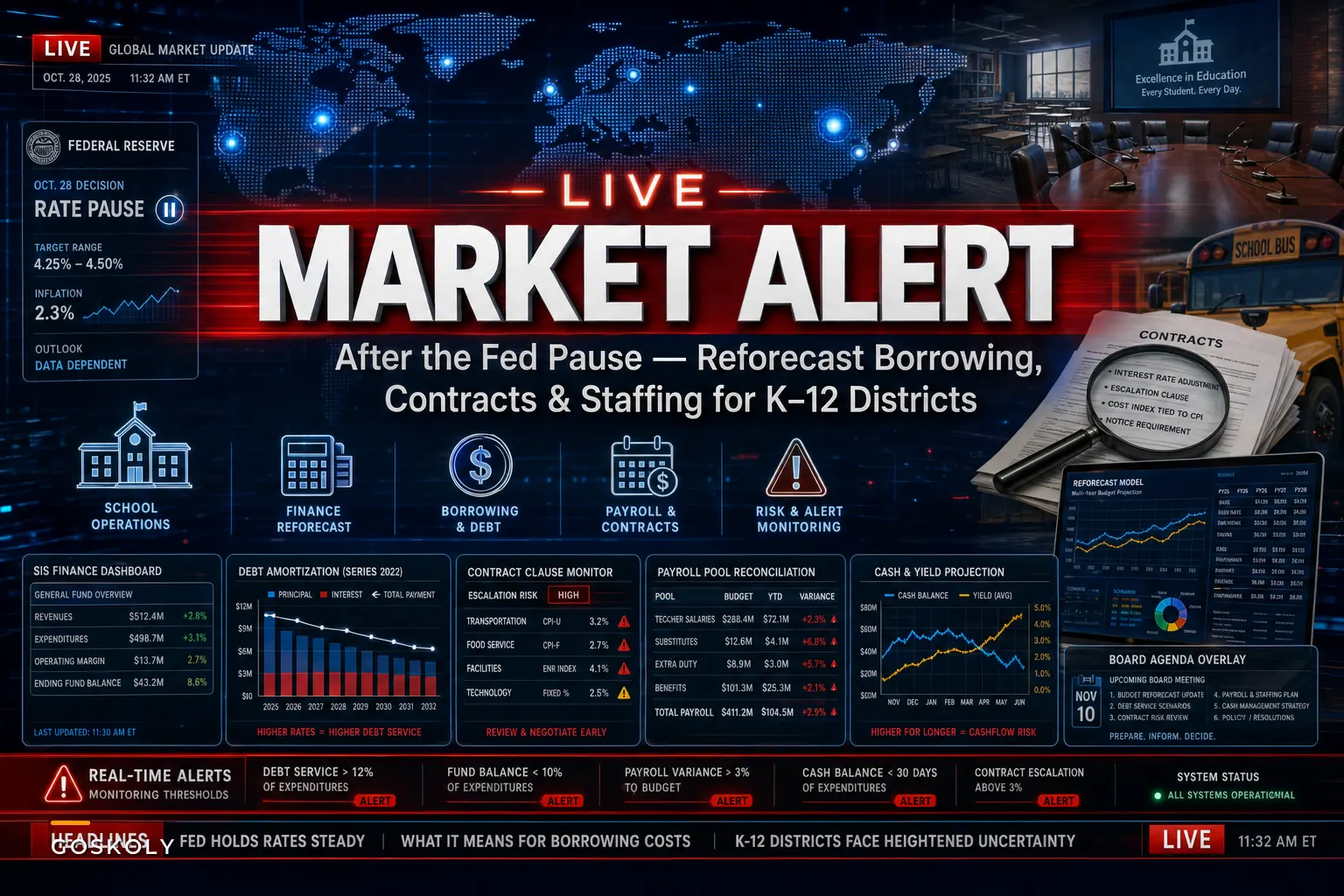

When the Federal Reserve held the funds rate steady at 3.75%–4.00% on October 28, 2026, most district finance offices probably caught the headline and moved on. No cut, no hike — nothing to act on, right? That's the trap. A pause isn't a non-event for a district budget. It's a signal that borrowing costs, cash yields, and wage pressure are all going to sit in an uncomfortable holding pattern for a while. Districts that treat "no change" as "no action" tend to get caught flat-footed when a capital project or lease renewal suddenly lands on the agenda.
The Fed's own FOMC statement framed the decision as data-dependent, and Reuters noted the committee is essentially waiting on more inflation data before committing to a direction. For a CFO, that translates pretty directly: rates are staying elevated long enough to matter, and the assumptions baked into last spring's budget build are probably stale.
This isn't a macro commentary piece. It's a runbook for the specific decisions a pause forces you to revisit — and the places where your financial assumptions quietly fall out of sync with data sitting in your SIS, your payroll system, and your procurement records.
Start with the reforecast, not the headline
The mistake most districts make after a Fed decision is reacting to the direction of rates instead of the duration. A hold tells you the current rate environment has staying power. That changes three numbers immediately:
-
Your debt-service assumptions on anything variable-rate or anything you planned to refinance.
-
Your cash-management yield — which is actually working in your favor right now. Idle reserves and operating cash are earning more than they have in years.
-
Your vendor and wage escalation math, because a persistent high-rate environment keeps input costs and benefit costs elevated.
The part that tends to get missed: districts model these three things in separate spreadsheets owned by separate people. The debt schedule lives with the finance director. The cash forecast lives with the treasurer or a part-time analyst. Wage pool projections sit somewhere between HR and payroll. When the rate environment shifts, nobody owns the combined picture, and the reforecast happens piecemeal over six weeks instead of in one coordinated pass.
A typical example looks something like this: a mid-sized district carries around $42M in outstanding debt, holds somewhere between $18M–$22M in operating and reserve cash across the year, and runs a substitute and extra-duty pool north of $1.5M. A sustained high-rate environment changes the net position on all three — but if you only update the debt tab because that's the one you mentally associate with the Fed, you leave real money on the table in the cash yield and misjudge the wage side entirely.
Where the real exposure hides: contracts, not bonds
Everyone thinks about bonds first. The quieter exposure is in multi-year vendor agreements, and a rate pause does its damage there slowly.
Eliminate administrative overload.
GoSkoly helps you manage schedules, attendance, and communications seamlessly.
- Unified student and staff management
- Automated attendance tracking
- Integrated communication tools
No credit card required
Most district service contracts — transportation, food service management, SaaS platforms, facilities, managed IT — carry escalation clauses. Some are tied to CPI, some to a fixed annual bump, some to vaguely worded "market conditions" triggers. In a high-rate, elevated-input-cost environment, vendors lean on those clauses harder. Renewal quotes come in at 5–9% increases and often get waved through because nobody has time to argue line by line during a busy renewal season.
The underlying problem is visibility. Contract terms live as PDFs in a shared drive. The renewal date lives in someone's calendar — if it lives anywhere at all. There's no single view that says "these 14 contracts renew in the next 120 days, here are their escalation terms, and here's which ones we can actually push back on."
Before your next renewal cycle, pull every active contract and sort them into something like this:
| Contract type | Typical escalation driver | Renegotiation leverage in a rate pause | Priority to revisit |
|---|---|---|---|
| Transportation / fuel | Fuel index + labor | Low — fuel is exogenous | Medium |
| Food service management | CPI-food + labor | Medium — multi-year lock-ins possible | High |
| SaaS / software | Fixed annual % | High — competitive market, negotiable | High |
| Managed IT / facilities | Labor + "market" clauses | Medium — vague clauses invite challenge | High |
| Construction / capital | Rate-sensitive financing | High — timing is everything | Critical |
The point of the table isn't specific percentages — those vary wildly by region. It's forcing a conversation about leverage. A SaaS contract with a soft annual bump is far more negotiable than a fuel-indexed transportation deal, but districts often spend their negotiating energy backwards because they attack whatever renewal happens to land first.
The capital timing decision nobody wants to make
If you have a planned bond issuance or a lease-financing deal queued up, a rate hold puts you in genuine decision territory. There's no clean answer here.
When waiting actually makes sense: If your project has real flexibility on timing and the Fed's data-dependent language suggests cuts could come in the next few quarters, delaying issuance by even one or two cycles can shave real money off a 20-year obligation. On a $30M issuance, a modest rate improvement is not a rounding error — it can be hundreds of thousands in total debt service over the life of the bond.
When waiting is a bad idea: If construction costs are climbing faster than any plausible rate improvement would save you, the "wait for cheaper money" play backfires. Districts chase a better rate while bid prices on the actual project escalate past whatever the financing savings would have been. In an environment where input costs stay sticky, construction inflation often outruns the interest savings.
Who should not try to time this at all: Small districts without dedicated debt-advisory support. If you don't have a municipal advisor modeling scenarios, trying to time a bond issuance is guessing with public money. Lock in predictability instead.
Nobody knows where rates go next — the Fed just told you they don't either. Your job isn't to predict. It's to build a reforecast that holds up under two or three rate scenarios so the board decision is grounded, not a gut call.
A 7-step reforecast process you can run this month
Here's a sequence that keeps the reforecast coordinated instead of scattered across four people's spreadsheets:
-
Freeze your current assumptions in writing. Document the rate, yield, and escalation numbers your existing budget actually used. You can't measure drift if you never wrote down the baseline.
-
Re-pull your variable-rate debt schedule and model it under rate-flat, modest-cut, and modest-hike scenarios. Three columns, not one.
-
Update cash-yield projections. Elevated rates mean your reserves are earning more — make sure that upside is captured, because it partially offsets cost pressure elsewhere.
-
Inventory every contract renewing in the next 180 days with escalation clauses spelled out plainly. Flag the high-leverage ones for active renegotiation.
-
Reconcile your wage pools — substitute pay, extra-duty, salary step movement — against realistic cost pressure, not last year's flat assumption.
-
Build board and union communication drafts early. The numbers will move; the narrative shouldn't be improvised the night before a meeting.
-
Set alerts for interest-sensitive spend and renewal dates so the next rate move doesn't catch you reconstructing the picture from scratch.
Steps 2 through 5 all depend on pulling clean data from systems that don't naturally talk to each other — the debt schedule, the general ledger, procurement records, and payroll. That dependency is the real bottleneck, and it's worth being honest about upfront.
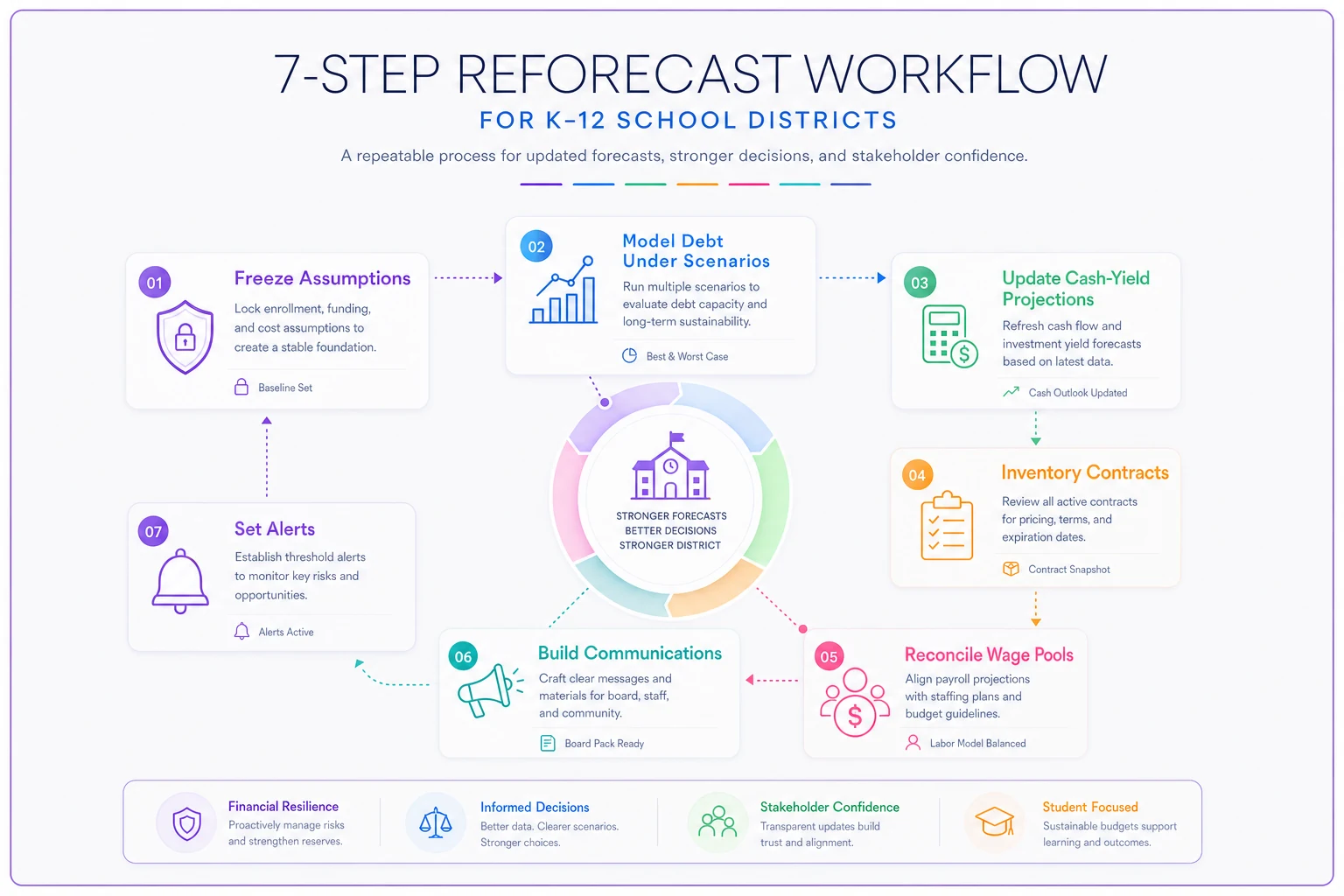
Here's a quick visual to follow when you run this pass.
The deeper problem: your financial picture is only as good as your data alignment
A rate pause exposes something that was always there — the gap between what your SIS and operational systems know and what your finance ledger assumes.
Wage pool reforecasting is the clearest case. Substitute and extra-duty costs are driven by actual assignments recorded in scheduling and SIS data, but the budgeted pool is a number set months ago in the finance system. When those two drift apart, you typically discover it in April when the pool is nearly exhausted — not in November when you could have done something about it. The same disconnect hits enrollment-driven revenue, fee collections, and meal-program funding, all of which feed cash-flow assumptions that your debt and reserve decisions rest on.
This is exactly the alignment work that doesn't get attention until a rate decision forces a reforecast. If your SIS and finance ledgers reconcile cleanly, a reforecast is a one-week exercise. If they don't, it's a month of manual tie-outs and a nagging suspicion your numbers are wrong. We've written about building that foundation in district finance and SIS alignment for reliable reconciliation, and a moment like this is precisely when that groundwork pays off — or where its absence becomes painfully obvious.
Prioritize centralizing contract renewal dates and escalation terms so they can be surfaced on demand.
The practical fix isn't glamorous. It's making sure the systems that hold your real operational data can surface it on demand: contract renewal dates and terms, wage pool consumption against budget, cash balances by fund, debt schedules by instrument. Districts that keep this information centralized — with clear owners and automated alerts for interest-sensitive spend and upcoming renewals — turn a Fed decision into a Tuesday afternoon update. Districts that keep it scattered across inboxes and shared drives turn it into a fire drill.
A quick real scenario
A suburban district of roughly 6,800 students had a lease-financing renewal for its transportation fleet and a food-service management contract both landing in the same quarter the Fed held rates. Their original plan assumed last year's escalation figures — around 3% on the food-service side — and a fleet-financing rate pulled from a quote that was already four months old.
When they actually ran the reforecast across scenarios, two things surfaced. The food-service vendor had quietly proposed a 7% bump citing "market conditions," and the stale fleet-financing quote no longer reflected the current environment. By catching both before sign-off, they pushed the food-service increase down closer to 4% through negotiation and re-solicited the fleet financing. The combined difference landed somewhere in the low-to-mid six figures over the life of the agreements — not from any clever market timing, just from refusing to roll forward assumptions that had gone stale.
Nothing about that outcome required predicting the Fed. It required knowing, in one place, which contracts were renewing, what their escalation terms said, and what the current rate environment actually meant for each decision.
Bottom line for budget owners
A Fed pause is easy to ignore precisely because nothing changed on the surface. But a sustained high-rate environment keeps pressure on your debt service, hands you a real yield opportunity on reserves, and emboldens vendors leaning on escalation clauses — all at once, and all in systems that rarely give you a combined view.
The districts that handle this well aren't the ones with the best rate forecast. They're the ones whose finance and operational data stay aligned well enough that a reforecast is a routine exercise instead of an emergency. Run the seven-step pass, pressure-test your contracts before signing anything, and build the board narrative while you still have time to shape it. The next Fed decision — cut, hold, or hike — will be a lot less stressful if the underlying numbers are already clean.
The districts that handle this well aren't the ones with the best rate forecast. They're the ones whose finance and operational data stay aligned well enough that a reforecast is a routine exercise instead of an emergency. Run the seven-step pass, pressure-test your contracts before signing anything, and build the board narrative while you still have time to shape it. The next Fed decision — cut, hold, or hike — will be a lot less stressful if the underlying numbers are already clean.
Ready to optimize your school operations?
Join hundreds of schools using GoSkoly to save time, improve collaboration, and enhance student outcomes.