


The scheduling coordinator at Riverside School District just discovered their worst nightmare at 2:47 PM on a Thursday. Twenty-three AP Chemistry students showed up for their lab session at the North campus, but the science lab was already occupied by freshman biology. The chemistry teacher drove from South campus with equipment. The biology teacher had a printed schedule showing the room was theirs. Both were right according to their campus schedules.
This wasn't a one-time mistake. It was the third major room conflict that week across their three-campus system serving 4,200 students.
Multi-campus timetable optimization isn't about finding the perfect algorithm or buying expensive scheduling software. It's about building a constraint-priority framework that actually works when you're juggling 127 teachers, 68 classrooms, and roughly 4,000 student course requests across multiple locations with different room configurations.
The hidden complexity of multi-campus scheduling
Most districts underestimate how quickly scheduling complexity multiplies with each campus. A single high school with 40 classrooms and 1,400 students might have around 50,000 scheduling constraints to manage. Add two more campuses with shared faculty and specialized rooms, and you're suddenly dealing with close to 280,000 interdependent constraints.
The Riverside situation happens when districts try to schedule each campus independently, then manually reconcile conflicts. They build three separate master schedules in spreadsheets, email them back and forth, and hope someone catches the overlaps before September.
What makes this particularly challenging is that room limitations aren't uniform. The North campus might have three chemistry labs while South campus has one. West campus has the only automotive shop. The performing arts center is at North but drama classes happen at all three locations. Each constraint creates ripple effects across the entire system.
Traditional scheduling approaches treat all constraints equally. They try to satisfy every requirement simultaneously, which usually means satisfying none of them well. A physics teacher ends up driving between campuses four times per day. The computer lab sits empty during peak periods while students take programming classes in regular classrooms without adequate equipment.
Building a constraint-priority framework that actually works
A functional multi-campus scheduling system starts with categorizing constraints by their actual impact on operations. Not all scheduling conflicts are equal, and treating them like they are guarantees chaos.
Eliminate administrative overload.
GoSkoly helps you manage schedules, attendance, and communications seamlessly.
- Unified student and staff management
- Automated attendance tracking
- Integrated communication tools
No credit card required
Priority Level 1: Hard Physical Constraints These are non-negotiable. You cannot put 31 students in a room with 28 desks. You cannot schedule chemistry labs in rooms without sinks and ventilation. A teacher cannot be in two places simultaneously.
Start by mapping every specialized room across all campuses. Document exact capacity, equipment, and access requirements. The music room at South campus might technically hold 45 students, but only has 32 music stands. That's your real capacity.
Priority Level 2: Certification and Compliance Requirements State regulations often dictate specific requirements. AP courses need certified instructors. Special education services require licensed specialists. Career technical education programs have industry-standard equipment requirements.
Create a matrix showing which teachers can legally teach which courses at which locations. Include credential expiration dates. Nothing disrupts a semester faster than discovering your only qualified statistics teacher's certification expired and they can't teach the course.
Priority Level 3: Transportation Windows Bus schedules between campuses aren't suggestions. If it takes 18 minutes to drive from North to South campus during school hours, you need 25-minute passing periods for anyone making that transition. Missing this means students are perpetually late or missing instruction time.
Document actual travel times during school hours, not Google Maps estimates. Include parking availability and walking time from parking to classrooms.
Priority Level 4: Pedagogical Preferences These matter but can flex. The English department wants all sophomore classes before lunch for consistency. The math department prefers 90-minute blocks for advanced courses. Honor these when possible, but they yield to higher priorities.
Document real capacities including equipment counts to avoid mismatches between room capacity and usable resources.
These priority levels create a hierarchy you can use when making trade-offs during the scheduling process.
Iterative sequencing with pilot checks
Instead of trying to build the perfect schedule in one attempt, use iterative sequencing with pilot checks at each stage. This means scheduling in waves, testing for conflicts, and adjusting before adding the next layer of complexity.
The workflow below shows iterative sequencing and pilot checks.
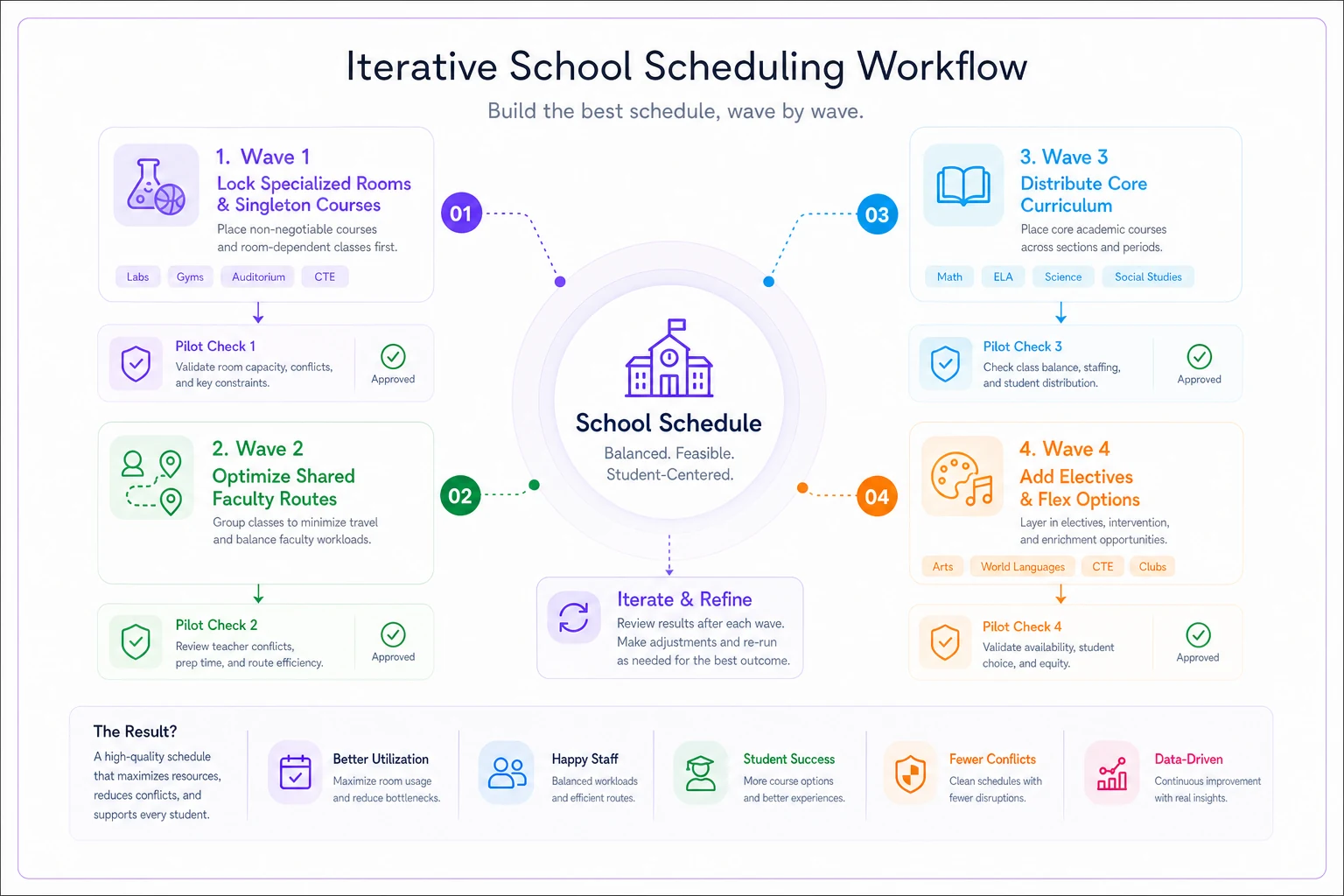
Wave 1: Lock in specialized rooms and singleton courses Start with courses that can only happen in specific rooms or with specific teachers. If you have one teacher certified for Mandarin 4 and one room equipped for automotive technology, those get scheduled first. These become your anchor points.
Run a pilot check: Can every student enrolled in these courses physically attend them? Are there timing conflicts with graduation requirements?
Wave 2: Schedule shared faculty routes Teachers working across multiple campuses need sustainable daily routes. A teacher shouldn't drive from North to South, back to North, then to West. Build logical circuits that minimize travel.
At Riverside District, they discovered seven teachers were scheduled to make 14 inter-campus trips daily. After route optimization, the same coverage required only nine trips, saving roughly 3.5 hours of transit time that became instruction or planning time.
Wave 3: Core curriculum distribution With specialized courses and traveling teachers locked in, distribute core curriculum across remaining spaces. This is where section balancing happens. If North campus has 180 freshmen needing English 1, and you have six qualified teachers, you need six appropriate rooms during six different periods.
Run another pilot check: Does every student have access to required courses for graduation? Are class sizes within contractual limits?
Wave 4: Electives and flexibility spaces Finally, add elective courses where space and staffing remain. This is where you can accommodate preferences and optimize for student choice.
Pilot checks at each wave catch conflicts while they're still manageable.
Trade-off matrices for real-world decisions
Every scheduling decision involves trade-offs. The key is making them visible and deliberate rather than accidental. A trade-off matrix helps administrators see the real cost of each choice.
| Scheduling Option | Room Utilization | Teacher Travel Time | Student Access | Special Programs | Cost Impact |
|---|---|---|---|---|---|
| Concentrate STEM at North Campus | 87% efficiency | Saves 12 hrs/week | 68% can access | Full lab availability | Saves $4K monthly on transport |
| Distribute STEM equally | 72% efficiency | Adds 18 hrs/week | 94% can access | Limited lab time | Adds $6K monthly transport |
| Hybrid model (advanced at North) | 81% efficiency | Adds 7 hrs/week | 85% can access | Good lab access for advanced | Adds $2K monthly |
The matrix reveals that concentrating STEM at North campus maximizes efficiency and reduces costs, but limits access for 32% of students who can't easily reach that campus. The hybrid model balances these concerns, though it's nobody's first choice.
Perfect solutions rarely exist. The goal is making informed trade-offs that align with district priorities.
Sample prioritization rules that prevent common failures
After analyzing scheduling failures across dozens of districts, certain patterns emerge repeatedly. These prioritization rules prevent the most common and disruptive problems:
Rule 1: No teacher travels more than once per day Exception only for specialists serving all campuses (speech therapist, psychologist). This prevents the 4-campus-per-day marathons that lead to teacher burnout and chronic lateness.
Rule 2: Singleton courses get priority scheduling If only one section of AP Physics exists across all campuses, it schedules before courses with multiple sections. Students can usually find another English 2 section. They can't find another AP Physics.
Rule 3: Lab and shop courses book their specialized rooms for consecutive periods Chemistry labs need setup and cleanup time. Auto shop projects span multiple days. Block scheduling for these courses prevents the constant setup/teardown that wastes learning time.
Rule 4: Graduation requirements schedule before electives Seems obvious, but many districts schedule popular electives first to maximize enrollment, then scramble to fit required courses around them. This backwards approach creates seniors missing graduation requirements.
Rule 5: Special education services anchor their host campuses If resource room support exists at South campus, special education students needing those services should have core courses at South, not scattered across the district.
The real cost of manual reconciliation
Riverside District's scheduling coordinator spent approximately 200 hours each summer building and reconciling schedules across their three campuses. That's five weeks of full-time work, not counting the constant adjustments throughout the year.
But the time cost is minimal compared to the operational disruption. Each room conflict means:
-
25-30 students losing instruction time
-
Two teachers unable to deliver planned lessons
-
Administrative time resolving the immediate crisis
-
Makeup work and shifted lesson plans
-
Parent complaints and lost confidence
When that North campus chemistry lab conflict happened, it triggered six hours of administrative work to resolve. Finding alternative space, communicating with parents, rescheduling the lab, documenting the issue for accreditation. Multiply this by even ten conflicts per semester, and you're looking at 60+ hours of crisis management that could have been prevented.
More critically, these conflicts erode trust. Teachers stop believing the schedule. They make informal arrangements, book rooms outside the system, and create shadow schedules that nobody tracks. By October, the official schedule barely resembles reality.
Moving from reactive fixes to proactive optimization
The path forward doesn't require massive technology investments or hiring scheduling consultants. It requires building systematic approaches to constraint management and conflict resolution before the school year starts.
Start with a complete constraint inventory. Not the ideal world where every teacher is fully certified and every room is perfectly equipped, but the actual reality of your facilities, staff, and students. Document every limitation, every shared resource, every transportation requirement.
Build your schedule iteratively using the constraint-priority framework. Test each wave before adding complexity. Use pilot checks to catch conflicts while they're still manageable.
Create clear trade-off documentation. When you choose to concentrate advanced courses at one campus, document why and what alternatives you considered. This helps during the inevitable complaints and provides institutional memory for future years.
Establish modification protocols before you need them. When a teacher leaves mid-year or enrollment shifts unexpectedly, how will you adjust? Having predetermined decision rules prevents panic-driven choices that cascade into larger problems.
Technology's role in multi-campus coordination
Modern scheduling doesn't mean complex software that requires extensive training. The most effective multi-campus timetable optimization often uses straightforward operational platforms that centralize information and automate conflict detection.
At Riverside District, moving from spreadsheet juggling to an integrated scheduling platform eliminated about 85% of their room conflicts. Not through complex algorithms, but through simple collision detection. When someone schedules Chemistry for room 203 at North campus on Tuesday period 3, the system immediately flags that Biology is already booked there.
The key improvement wasn't sophisticated optimization (though that helps), but real-time visibility across all campuses. Schedulers at each site see the complete picture, not just their local view. Changes propagate immediately. Conflicts surface before they become crises.
AI-powered operational software can enhance this further by suggesting optimal teacher routes, identifying underutilized spaces, and predicting where conflicts are most likely to occur based on historical patterns. The AI doesn't replace human judgment about educational priorities, but it eliminates the manual work of checking thousands of constraint combinations.
A unified platform also provides something spreadsheets never could: version control and audit trails. When a parent complains their student's schedule changed, you can see exactly when, why, and who approved it. When accreditors ask about course access equity, you have data showing section distribution across campuses and demographics.
The compound effect of small improvements
Multi-campus timetable optimization doesn't require perfection. Even modest improvements compound into significant operational gains.
Reducing room conflicts from 15 per week to 3 saves roughly 48 hours of administrative time monthly. Cutting teacher travel time by 20% adds back approximately 10 hours of instruction or planning time weekly across the district. Improving room utilization by 15% might defer the need for portable classrooms, saving $50,000+ annually.
The biggest gains are harder to measure. Teachers who aren't constantly rushing between campuses are more present for students. Students who aren't shuffled due to room conflicts maintain learning momentum. Administrators spending less time on crisis management can focus on instructional improvement.
For Riverside District, implementing a constraint-priority framework with iterative sequencing reduced their scheduling conflicts by roughly 75% in the first year. Not perfect, but functional enough that scheduling stopped dominating administrative time and teacher frustration.
Multi-campus scheduling will never be simple. But it doesn't have to be chaotic. Building systematic approaches to constraint management, using pilot testing to catch conflicts early, and leveraging technology for visibility and automation transforms scheduling from an annual crisis into a manageable operational challenge.
The goal isn't optimization for its own sake. It's creating stable, predictable schedules that let teachers teach and students learn without constant disruption. In multi-campus environments, that starts with acknowledging the true complexity, prioritizing constraints that matter most, and building systems that handle the inevitable adjustments without falling apart.
Ready to optimize your school operations?
Join hundreds of schools using GoSkoly to save time, improve collaboration, and enhance student outcomes.