

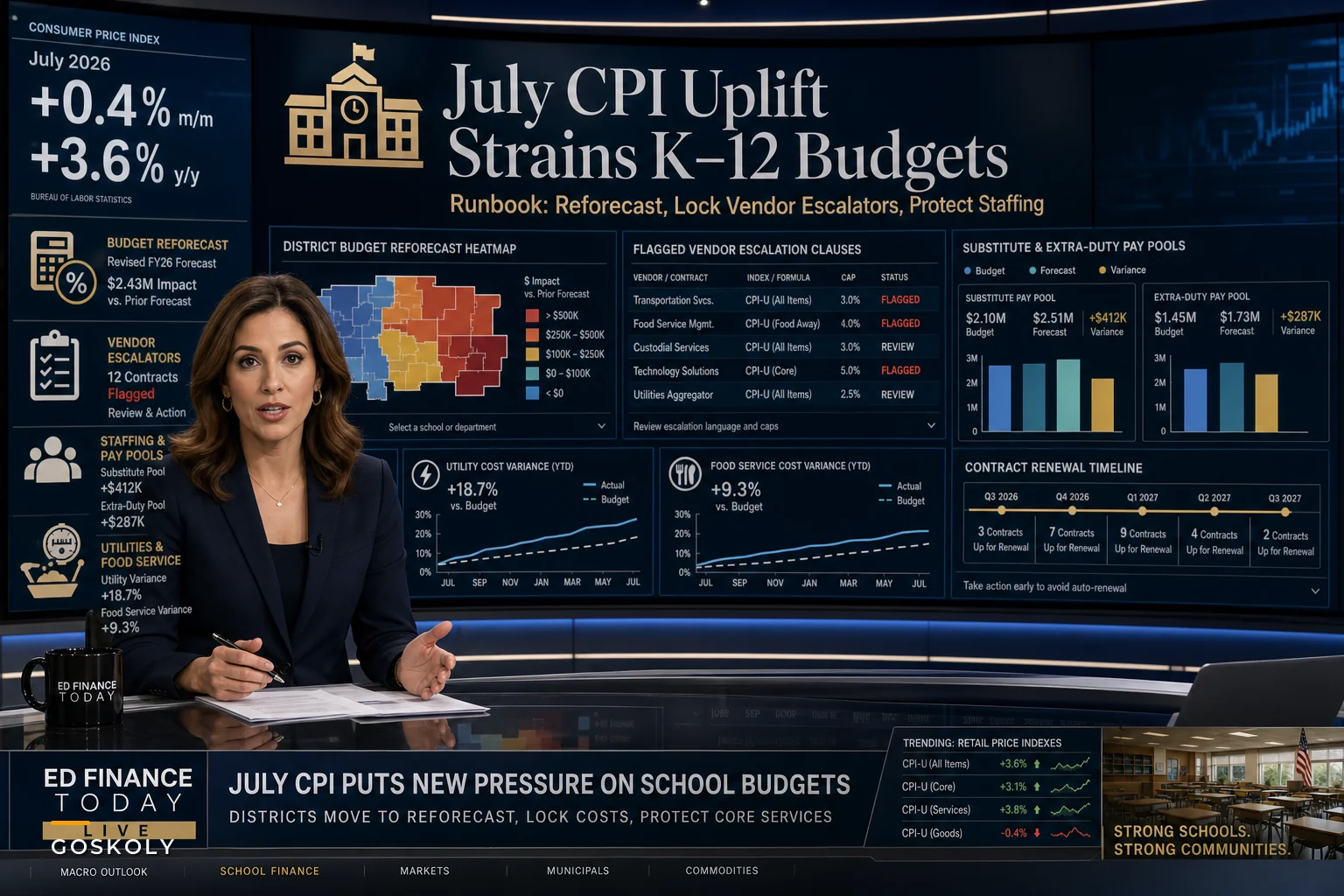

The July 2026 CPI came in softer than most district finance teams had penciled into their spring forecasts. Headline inflation rose just 0.1% month-over-month and 3.4% year-over-year, while core CPI ticked up 0.2% monthly and 2.5% annually. As CNBC's coverage of the July report noted, energy prices pulled back while shelter costs kept doing most of the upward lifting.
Most districts treat a number like this as background noise — inflation's cooling, good, moving on. But a shift in the CPI trajectory, especially one that moves rate expectations, touches several line items you've probably already treated as settled. If your budget was built in March or April on a hotter inflation assumption, there's now a gap between your reforecast and reality that quietly compounds through the year.
This isn't about reacting to a single data point. Most K–12 budgets are built once and then defended, not revisited. That's the actual problem the CPI impact on school budgets exposes — not the number itself.
Why a "good" CPI reading still forces work on your desk
The instinct is to relax. A cooler print eases pressure on borrowing costs, which matters if your district is planning capital work or short-term cash-flow borrowing before state aid arrives. Reuters framed the July move as gasoline prices easing while overall inflation stayed moderate, and lower energy costs flow directly into two of your bigger uncontrollable categories: utilities and transportation fuel.
But fuel prices dropping in July doesn't mean your transportation contract adjusts in July. Most diesel and utility contracts have lag built in — tied to quarterly indexes or annual true-ups. The benefit shows up later, or not at all if your contract locked a rate near the top of the cycle.
Meanwhile shelter, the stubborn category, doesn't map cleanly to school budgets, but it does move the labor market. When housing costs stay elevated in your area, your substitute pool and support staff feel it in their own budgets, and that pressure eventually shows up at the negotiating table. A cooler headline number doesn't cool the local wage conversation.
The reading matters for three concrete reasons:
-
Energy assumptions in your budget may now be too conservative — you budgeted for more than you'll spend, which is good, but reallocate deliberately rather than letting it evaporate.
-
Contract escalation clauses tied to CPI will recalculate on the new, lower figure, affecting vendor renewals timed for late summer and fall.
-
Wage pressure from shelter costs stays real even as headline inflation eases — which is exactly where staffing budgets get squeezed.
Multi-year vendor contracts include CPI-linked escalation clauses, and almost nobody rereads the exact language until an invoice arrives higher than expected.
The escalation clause problem nobody rereads until it's too late
The problem is that "CPI" isn't one number. A contract might reference:
Eliminate administrative overload.
GoSkoly helps you manage schedules, attendance, and communications seamlessly.
- Unified student and staff management
- Automated attendance tracking
- Integrated communication tools
No credit card required
-
Headline CPI-U vs. core CPI
-
National vs. a specific regional index (a metro area CPI moves differently from the national figure)
-
A trailing 12-month average vs. a point-in-time year-over-year figure
-
The reading from a specific month vs. an annual average
A softer July print means the timing of when your escalator gets calculated suddenly matters more. If your contract locks to the July or August figure, you may catch a genuinely lower increase. If it uses a trailing average that still absorbs hotter months from earlier in the year, you won't see much relief yet.
| Escalation basis | What July's cooler print means | Action before renewal |
|---|---|---|
| Point-in-time YoY (July) | Lower escalator this cycle | Confirm the reference month; time renewals to capture it |
| Trailing 12-month average | Still absorbing hotter earlier months | Model the actual blended rate, don't assume relief |
| Regional CPI | May diverge from the national 3.4% | Pull the correct metro index, not the headline |
| Capped escalator (e.g., 3% max) | Cap may now exceed actual CPI | You may be paying more than the index requires — flag it |
That last row is where districts leak money quietly. If your contract caps escalation at 3% but actual applicable CPI came in lower, some vendor billing systems still apply the cap. Nobody's being sneaky — the invoice just runs on the default. If you don't check, you overpay.
Use this workflow as a quick checklist before you accept renewal invoices or sign extensions.
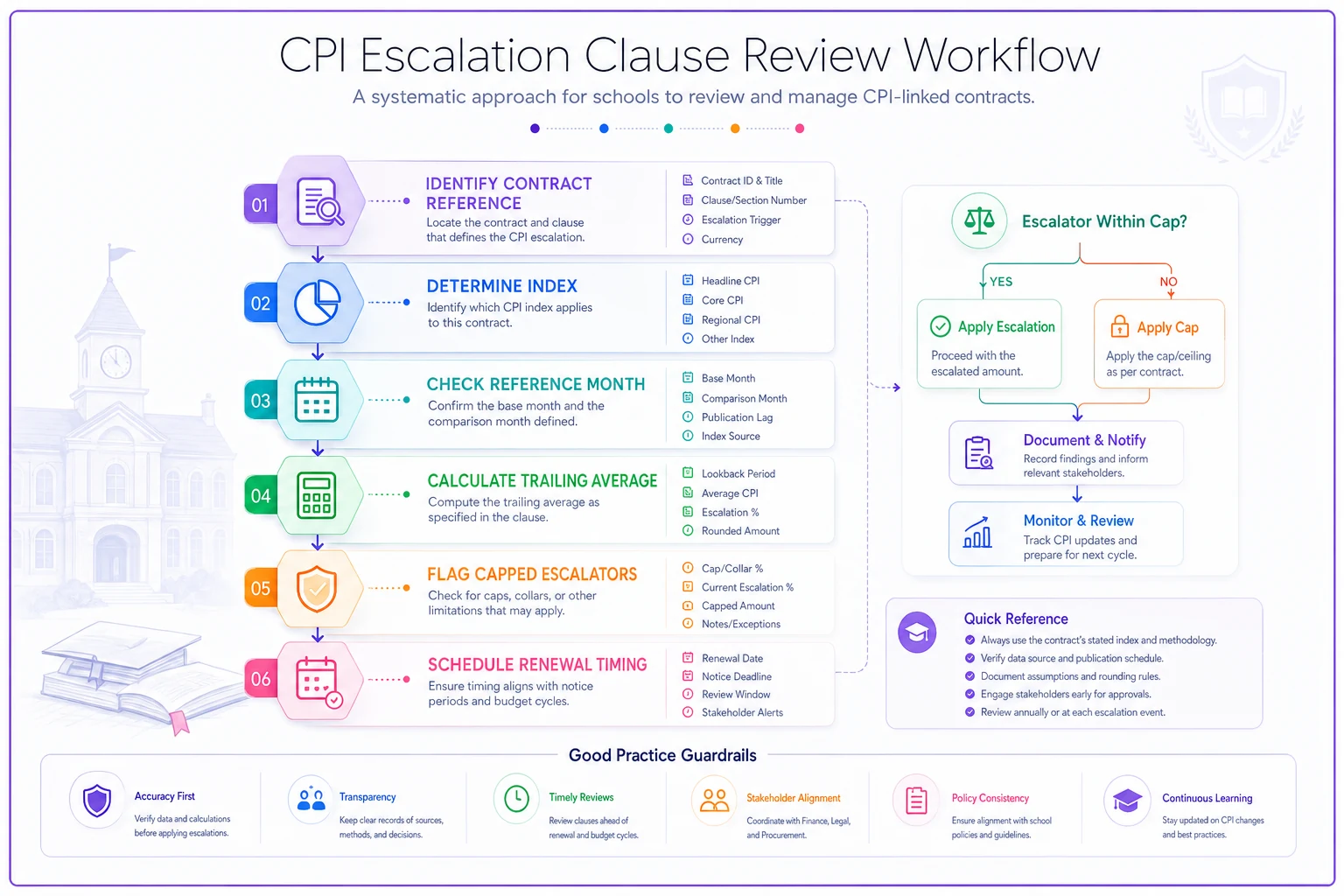
Run the workflow with procurement and finance leads early in the renewal cycle.
What to actually reforecast (and what to leave alone)
Not everything needs to reopen. Chasing every line item after a single CPI print is how finance teams burn August on work that doesn't move the needle. The useful move is reforecasting categories that are both large and price-sensitive in the near term, and leaving the rest alone.
A working order of operations:
-
Pull your energy and fuel line items first. These respond fastest to the July move. If you budgeted a fuel escalation that no longer looks realistic, quantify the cushion and decide where it goes before it disappears into general spend.
-
Inventory every vendor contract with a CPI clause. List the reference index, reference month, and next recalculation date. Tedious, yes — also exactly the step that gets skipped.
-
Re-run your food-service model separately. Food costs don't track headline CPI neatly. Food-at-home and food-away indexes move independently. A cooler overall number can hide sticky food inflation.
-
Stress-test your substitute and extra-duty pay pool. This is where cooler inflation and sticky wage pressure collide, and it's the category most districts underestimate.
-
Update board-facing narrative last. Once the numbers are re-run, put together a one-page explanation of what changed and why. Boards remember the spring assumption — you need to explain the delta clearly.
What you can usually leave alone: multi-year fixed-price contracts with no CPI link, categories that already trued up recently, and anything where the reforecasting effort clearly exceeds the likely recovery.
The staffing runbook is where this gets operationally messy
Utilities and fuel are relatively clean — volume times price. Staffing is where a CPI shift turns into an actual operations problem, because substitute and extra-duty pay isn't a single number. It's hundreds of small, variable transactions that each depend on assignment type, rate, coverage rules, and payroll coding.
When wage pressure pushes you to raise sub rates or expand extra-duty pools mid-year — a very plausible response to a labor market that shelter costs keep tight — the risk isn't the raise itself. It's whether your reconciliation process can absorb a rate change without generating a wave of payroll exceptions.
A typical failure: a district bumps its daily sub rate in October to stay competitive. The SIS gets updated. Payroll gets a memo. But the mapping between SIS assignment codes and payroll rate codes has three edge cases nobody documented — half-day assignments, long-term sub conversions, and cross-building coverage. Those three cases produce mismatched pay for weeks until someone reconciles them by hand.
Run a dummy payroll after updating rates to catch mapping issues before they hit staff pay.
If you're adjusting pay pools in response to shifting cost assumptions this year, the reconciliation layer has to be solid before the rate changes. The mechanics of mapping SIS assignments to payroll codes and running exception scripts to catch mismatches are worth getting right ahead of any rate change — we walked through that process in detail in our guide to substitute payroll and extra-duty pay reconciliation, and the same logic applies double when rates are moving mid-year.
A realistic scenario
A mid-sized district — roughly 6,800 students, seven buildings — built its 2026–27 budget in April assuming a fuel escalation of around 6% and a substitute rate increase of 4% to stay competitive with a neighboring district.
After the July CPI print, they reopened two categories. On fuel, the softer energy trend meant their contracted diesel index recalculated lower than budgeted, freeing up somewhere in the range of $40k–$55k against their transportation line. On substitutes, local wage pressure hadn't eased at all, so they held the 4% rate increase — but chose to fund part of it from the fuel cushion rather than the general fund.
The messy part came in payroll. The 4% rate change hit a mapping gap around long-term substitute conversions, and roughly 30 assignments over six weeks paid at the old rate before anyone caught it. Total mispay wasn't large — a few thousand dollars — but the fix took a payroll clerk parts of three days, plus corrected pay stubs and two frustrated staff calls. The finance director's takeaway had nothing to do with the CPI number itself. It was that the reconciliation process should have been tightened before the rate moved, not after.
When reopening the budget makes sense — and when it doesn't
When it makes sense:
-
You built the budget on assumptions materially different from the new trajectory
-
You have large price-sensitive categories tied to near-term prices
-
Contract renewals are landing in the next quarter with CPI-linked terms
-
You're considering mid-year staffing rate changes
When it's a waste of time:
-
Your assumptions were already conservative and the delta is small
-
Major contracts are fixed-price with no CPI link
-
The reforecasting effort would cost more staff hours than the dollars recovered
-
You're chasing a single print instead of a confirmed trend — one month isn't a direction
Who should be careful here: small districts with thin finance staff. Reopening everything after each data release is a real risk of burning limited capacity. Pick the two or three categories that actually move the needle.
A short pre-board checklist
Before you present anything to the board this cycle:
-
[ ] Confirmed the exact CPI reference (index, region, month) in every escalation clause
-
[ ] Re-run energy and fuel lines against the softer trajectory
-
[ ] Modeled food-service costs separately from headline CPI
-
[ ] Verified capped escalators aren't defaulting to the cap when actual CPI is lower
-
[ ] Documented SIS-to-payroll mappings before any sub-rate change
-
[ ] Prepared a one-page explanation of what changed since the spring assumption
-
[ ] Set an alert threshold on utility and food-service spend so variances surface monthly, not at year-end
The July CPI reading is a hook, not the story. What it actually surfaces is that most districts build a budget once and spend the year defending it, rather than treating it as something that responds to a handful of tracked signals.
The underlying issue
The July CPI reading is a hook, not the story. What it actually surfaces is that most districts build a budget once and spend the year defending it, rather than treating it as something that responds to a handful of tracked signals. A cooler inflation print is genuinely useful information — but only if your operating model is set up to act on it without triggering a mess in payroll, procurement, or board communications.
The districts that handle this well aren't the ones with the best forecast. They're the ones whose reconciliation and alerting are tight enough that a mid-year change — a rate bump, a re-timed contract, a reallocated fuel cushion — doesn't cascade into weeks of manual cleanup. That readiness is what turns an economic data release from a distraction into a decision you can actually make.
That readiness is what turns an economic data release from a distraction into a decision you can actually make.
Ready to optimize your school operations?
Join hundreds of schools using GoSkoly to save time, improve collaboration, and enhance student outcomes.